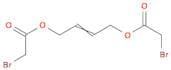
CAS 20679-58-7
:1,4-Bis(bromoacetoxy)-2-buten
- (2E)-but-2-ene-1,4-diyl bis(bromoacetate)
- (2Z)-but-2-ene-1,4-diyl bis(bromoacetate)
- 1,4-Bis(bromoacetoxy)-2-butene
- 2-Butene-1,4-diol, bis(bromoacetate)
- 2-Butene-1,4-diyl bis(bromoacetate)
- Acetic acid, 2-bromo-, 1,1′-(2-butene-1,4-diyl) ester
- Acetic acid, bromo-, 2-butene-1,4-diyl ester
- Acetic acid, bromo-, 2-butenylene ester
- Bbab
- Busan 1210
- But-2-ene-1,4-diyl bis(bromoacetate)
- Fennosan F 50
- NSC 23989
- Slimacide V 10
- Weitere Synonyme anzeigen
ACETIC ACID, 2-BROMO-, 1,1'-(2-BUTENE-1,4-DIYL) ESTER
CAS:Formel:C8H10Br2O4Reinheit:90%Farbe und Form:LiquidMolekulargewicht:329.97061,4-Bis-(bromoacetoxy)-2-butene
CAS:1,4-Bis-(bromoacetoxy)-2-butene is a cationic surfactant that has been shown to have microbicidal activity. It is synthesized by the reaction of 1,4-dibromobutane and acetyl bromide in an activated state. This compound can be used as a disinfectant for blood and other bodily fluids. 1,4-Bis-(bromoacetoxy)-2-butene can also be used to remove cholesterol from the surface of cells in the human body and is often used as a hybridization reagent for specific antibodies. The compound binds to the erythrocyte membrane, which may cause cell lysis. The compound has been shown to have synergistic effects when combined with chlorides such as sodium chloride or potassium chloride. 1,4-Bis-(bromoacetoxy)-2-butene has also been found to bind specifically to both A and B blood
Formel:C8H10Br2O4Reinheit:Min. 95%Molekulargewicht:329.97 g/mol