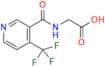
![Glycine, N-[[4-(trifluoromethyl)-3-pyridinyl]carbonyl]-](/_next/image/?url=https%3A%2Fstatic.cymitquimica.com%2Fcas-image%2Fthumb-webp%2F116843-glycine-n-4-trifluoromethyl-3-pyridinyl-carbonyl.webp&w=3840&q=75)
CAS 207502-65-6
:Glycin, N-[[4-(trifluormethyl)-3-pyridinyl]carbonyl]-
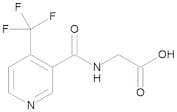
2-(4-(Trifluoromethyl)nicotinamido)acetic acid
CAS:Formel:C9H7F3N2O3Farbe und Form:SolidMolekulargewicht:248.15872-{[4-(Trifluoromethyl)pyridin-3-yl]formamido}acetic acid
CAS:2-{[4-(Trifluoromethyl)pyridin-3-yl]formamido}acetic acidFormel:C9H7F3N2O3Reinheit:96%Farbe und Form: solidMolekulargewicht:248.16g/molFlonicamid-carboxylic acid 100 µg/mL in Acetonitrile
CAS:Formel:C9H7F3N2O3Farbe und Form:Single SolutionMolekulargewicht:248.164-(Trifluoromethyl)nicotinoyl Glycine
CAS:Kontrolliertes ProduktApplications 4-(Trifluoromethyl)nicotinoyl Glycine is a metabolite of Flonicamid (F405710); a novel insecticide with rapid inhibitory effect against aphid feeding.
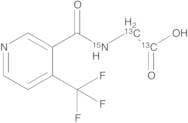
References Lee, Sung Woo., et al.: J. Chrom. A., 1218(28), 4366-4377 (2011); Hengel, Matt J., et al.: J. Agr. Food Chem., 55(20), 8033-8039 (2007); Morita, M., et al.: Pest. Manag. Sci.,63, 969 (2007); Sabatino, L., et al.: Food. Additive. Contamin., 6, 11 (2013)Formel:C9H7F3N2O3Farbe und Form:YellowMolekulargewicht:248.164-(Trifluoromethyl)nicotinoyl Glycine-13C2,15N
CAS:Kontrolliertes ProduktApplications 4-(Trifluoromethyl)nicotinoyl Glycine-13C2,15N is the isotope labelled analog of 4-(Trifluoromethyl)nicotinoyl Glycine (T791375); a metabolite of Flonicamid (F405710), which is a novel insecticide with rapid inhibitory effect against aphid feeding.
References Lee, Sung Woo., et al.: J. Chrom. A., 1218(28), 4366-4377 (2011); Hengel, Matt J., et al.: J. Agr. Food Chem., 55(20), 8033-8039 (2007); Morita, M., et al.: Pest. Manag. Sci.,63, 969 (2007); Sabatino, L., et al.: Food. Additive. Contamin., 6, 11 (2013);Formel:C713C2H7F3N15NO3Farbe und Form:NeatMolekulargewicht:251.14N-[[4-(Trifluoromethyl)-3-pyridinyl]carbonyl]glycine
CAS:N-[[4-(Trifluoromethyl)-3-pyridinyl]carbonyl]glycine is a linear peptide with significant antifungal activity. It can be used in the diagnosis of chlamydia, which is a sexually transmitted infection. The terminal residues of this peptide are important for its biological activity, while the matrix effect and sample preparation are important considerations when using this peptide. This peptide has been found to inhibit the growth of mosquitoes, which may be useful in controlling mosquito-borne diseases such as malaria. N-[[4-(Trifluoromethyl)-3-pyridinyl]carbonyl]glycine has also been reported to have effects on human immunodeficiency virus (HIV).Formel:C9H7F3N2O3Reinheit:Min. 95%Farbe und Form:PowderMolekulargewicht:248.16 g/mol
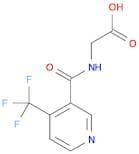

![2-{[4-(Trifluoromethyl)pyridin-3-yl]formamido}acetic acid](/_next/image/?url=https%3A%2Fstatic.cymitquimica.com%2Fproducts%2F54%2Fthumb%2FPC450018.jpg&w=3840&q=75)

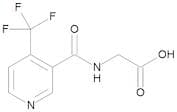

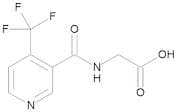


![N-[[4-(Trifluoromethyl)-3-pyridinyl]carbonyl]glycine](/_next/image/?url=https%3A%2Fstatic.cymitquimica.com%2Fproducts%2F3D%2Fthumb%2FFT93114.jpg&w=3840&q=75)