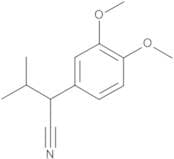
CAS 20850-49-1
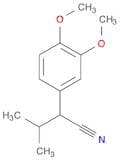
:2-(3,4-Dimethoxyphenyl)-3-methylbutannitril
Beschreibung:
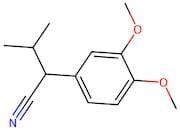
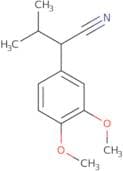
2-(3,4-Dimethoxyphenyl)-3-methylbutannitril, mit der CAS-Nummer 20850-49-1, ist eine organische Verbindung, die durch ihre Nitril-Funktionalgruppe und eine komplexe aromatische Struktur gekennzeichnet ist. Diese Verbindung weist eine 3,4-Dimethoxyphenylgruppe auf, die zu ihrer potenziellen biologischen Aktivität und Löslichkeitseigenschaften beiträgt. Die Anwesenheit der Nitrilgruppe (-C≡N) deutet darauf hin, dass sie polare Eigenschaften aufweisen könnte, die ihre Reaktivität und Wechselwirkungen in verschiedenen chemischen Umgebungen beeinflussen. Die an die Butankette gebundene Methylgruppe verbessert ihre hydrophobe Natur, was ihre Löslichkeit in organischen Lösungsmitteln beeinflussen kann. Diese Verbindung könnte aufgrund ihrer strukturellen Merkmale von Interesse in der medizinischen Chemie und Materialwissenschaft sein, die zu einzigartigen pharmakologischen Eigenschaften oder Anwendungen in der Synthese führen könnten. Wie bei vielen organischen Verbindungen können Stabilität, Reaktivität und potenzielle Anwendungen durch Faktoren wie Temperatur, pH und das Vorhandensein anderer chemischer Spezies beeinflusst werden. Bei der Arbeit mit dieser Substanz in einem Laborumfeld sollten angemessene Handhabungs- und Sicherheitsmaßnahmen beachtet werden.
Formel:C13H17NO2
InChl:InChI=1S/C13H17NO2/c1-9(2)11(8-14)10-5-6-12(15-3)13(7-10)16-4/h5-7,9,11H,1-4H3
InChI Key:InChIKey=NFXAXMOAVPLEBH-UHFFFAOYSA-N
SMILES:C(C(C)C)(C#N)C1=CC(OC)=C(OC)C=C1
Synonyme:- (±)-2-(3,4-Dimethoxyphenyl)-3-methylbutanenitrile
- (±)-3,4-Dimethoxy-α-isopropylbenzeneacetonitrile
- 2-(3,4-Dimethoxy phenyl)-d-methylbutyronitrile
- 2-(3,4-Dimethoxy phenyl)-β-methylbutyronitrile
- 2-(3,4-Dimethoxyphenyl)-2-isopropylacetonitrile
- 2-(3,4-Dimethoxyphenyl)-3-Methyl Butyronitrile
- 3,4-Dimethoxy-α-(1-methylethyl)benzeneacetonitrile
- 3-Methyl-2-(3,4-dimethoxyphenyl)butyronitrile
- Benzeneacetonitrile, 3,4-dimethoxy-α-(1-methylethyl)-
- Butyronitrile, 2-(3,4-dimethoxyphenyl)-3-methyl-
- Isopropyl(3,4-dimethoxyphenyl)acetonitrile
- alpha-Isopropyl homoveratronitrile
- α-Isopropylhomoveratronitrile
- α-Isopropylveratryl cyanide
- Weitere Synonyme anzeigen
Sortieren nach
Reinheit (%)
0
100
|
0
|
50
|
90
|
95
|
100
10 Produkte.
Benzeneacetonitrile, 3,4-dimethoxy-α-(1-methylethyl)-
CAS:Formel:C13H17NO2Reinheit:95%Farbe und Form:SolidMolekulargewicht:219.2796Verapamil EP Impurity K
CAS:Formel:C13H17NO2Farbe und Form:White To Off-White SolidMolekulargewicht:219.282-(3,4-Dimethoxy-phenyl)-3-methyl-butyronitrile
CAS:2-(3,4-Dimethoxy-phenyl)-3-methyl-butyronitrileFormel:C13H17NO2Reinheit:95%Farbe und Form: off-white low melting solidMolekulargewicht:219.28g/mol(2RS)-2-(3,4-Dimethoxyphenyl)-3-methylbutanenitrile
CAS:Kontrolliertes ProduktFormel:C13H17NO2Farbe und Form:NeatMolekulargewicht:219.282-(3,4-Dimethoxy-phenyl)-3-methyl-butyronitrile
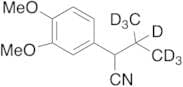
CAS:Formel:C13H17NO2Reinheit:98%Farbe und Form:Solid, Low Melting SolidMolekulargewicht:219.2843,4-Dimethoxy-α-(1-methylethyl-d7)benzeneacetonitrile
CAS:Kontrolliertes ProduktApplications 3,4-Dimethoxy-α-(1-methylethyl-d7)benzeneacetonitrile is the labeled analogue of 3,4-Dimethoxy-α-(1-methylethyl)benzeneacetonitrile (D474780), a reactant used in the synthesis of [11C]D617, a metabolite of (R)-[11C]verapamil that can enter the brain.
References Verbeek, J., et. al.: Nucl. Med. Biol., 39, 530 (2012)Formel:C13H10D7NO2Farbe und Form:NeatMolekulargewicht:226.333,4-Dimethoxy-a-(1-methylethyl)benzeneacetonitrile
CAS:Kontrolliertes ProduktImpurity Verapamil EP Impurity K
Applications (Verapamil EP Impurity K)Formel:C13H17NO2Farbe und Form:White To Light GreenMolekulargewicht:219.283,4-Dimethoxy-a-(1-methylethyl)benzeneacetonitrile
CAS:3,4-Dimethoxy-a-(1-methylethyl)benzeneacetonitrile (DXM) is a synthetic phenylethylamine that is usually found in cough suppressant preparations. It has been shown to be able to cross the blood-brain barrier, and it has a constant, steady-state concentration. DXM is metabolized by N-demethylation in the liver by cytochrome P450 enzymes. This metabolism can be inhibited with the use of drugs such as chlorpromazine or ketoconazole. Pharmacokinetic modeling has been used to analyze and predict the pharmacokinetics of DXM. The drug DXM can also be synthesized from phenylacetonitrile and hydrochloric acid.Formel:C13H17NO2Reinheit:Min. 95%Farbe und Form:PowderMolekulargewicht:219.28 g/mol