CAS 20859-02-3
:L-tert-Leucin
Beschreibung:
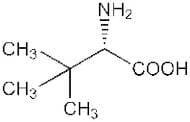
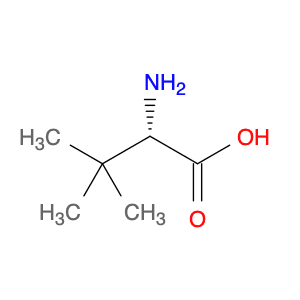
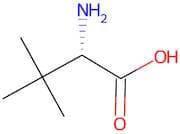
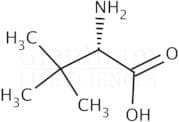
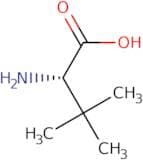
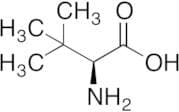
L-tert-Leucin, mit der CAS-Nummer 20859-02-3, ist ein Derivat von Aminosäuren, das durch seine verzweigte Kettenstruktur gekennzeichnet ist, die ein Markenzeichen von Leucin und seinen Derivaten ist. Es handelt sich um eine unpolare, hydrophobe Verbindung, die im Vergleich zu polareren Aminosäuren weniger löslich in Wasser ist. L-tert-Leucin weist eine tert-Butylgruppe auf, die am alpha-Kohlenstoff gebunden ist, was zu seinen einzigartigen sterischen Eigenschaften beiträgt und seine Wechselwirkungen in biologischen Systemen beeinflusst. Diese Verbindung wird häufig in der Peptidsynthese und als Baustein in der Entwicklung von Arzneimitteln und Biochemikalien verwendet. Ihre Chiralität, die die L-Form ist, ist in biologischen Kontexten von Bedeutung, da sie die Aktivität und Funktion von Peptiden und Proteinen beeinflussen kann. Darüber hinaus kann L-tert-Leucin an verschiedenen chemischen Reaktionen teilnehmen, einschließlich Acylierung und Amidierung, was es zu einem vielseitigen Reagenz in der organischen Synthese macht. Insgesamt machen seine strukturellen Eigenschaften und Merkmale L-tert-Leucin zu einer wichtigen Verbindung sowohl in der Forschung als auch in industriellen Anwendungen.
Formel:C6H13NO2
InChl:InChI=1/C6H13NO2/c1-6(2,3)4(7)5(8)9/h4H,7H2,1-3H3,(H,8,9)
InChI Key:InChIKey=NPDBDJFLKKQMCM-SCSAIBSYSA-N
SMILES:[C@H](C(C)(C)C)(C(O)=O)N
Synonyme:- (2S)-2-Amino-3,3-dimethylbutanoic acid
- (S)-2-Amino-3,3-dimethylbutanoic acid
- (S)-2-Amino-3,3-dimethylbutyric acid
- (S)-tert-Butylglycine
- (S)-tert-Leucine
- 2-Amino-3,3-Dimethyl-Butanoic Acid
- 3-Methyl-<span class="text-smallcaps">L</span>-valine
- 3-Methyl-l-valine
- 3-Methylvaline
- <span class="text-smallcaps">L</span>-2-Amino-3,3-dimethylbutyric acid
- <span class="text-smallcaps">L</span>-Pseudoleucine
- <span class="text-smallcaps">L</span>-Valine, 3-methyl-
- <span class="text-smallcaps">L</span>-tert-Butylglycine
- <span class="text-smallcaps">L</span>-tert-Leucine
- Butyric acid, 2-amino-3,3-dimethyl-, <span class="text-smallcaps">L</span>-
- D-t-Butylglycine
- H-Tle-OH
- L-tert-Leucine
- L-valine,3-methyl
- NSC 203785
- Nsc203785
- tert-<span class="text-smallcaps">L</span>-Leucine
- tert-Butyl-<span class="text-smallcaps">L</span>-glycine
- β-Methyl-<span class="text-smallcaps">L</span>-valine
- Butyric acid, 2-amino-3,3-dimethyl-, L-
- β-Methyl-L-valine
- L-LEUCINE
- LEU
- L-α-tert-Butylglycine
- L-2-AMINO-4-METHYLVALERIC ACID
- L-2-(T-BUTYL)GLYCINE
- (2S)-2-Amino-3,3-dimethylbutanoicacid
- L-2-AMINO-4-METHYLPENTANOIC ACID
- L-TERT-LEUCINE, 99% (99% EE/GLC)
- FEMA 3297
- L-A-AMINO-G-METHYL VALERIC ACID
- LEUCINE
- H-LEU-OH
- (S)-(+)-LEUCINE
- L-LEU
- H-L-LEU-OH
- (S)-2-AMINO-4-METHYLPENTANOIC ACID
- LEUCINE, L-
- RARECHEM AB PP 3754
- L-A-AMINOISOCAPROIC ACID
- Weitere Synonyme anzeigen
Sortieren nach
Reinheit (%)
0
100
|
0
|
50
|
90
|
95
|
100
10 Produkte.
L-tert-Leucine
CAS:Formel:C6H13NO2Reinheit:>98.0%(T)Farbe und Form:White to Almost white powder to crystalMolekulargewicht:131.18L-tert-Leucine, 99%
CAS:L-tert-Leucine is an essential amino acid and makes up one third of our muscle protein. It can be used as a food additive. It is used in the formation of sterols. It is used in the production of cobalt oxazoline palladacycles complex, which acts as a catalyst in the rearrangement of prochiral N-arylFormel:C6H13NO2Reinheit:99%Farbe und Form:White, Crystals or powder or crystalline powderMolekulargewicht:131.18Ref: IN-DA002JSN
1gNachfragen5gNachfragen10kgNachfragen25kgNachfragen10g20,00€25g23,00€50g28,00€100g28,00€200g52,00€500g80,00€5kg530,00€3-Methyl-L-valine
CAS:3-Methyl-L-valineFormel:C6H13NO2Reinheit:97%Farbe und Form: light beige powderMolekulargewicht:131.17g/molL-tert-Leucine
CAS:L-tert-Leucine is a chiral compound that inhibits the activity of metalloproteases, enzymes that catalyze the breakdown of proteins. L-tert-Leucine has been shown to inhibit proteolytic activity in recombinant cells and bacterial strain such as Escherichia coli, Pseudomonas aeruginosa, and Bacillus subtilis. L-tert-Leucine binds to the active site of metalloproteases by competitive inhibition, inhibiting the breakdown of proteins. This compound also prevents degradation of dinucleotide phosphate and chiral synthesis. The enantiopure form of this compound is used as a substrate for kinetic studies with type strains of various metalloprotease enzymes.Formel:C6H13NO2Reinheit:(%) Min. 95%Farbe und Form:White PowderMolekulargewicht:131.17 g/molL-tert-Leucine
CAS:Kontrolliertes ProduktApplications L-tert-Leucine acts as a catalyst for the enantioselective oxidative coupling and cyclization of benzophenathrenols to oxa[9]helicenes.
References Sako, M., et al.: J. Amer. Chem. Society., 138, 11481-11484 (2016)Formel:C6H13NO2Farbe und Form:NeatMolekulargewicht:131.17