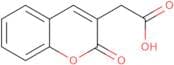
CAS 20862-58-2
:2-Oxo-2H-1-benzopyran-3-essigsäure
Beschreibung:
2-Oxo-2H-1-benzopyran-3-essigsäure (CAS 20862-58-2) ist eine chemische Verbindung, die zur Klasse der Flavonoide gehört, speziell zu einer Art von Cumarin-Derivat. Diese Verbindung weist eine Benzopyran-Struktur auf, die durch einen fusionierten Benzol- und Pyranring gekennzeichnet ist, und enthält eine Essigsäure-Funktionalgruppe sowie eine Keto-Gruppe an der Position 2. Ihre molekulare Struktur trägt zu ihren potenziellen biologischen Aktivitäten bei, einschließlich antioxidativer und entzündungshemmender Eigenschaften. Die Verbindung ist typischerweise ein weißer bis schmutzig-weißer Feststoff und in organischen Lösungsmitteln löslich. Sie kann verschiedene pharmakologische Wirkungen zeigen, was sie in der medizinischen Chemie und der Forschung zu Naturstoffen von Interesse macht. Wie bei vielen organischen Verbindungen können Stabilität und Reaktivität durch Umweltfaktoren wie pH und Temperatur beeinflusst werden. Sicherheitsdaten sollten für den Umgang und die Verwendung konsultiert werden, wie bei jeder chemischen Substanz.
Formel:C11H8O4
Synonyme:- 2-(2-oxochromen-3-yl)ethanoic acid
- (2-Oxo-2H-chromen-3-yl)acetic acid
- 2-(2-OXO-2H-CHROMEN-3-YL)ACETIC ACID
- 2H-1-Benzopyran-3-acetic acid, 2-oxo-
- 2-(2-oxochromen-3-yl)acetic acid
- 2-(2-oxo-3-chromenyl)acetic acid
- Acetic acid, 2-(coumarin-3-yl)-
- AKOS MSC-0227
- Coumarin-3-acetic acid
- 2-(2-ketochromen-3-yl)acetic acid
Sortieren nach
Reinheit (%)
0
100
|
0
|
50
|
90
|
95
|
100
1 Produkte.
(2-Oxo-2H-chromen-3-yl)acetic acid
CAS:(2-Oxo-2H-chromen-3-yl)acetic acid is a molecule that has been shown to have antibacterial activity against Staphylococcus aureus and other bacteria. It is an amide that reacts with lysine residues in the bacterial cell wall, which leads to inhibition of growth. (2-Oxo-2H-chromen-3-yl)acetic acid also has conjugates with malic acid, which can be used as a fluorescent indicator for its presence in bacterial cells. This compound has been shown to be active against Gram-positive and Gram-negative bacteria, but not against Mycobacterium tuberculosis or Mycobacterium avium complex. The dilution method is used to determine the concentration of this compound in bacterial cells.
Formel:C11H8O4Reinheit:Min. 95%Farbe und Form:PowderMolekulargewicht:204.18 g/molRef: 3D-FO112174
Ausgelaufenes produkt