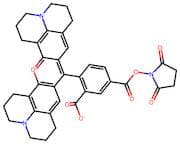
![5-{[(2,5-dioxopyrrolidin-1-yl)oxy]carbonyl}-2-(2,3,6,7,12,13,16,17-octahydro-1H,5H,11H,15H-pyrido[…](/_next/image/?url=https%3A%2Fstatic.cymitquimica.com%2Fcas-image%2Fthumb-webp%2F267152-5-25-dioxopyrrolidin-1-yl-oxy-carbonyl-2-236712131617-octahydro-1h-5h-11h-15h-pyrido-321-ij-quinolizino-1-9-678-chromeno-23-f-quinolin-4-ium-9-yl-benzoate.webp&w=3840&q=75)
CAS 209734-74-7
:5-{[(2,5-dioxopyrrolidin-1-yl)oxy]carbonyl}-2-(2,3,6,7,12,13,16,17-octahydro-1H,5H,11H,15H-pyrido[3,2,1-ij]chinolizino[1',9':6,7,8]chromeno[2,3-f]chinolin-4-ium-9-yl)benzoat
Beschreibung:
Die chemische Substanz mit dem Namen "5-{[(2,5-dioxopyrrolidin-1-yl)oxy]carbonyl}-2-(2,3,6,7,12,13,16,17-octahydro-1H,5H,11H,15H-pyrido[3,2,1-ij]chinolizino[1',9':6,7,8]chromeno[2,3-f]chinolin-4-ium-9-yl)benzoat" und der CAS-Nummer 209734-74-7 ist eine komplexe organische Verbindung, die durch ihre komplizierte molekulare Struktur gekennzeichnet ist, die mehrere fusionierte Ringsysteme und funktionelle Gruppen umfasst. Diese Substanz weist eine Pyrrolidin-Einheit auf, was auf potenzielle Reaktivität und biologische Aktivität hinweist. Das Vorhandensein einer Benzoatgruppe deutet darauf hin, dass sie Eigenschaften aufweisen könnte, die typisch für Ester sind, wie z.B. Löslichkeit in organischen Lösungsmitteln. Die Struktur der Verbindung impliziert, dass sie Anwendungen in der medizinischen Chemie haben könnte, möglicherweise als pharmazeutischer Wirkstoff, aufgrund ihrer potenziellen Wechselwirkungen mit biologischen Zielen. Ihre Komplexität könnte auch spezifische stereochemische Konfigurationen anzeigen, die ihre Pharmakokinetik und Pharmakodynamik beeinflussen könnten. Insgesamt veranschaulicht diese Verbindung die Vielfalt organischer Moleküle und deren potenzielle Nützlichkeit in verschiedenen chemischen und biologischen Kontexten.
Formel:C37H33N3O7
InChl:InChI=1/C37H33N3O7/c41-29-11-12-30(42)40(29)47-37(45)22-9-10-23(26(19-22)36(43)44)31-27-17-20-5-1-13-38-15-3-7-24(32(20)38)34(27)46-35-25-8-4-16-39-14-2-6-21(33(25)39)18-28(31)35/h9-10,17-19H,1-8,11-16H2
SMILES:C1Cc2cc3c(c4ccc(cc4C(=O)[O-])C(=O)ON4C(=O)CCC4=O)c4cc5CCCN6CCCc(c56)c4[o+]c3c3CCCN(C1)c23
Sortieren nach
Reinheit (%)
0
100
|
0
|
50
|
90
|
95
|
100
4 Produkte.
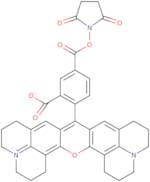
1H,5H,11H,15H-Xantheno[2,3,4-ij:5,6,7-i'j']diquinolizin-18-ium, 9-[2-carboxy-4-[[(2,5-dioxo-1-pyrrolidinyl)oxy]carbonyl]phenyl]-2,3,6,7,12,13,16,17-octahydro-, inner salt
CAS:Formel:C37H33N3O7Reinheit:95%Molekulargewicht:631.67385-Carboxy-X-rhodamine, succinimidyl ester
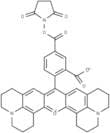
CAS:Single isomer of 5(6)-ROX. It is a fluorescent dye used in RT-PCR methods as an internal reference to determine fluorescence variation that is not associated with the amplification process (plastic of the wells, small differences in concentration or volume, instrument measurements). It produces a constant fluorescence emission signal during the PCR process that is used to normalise the emission produced by the reporter. The fluorescence signal is compatible with that of most reporters. It is used to label the 5â end of oligonucleotides as a reporter in the presence of a quencher at the 3â end (dual labelled probe). During amplification, the dye is cleaved, and the fluorescence increases proportionally with the amount of the specific sequence amplified during the PCR process. The development of the fluorescence signal is therefore specifically related to the amplification of the target sequence. 6-ROX with NHS-activated carboxylic acids reacts with primary amines.Formel:C37H33N3O7Reinheit:Min. 95%Farbe und Form:Red To Violet To Black SolidMolekulargewicht:631.67 g/mol5-ROX, SE
CAS:5-ROX, SE ([5-Carboxy-X-rhodamine, succinimidyl ester] *Single isomer*) is a labeling reagen used in the preparation of charge-modified dye-labeledFormel:C37H33N3O7Reinheit:95%Farbe und Form:SolidMolekulargewicht:631.68