CAS 20977-05-3
:Mononatriumsalz der Escin
Beschreibung:
Mononatriumsalz der Escin, mit der CAS-Nummer 20977-05-3, ist ein Glykosid, das aus den Samen des Rosskastanienbaums (Aesculus hippocastanum) gewonnen wird. Es ist hauptsächlich für seine entzündungshemmenden und venotonischen Eigenschaften bekannt, was es nützlich bei der Behandlung von Erkrankungen im Zusammenhang mit venöser Insuffizienz und Ödemen macht. Die Substanz zeichnet sich durch ihre Fähigkeit aus, die Kapillarwände zu stabilisieren, die Permeabilität zu reduzieren und den Lymphabfluss zu verbessern. Mononatriumsalz der Escin ist typischerweise in Wasser löslich, was seine Verwendung in verschiedenen pharmazeutischen Formulierungen erleichtert. Seine molekulare Struktur umfasst eine triterpenartige Saponin-Komponente, die zu seiner biologischen Aktivität beiträgt. Darüber hinaus weist Aescin antioxidative Eigenschaften auf, die helfen können, oxidativen Stress zu mildern. Aufgrund seines natürlichen Ursprungs und therapeutischer Vorteile wird Mononatriumsalz der Escin häufig in topischen Cremes und oralen Nahrungsergänzungsmitteln verwendet, die darauf abzielen, die Durchblutung zu verbessern und Schwellungen zu reduzieren. Sicherheits- und Wirksamkeitsprofile sind gut dokumentiert, obwohl potenzielle Nebenwirkungen bei einigen Personen gastrointestinale Störungen umfassen können. Insgesamt ist Mononatriumsalz der Escin eine wertvolle Verbindung sowohl in der Kräutermedizin als auch in der modernen Pharmakologie.
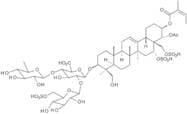
Formel:C53H82O36S4
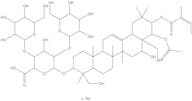
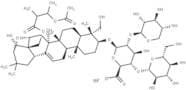
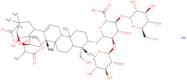
InChl:InChI=1/C54H84O23.Na/c1-22(23(2)71-24(3)57)45(68)70-21-54-26-16-49(4,5)43(42(54)65)73-32(54)17-53(9)25(26)10-11-30-50(6)14-13-31(51(7,20-56)29(50)12-15-52(30,53)8)74-48-40(76-46-36(62)33(59)27(58)19-69-46)38(64)39(41(77-48)44(66)67)75-47-37(63)35(61)34(60)28(18-55)72-47;/h10,22-23,26-43,46-48,55-56,58-65H,11-21H2,1-9H3,(H,66,67);/q;+1/t22?,23?,26?,27-,28-,29?,30?,31?,32-,33+,34-,35+,36-,37-,38+,39+,40-,41+,42?,43-,46+,47-,48-,50?,51-,52?,53-,54?;/m1./s1
SMILES:CC(C(C)OC(=O)C)C(=O)OCC12C3CC(C)(C)C(C2O)OC1CC1(C)C3=CCC2C3(C)CCC(C(C)(CO)C3CCC12C)OC1C(C(C(C(C(=O)O)O1)OC1C(C(C(C(CO)O1)O)O)O)O)OC1C(C(C(CO1)O)O)O.[Na]
Synonyme:- Aescin sodium
- Escin sodium
- Sodium Aescinate
- Sodium escin
- Sodium escinate
- butanoic acid, 3-(acetyloxy)-2-methyl-, (5xi,8xi,9xi,10xi,16alpha,17xi,18xi,21beta)-16,21-epoxy-3-[[O-alpha-D-glucopyranosyl-(1->4)-O-[beta-D-xylopyranosyl-(1->2)]-beta-D-glucopyranuronosyl]oxy]-22,24-dihydroxyolean-12-en-28-yl ester, monosodium salt
- Escin, monosodium salt
- Escin, monosodium salt
- Sodium Aescinate for Injection
- Escin, Mononatriumsalz
- Escin, monosodium salt USP/EP/BP
- Aescin monosodium salt
- Aescin polysulphate sodium salt
- Escin sodium salt
- Sodium Aescine
- Weitere Synonyme anzeigen
Sortieren nach
Reinheit (%)
0
100
|
0
|
50
|
90
|
95
|
100
5 Produkte.
Escin, monosodium salt
CAS:Formel:C54H84NaO23Reinheit:97%Farbe und Form:SolidMolekulargewicht:1124.2207Sodium Aescinate
CAS:Sodium Aescinate (Escin sodium salt) is extracted from Aesculus wilsonii.Formel:C54H83NaO23Reinheit:95.17%Farbe und Form:SolidMolekulargewicht:1123.21Aescin monosodium salt
CAS:Aescin monosodium salt is a semisynthetic, anti-inflammatory product derived from escin, which is a mixture of saponins extracted from horse chestnut seeds (Aesculus hippocastanum). It functions primarily by enhancing the integrity of venous walls and decreasing vascular permeability. This is achieved through the stabilization of lysosomal membranes and the inhibition of enzymes that contribute to the breakdown of the vascular endothelium, as well as promoting the release of prostaglandins with vasoprotective properties.Formel:C55H86NaO24Reinheit:Min. 95%Molekulargewicht:1,154.25 g/molAescin polysulphate sodium salt
CAS:Aescin polysulphate sodium salt is a synthetic anti-inflammatory compound, designed as an enhanced version of the natural saponin, aescin, derived from horse chestnut seeds (Aesculus hippocastanum). The modification to create the polysulphate sodium salt increases the solubility and bioavailability of the compound, facilitating its absorption and effectiveness in biological systems.
Formel:C53H82O36S4Reinheit:Min. 95%Molekulargewicht:1,423.46 g/mol