CAS 210108-89-7
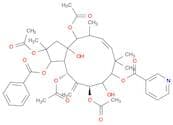
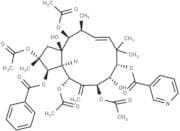
:(2R,3R,3aS,4R,6S,7S,8S,10E,12S,13S,13aR)-2,4,6,13-Tetrakis(acetoxy)-3-(benzoyloxy)-2,3,3a,4,5,6,7,8,9,12,13,13a-dodecahydro-7,13a-dihydroxy-2,9,9,12-tetramethyl-5-methylen-1H-cyclopentacyclododecen-8-yl 3-pyridincarboxylat
Beschreibung:
Die chemische Substanz mit dem Namen "(2R,3R,3aS,4R,6S,7S,8S,10E,12S,13S,13aR)-2,4,6,13-Tetrakis(acetoxy)-3-(benzoyloxy)-2,3,3a,4,5,6,7,8,9,12,13,13a-dodecahydro-7,13a-dihydroxy-2,9,9,12-tetramethyl-5-methylen-1H-cyclopentacyclododecen-8-yl 3-pyridincarboxylat" und der CAS-Nummer "210108-89-7" ist eine komplexe organische Verbindung, die durch ihre komplizierte Stereochemie und mehrere funktionelle Gruppen gekennzeichnet ist. Sie weist eine Tetrakis(acetyloxy)-Gruppe auf, was auf die Anwesenheit von vier Acetoxy-Gruppen hinweist, sowie eine Benzoyloxy-Gruppe, die aromatische Eigenschaften andeutet. Die Verbindung ist ein Derivat einer Dodecahydro-Struktur, was auf ein gesättigtes zyklisches Gerüst mit mehreren Ringen hinweist. Die Anwesenheit von Hydroxylgruppen trägt zu ihrer potenziellen Reaktivität und Löslichkeit in polaren Lösungsmitteln bei. Darüber hinaus deutet die Einbeziehung eines Pyridin-Carboxylats auf eine potenzielle biologische Aktivität hin, möglicherweise als Ligand oder in der medizinischen Chemie. Insgesamt kann die strukturelle Komplexität und funktionale Vielfalt dieser Verbindung einzigartige Eigenschaften verleihen, die sie in verschiedenen Bereichen, einschließlich der Pharmazie und der organischen Synthese, von Interesse machen.
Formel:C41H49NO14
InChl:InChI=1S/C41H49NO14/c1-22-17-18-39(7,8)36(55-38(49)29-16-13-19-42-20-29)31(47)33(52-25(4)44)23(2)32(51-24(3)43)30-35(54-37(48)28-14-11-10-12-15-28)40(9,56-27(6)46)21-41(30,50)34(22)53-26(5)45/h10-20,22,30-36,47,50H,2,21H2,1,3-9H3/b18-17+/t22-,30-,31+,32-,33-,34-,35+,36+,40+,41+/m0/s1
InChI Key:InChIKey=GLYDSECXZWCLMS-RWMROPJHSA-N
SMILES:O[C@@]12[C@]([C@@H](OC(=O)C3=CC=CC=C3)[C@@](OC(C)=O)(C)C1)([C@@H](OC(C)=O)C(=C)[C@H](OC(C)=O)[C@@H](O)[C@@H](OC(=O)C=4C=CC=NC4)C(C)(C)\C=C\[C@H](C)[C@@H]2OC(C)=O)[H]
Synonyme:- (2R,3R,3aS,4R,6S,7S,8S,10E,12S,13S,13aR)-2,4,6,13-Tetrakis(acetyloxy)-3-(benzoyloxy)-2,3,3a,4,5,6,7,8,9,12,13,13a-dodecahydro-7,13a-dihydroxy-2,9,9,12-tetramethyl-5-methylene-1H-cyclopentacyclododecen-8-yl 3-pyridinecarboxylate
- 3-Pyridinecarboxylic acid, (2R,3R,3aS,4R,6S,7S,8S,10E,12S,13S,13aR)-2,4,6,13-tetrakis(acetyloxy)-3-(benzoyloxy)-2,3,3a,4,5,6,7,8,9,12,13,13a-dodecahydro-7,13a-dihydroxy-2,9,9,12-tetramethyl-5-methylene-1H-cyclopentacyclododecen-8-yl ester
- Jatrophane 5
Sortieren nach
Reinheit (%)
0
100
|
0
|
50
|
90
|
95
|
100
3 Produkte.
3-Pyridinecarboxylic acid, (2R,3R,3aS,4R,6S,7S,8S,10E,12S,13S,13aR)-2,4,6,13-tetrakis(acetyloxy)-3-(benzoyloxy)-2,3,3a,4,5,6,7,8,9,12,13,13a-dodecahydro-7,13a-dihydroxy-2,9,9,12-tetramethyl-5-methylene-1H-cyclopentacyclododecen-8-yl ester
CAS:Formel:C41H49NO14Reinheit:96.0%Molekulargewicht:779.8261Jatrophane 5
CAS:Jatrophane 5 surpasses R(+)-verapamil and tariquidar in inhibiting P-gp in MDR colorectal cells (DLD1-TxR).Formel:C41H49NO14Reinheit:98%Farbe und Form:SolidMolekulargewicht:779.8362,5,7,14-Tetraacetoxy-3-benzoyloxy-8,15-dihydroxy-9-nicotinoyloxyjatropha-6(17),11E-diene
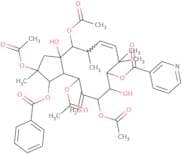
CAS:2,5,7,14-Tetraacetoxy-3-benzoyloxy-8,15-dihydroxy-9-nicotinoyloxyjatropha-6(17),11E-diene is a specialized diterpenoid ester compound, which is derived from the plant Jatropha. This compound belongs to the class of biochemicals known for their intricate molecular structure and potential biological activities. The source of this compound, Jatropha, is a genus of flowering plants in the spurge family, Euphorbiaceae. Extracted primarily from Jatropha species, these diterpenoids are known for their diverse pharmacological properties.Formel:C41H49NO14Reinheit:Min. 95%Molekulargewicht:779.8 g/mol