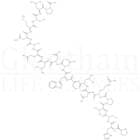
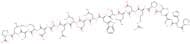
CAS 211364-78-2
:L-Prolin, L-prolyl-L-histidyl-L-cysteinyl-L-valyl-L-prolyl-L-arginyl-L-a-aspartyl-L-leucyl-L-seryl-L-tryptophyl-L-leucyl-L-a-aspartyl-L-leucyl-L-a-glutamyl-L-alanyl-L-asparaginyl-L-methionyl-L-cysteinyl-L-leucyl-
Beschreibung:
Die chemische Substanz, auf die Sie sich beziehen, mit dem Namen "L-Prolin, L-prolyl-L-histidyl-L-cysteinyl-L-valyl-L-prolyl-L-arginyl-L-a-asparaginyl-L-leucyl-L-seryl-L-tryptophyl-L-leucyl-L-a-asparaginyl-L-leucyl-L-a-glutamyl-L-alany-L-asparaginyl-L-methionyl-L-cysteinyl-L-leucyl-" und der CAS-Nummer 211364-78-2, ist ein komplexes Peptid, das aus mehreren Aminosäuren besteht. Diese Substanz ist durch ihre Sequenz von L-Aminosäuren gekennzeichnet, die die Bausteine von Proteinen sind. Das Vorhandensein verschiedener Aminosäuren deutet auf eine potenzielle biologische Aktivität hin, die möglicherweise mit der Proteinsynthese oder Signalwegen zusammenhängt. Die Struktur deutet darauf hin, dass sie Eigenschaften wie Wasserlöslichkeit aufweisen kann, abhängig von der spezifischen Aminosäurezusammensetzung und -sequenz. Darüber hinaus kann das Peptid spezifische Rollen in biologischen Systemen haben, einschließlich enzymatischer Aktivität, Rezeptorbindung oder zellulärer Signalgebung. Seine Stabilität, Reaktivität und potenziellen Anwendungen in der Pharmazie oder Biotechnologie würden von der genauen Anordnung der Aminosäuren und ihrer funktionellen Gruppen abhängen.
Formel:C101H157N27O29S3
Synonyme:- R18
Sortieren nach
Reinheit (%)
0
100
|
0
|
50
|
90
|
95
|
100
3 Produkte.
R18
CAS:14.3.3 protein antagonist, blocks binding to Raf-1/Bad/ASK1/exoenzyme S, competitive, no phosphorylation needed, KD ~80 nM.Formel:C101H157N27O29S3Reinheit:98%Farbe und Form:SolidMolekulargewicht:2309.69R18
CAS:R18 is a neuroprotective drug that belongs to the class of drugs called mitochondria-targeted antioxidants. It is a small molecule with a hydroxyl group that can be used as an antioxidant, which prevents oxidative stress and protects cells against various injuries. R18 has been shown to have anti-cancer effects in cell culture experiments and to promote axonal growth in vivo. It also has been shown to inhibit protein synthesis and to induce autophagy, but not at the same time. Toxicity studies have shown that R18 has no effect on the central nervous system or on fetal bovine brain cells.
Formel:C101H157N27O29S3Reinheit:Min. 95%Molekulargewicht:2,309.69 g/mol