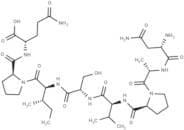
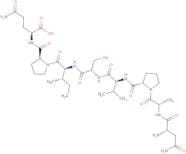
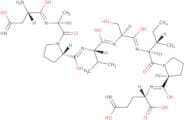
CAS 211439-12-2
:L-Glutamin, L-asparaginyl-L-alanyl-L-prolyl-L-valyl-L-seryl-L-isoleucyl-L-prolyl-
Beschreibung:
Die chemische Substanz mit dem Namen "L-Glutamin, L-Asparaginyl-L-Alany-L-Prolyl-L-Valyl-L-Serin-L-Isoleucin-L-Prolyl-" und der CAS-Nummer 211439-12-2 ist ein Peptid, das aus mehreren Aminosäuren besteht, insbesondere L-Glutamin und mehreren anderen L-Aminosäuren. Diese Verbindung zeichnet sich durch ihre Struktur aus, die eine Sequenz von Aminosäuren umfasst, die durch Peptidbindungen verbunden sind, was zu ihrer potenziellen biologischen Aktivität beiträgt. Peptide wie dieses können eine bedeutende Rolle in verschiedenen physiologischen Prozessen spielen, einschließlich der Proteinsynthese, der zellulären Signalübertragung und der metabolischen Regulation. Das Vorhandensein mehrerer L-Aminosäuren deutet darauf hin, dass dieses Peptid spezifische konformationale Eigenschaften aufweisen kann, die seine Stabilität und Interaktionen mit biologischen Zielen beeinflussen. Darüber hinaus kann die Sequenz der Aminosäuren die Löslichkeit, Reaktivität und die allgemeine Funktionalität des Peptids in biologischen Systemen bestimmen. Solche Verbindungen werden oft auf ihr therapeutisches Potenzial untersucht, einschließlich Anwendungen in der Ernährung, Medizin und Biochemie. Detaillierte Studien wären jedoch erforderlich, um seine spezifischen Eigenschaften und potenziellen Anwendungen vollständig zu verstehen.
Formel:C36H60N10O12
Sortieren nach
Reinheit (%)
0
100
|
0
|
50
|
90
|
95
|
100
4 Produkte.
L-Asparaginyl-L-alanyl-L-prolyl-L-valyl-L-seryl-L-isoleucyl-L-prolyl-L-glutamine
CAS:Formel:C36H60N10O12Reinheit:97%Farbe und Form:SolidMolekulargewicht:824.9214Davunetide
CAS:Davunetide: neuroprotective 8-amino acid peptide, improves daily function in schizophrenia, boosts memory in mild cognitive impairment.Formel:C36H60N10O12Reinheit:98%Farbe und Form:SolidMolekulargewicht:824.92NAP
CAS:NAP is a neuroprotective peptide, which is derived from activity-dependent neuroprotective protein (ADNP), with a mechanism involving microtubule stabilization and neuronal protection. It exhibits the ability to protect neurons from various types of damage, including oxidative stress and conditions mimicking neurodegenerative diseases. NAP enhances axonal transport and increases the resilience of neurons to insults that would typically result in cell death. This peptide has shown promise in preclinical studies for its potential to halt or reverse cognitive decline, making it a focal point for research into therapeutic strategies for disorders like Alzheimer's disease and other tauopathies. The peptide operates by binding to microtubules, promoting stability, and facilitating efficient transport of cellular components. Studies have highlighted its role in traversing the blood-brain barrier, which makes it a viable candidate for central nervous system-targeted therapies. Researchers continue to explore its efficacy and possible applications in improving cognitive function and providing neuroprotection in aging populations.Reinheit:(Hplc-Ms) Min. 98 Area-%NAP
CAS:NAP is a potent, selective and orally bioavailable inhibitor of bacterial nitrate reductase. It has been shown to have broad-spectrum activity against Gram-positive and Gram-negative bacteria. NAP inhibits the synthesis of DNA, which is essential for the bacterial cell cycle. It binds to the active site of the enzyme, thereby inhibiting the reduction of nitrite to nitric oxide. NAP also displays high selectivity for bacteria with respect to mammalian cells. This agent has been shown to be effective in treating bowel disease by reducing nitrate levels in the gut, as well as in models of neuronal death caused by cerebral ischemia.Formel:C36H60N10O12Reinheit:(Hplc-Ms) Min. 98 Area-%Molekulargewicht:824.93 g/mol