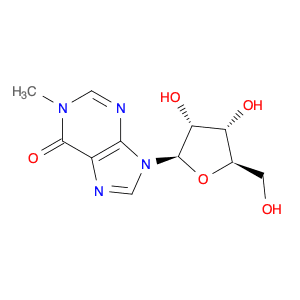
CAS 2140-73-0
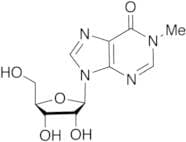
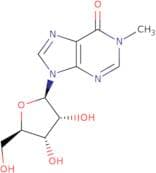
:1-Methylinosin
- 2140-73-0
- Inosine, 1-methyl-
- N<sup>1</sup>-Methylinosine
- 1-Methylinosine
- N1-Methylinosine
(2R,3R,4S,5R)-2-(6-Hydroxy-1-Methyl-1H-Purin-9(2H)-Yl)-5-(Hydroxymethyl)Tetrahydrofuran-3,4-Diol
CAS:(2R,3R,4S,5R)-2-(6-Hydroxy-1-Methyl-1H-Purin-9(2H)-Yl)-5-(Hydroxymethyl)Tetrahydrofuran-3,4-DiolReinheit:99%Molekulargewicht:282.25g/mol1-Methylinosine
CAS:Formel:C11H14N4O5Reinheit:>98.0%(HPLC)Farbe und Form:White to Light yellow powder to crystalMolekulargewicht:282.261-Methylinosine
CAS:1-Methylinosine (N1-Methylinosine) is a modified nucleotide found at position 37 in tRNA 3' to the anticodon of eukaryotic tRNA and has a role as a metabolite.Formel:C11H14N4O5Reinheit:99.7%Farbe und Form:SolidMolekulargewicht:282.251-Methyl-Inosine
CAS:Kontrolliertes ProduktApplications 1-Methyl-Inosine is a modified nucleoside which is present in higher concentrations in the urinary excretion of patients afflicted with breast cancer. It acts a a biomarker for diagnosis of the disease.
References Frickenschmidt, A. et al.: Biomark., 13, 435 (2008); Studzinska, S. et al.: J. Chrom. B. Tech. Biomed. Life Sci., 887, 93 (2012);Formel:C11H14N4O5Farbe und Form:NeatMolekulargewicht:282.25N1-Methylinosine
CAS:Kontrolliertes ProduktN1-Methylinosine is a purine derivative that can be used as an imaging agent for the detection of autoimmune disorders. It has been shown to form stable complexes with proteins and human serum proteins, which have been detected in urine samples. N1-Methylinosine has also been used in clinical studies to measure disease activity in patients with rheumatoid arthritis and chronic kidney disease. This drug is activated by catalysis to produce a fluorescent product that can be detected using nmr spectroscopy. N1-Methylinosine is able to bind to autoantibodies and activate markers of chronic inflammation, such as nuclear factor kappa B (NF-κB) and tumor necrosis factor alpha (TNFα). N1-Methylinosine has also been shown to inhibit breast cancer cell growth and reduce the severity of chronic kidney disease.Formel:C11H14N4O5Reinheit:Min. 95%Farbe und Form:PowderMolekulargewicht:282.25 g/mol1-Methyl-Inosine-d3
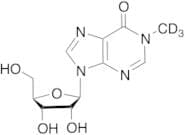
CAS:Kontrolliertes ProduktApplications 1-Methyl-Inosine-d3 is the isotope labelled analog of 1-Methyl-Inosine (M313600); a modified nucleoside which is present in higher concentrations in the urinary excretion of patients afflicted with breast cancer. It acts as a biomarker for diagnosis of the disease.
References Frickenschmidt, A. et al.: Biomark., 13, 435 (2008); Studzinska, S. et al.: J. Chrom. B. Tech. Biomed. Life Sci., 887, 93 (2012)Formel:C11D3H11N4O5Farbe und Form:NeatMolekulargewicht:285.271