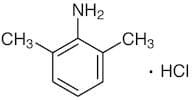
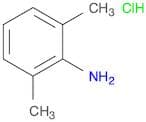
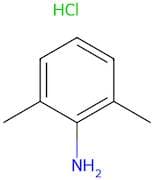
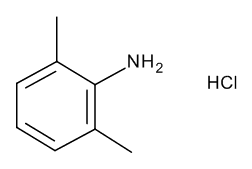
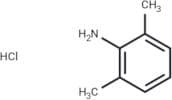
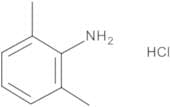
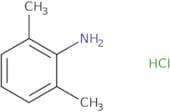
CAS 21436-98-6
:Benzenamin, 2,6-dimethyl-, Hydrochlorid (1:1)
- 2,6-Dimethylaniline Hydrochloride (1:1)
- 2,6-Dimethylbenzenamine hydrochloride
- 2,6-Xylidine, hydrochloride
- 2,6-Xylidinium chloride
- Benzenamine, 2,6-dimethyl-, hydrochloride
- Benzenamine, 2,6-dimethyl-, hydrochloride (1:1)
- 2,6-Dimethylaniline hydrochloride
2,6-Dimethylaniline Hydrochloride
CAS:Formel:C8H11N·HClReinheit:>98.0%(HPLC)(N)Farbe und Form:White powder to crystalMolekulargewicht:157.64Ropivacaine Related Compound A (2,6-dimethylaniline hydrochloride)
CAS:Aromatic monoamines and their derivatives, salts thereof, nesoiFormel:C8H11N·ClHFarbe und Form:White Crystalline PowderMolekulargewicht:157.06583Lidocaine EP Impurity A-d6 HCl (Bupivacaine EP Impurity F-d6 HCl, Ropivacaine EP Impurity H-d6 HCl, Ropivacaine USP Related Compound A-d6)
CAS:Formel:C8H5D6N·HClFarbe und Form:White To Off-White SolidMolekulargewicht:127.22 36.46Lidocaine EP Impurity A HCl (Bupivacaine EP Impurity F HCl, Ropivacaine EP Impurity H HCl, Ropivacaine USP Related Compound A)
CAS:Formel:C8H11N·HClMolekulargewicht:121.18 36.462,6-Dimethylaniline hydrochloride
CAS:2,6-Dimethylaniline hydrochlorideReinheit:96%Molekulargewicht:157.64g/mol2,6-Dimethylaniline Hydrochloride
CAS:2,6-Dimethylaniline Hydrochloride is a useful organic compound for research related to life sciences.The CAS number is 21436-98-6.Formel:C8H12ClNReinheit:99.80%Farbe und Form:SolidMolekulargewicht:157.642,6-Dimethylaniline Hydrochloride
CAS:Kontrolliertes ProduktImpurity Ropivacaine EP Impurity H
Applications 2,6-Dimethylaniline Hydrochloride (Ropivacaine EP Impurity H) is chemical reagent frequently used in the synthesis of pharmaceutical compounds. Impurity of Ropivacaine (R675000), anesthetic (local).
References Li, H. et al.: J. Polym. Sci. A. Poly. Chem., 44, 2665 (2006); Cederholm. I., et al.: Reg. Anesth., 19, 18 (1994), Johansson, B., et al.: Anesth. Analg., 78, 210 (1994), Oda, Y., et al.: Anesthesiology, 82, 214 (1995); Lv, C. et al.: Chem. A Eur. J., 19, 1174 (2013);Formel:C8H11N·ClHFarbe und Form:White To Light BrownMolekulargewicht:157.642,6-Dimethylaniline hydrochloride
CAS:Formel:C8H12ClNReinheit:99.9%Farbe und Form:Crystalline Powder,PowderMolekulargewicht:157.642,6-Dimethylaniline hydrochloride
CAS:Ropivacaine Related Compound A is a chemical compound that has not been fully characterized. It is an inhibitor of the enzyme P-hydroxybenzoic acid, which is involved in the synthesis of tyrosine and phenylalanine. Ropivacaine Related Compound A has shown to be potent inducers of the enzyme polymerase chain reaction (PCR) when combined with other chemicals such as potassium peroxydisulfate. The optimum concentration for this chemical compound to inhibit PCR reactions is 50 mM. Ropivacaine Related Compound A may have carcinogenic potential due to its ability to form p-hydroxybenzoic acid and other carcinogenic compounds. This chemical compound has been found to be a good candidate for wastewater treatment due to its low potency and high solubility in water.
Formel:C8H12ClNReinheit:Min. 95%Farbe und Form:PowderMolekulargewicht:157.64 g/mol