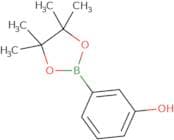
CAS 214360-76-6
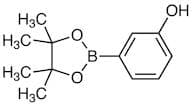
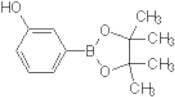
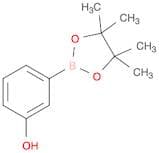
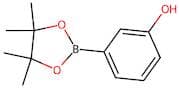
:3-(4,4,5,5-Tetramethyl-1,3,2-dioxaborolan-2-yl)phenol
Beschreibung:
3-(4,4,5,5-Tetramethyl-1,3,2-dioxaborolan-2-yl)phenol, mit der CAS-Nummer 214360-76-6, ist eine organische Verbindung, die eine phenolische Struktur aufweist, die mit einer Dioxaborolan-Gruppe substituiert ist. Diese Verbindung ist durch ihren borhaltigen Dioxaborolan-Ring gekennzeichnet, der zu ihrer einzigartigen Reaktivität und potenziellen Anwendungen in der organischen Synthese beiträgt, insbesondere in Kreuzkupplungsreaktionen. Das Vorhandensein der Tetramethylgruppen verbessert ihre Stabilität und Löslichkeit in organischen Lösungsmitteln. Als Phenolderivat zeigt es typische phenolische Eigenschaften, wie die Fähigkeit, als schwache Säure zu wirken und an Wasserstoffbrückenbindungen teilzunehmen. Die Verbindung kann auch interessante optische Eigenschaften aufgrund ihres aromatischen Systems aufweisen. Ihre Anwendungen können sich auf Materialwissenschaften, Pharmazeutika und als Reagenz in verschiedenen chemischen Umwandlungen erstrecken. Sicherheits- und Handhabungsvorkehrungen sollten beachtet werden, wie bei allen chemischen Substanzen, um mögliche Gefahren im Zusammenhang mit ihrer Verwendung zu mindern.
Formel:C12H17BO3
InChl:InChI=1S/C12H17BO3/c1-11(2)12(3,4)16-13(15-11)9-6-5-7-10(14)8-9/h5-8,14H,1-4H3
InChI Key:InChIKey=MUKIFYQKIZOYKT-UHFFFAOYSA-N
SMILES:CC1(C)OB(OC1(C)C)C2=CC(O)=CC=C2
Synonyme:- 2-(3-Hydroxyphenyl)-4,4,5,5-tetramethyl-1,3,2-dioxaborolane
- 3-(Tetramethyl-1,3,2-dioxaborolan-2-yl)phenol
- 3-Hydroxyphenylboronic acid pinacol ester
- 3-Hydroxyphenylboronic acid,Pinacol cyclic ester
- Phenol, 3-(4,4,5,5-tetramethyl-1,3,2-dioxaborolan-2-yl)-
- 3-(4,4,5,5-Tetramethyl-[1,3,2]dioxaborolan-2-yl)phenol
- 3-(4,4,5,5-Tetramethyl-1,3,2-dioxaborolan-2-yl)phenol
Sortieren nach
Reinheit (%)
0
100
|
0
|
50
|
90
|
95
|
100
6 Produkte.
3-(4,4,5,5-Tetramethyl-1,3,2-dioxaborolan-2-yl)phenol
CAS:Formel:C12H17BO3Reinheit:>98.0%(GC)Farbe und Form:White to Gray to Brown powder to crystalMolekulargewicht:220.083-(4,4,5,5-Tetramethyl-1,3,2-dioxaborolan-2-yl)phenol, min. 97%
CAS:3-(4,4,5,5-Tetramethyl-1,3,2-dioxaborolan-2-yl)phenol, min. 97%
Formel:C12H17BO3Reinheit:min. 97%Farbe und Form:pale yellow pwdr.Molekulargewicht:220.083-(4,4,5,5-Tetramethyl-1,3,2-dioxaborolan-2-yl)phenol
CAS:Formel:C12H17BO3Reinheit:98%Farbe und Form:SolidMolekulargewicht:220.07263-Hydroxybenzeneboronic acid, pinacol ester
CAS:3-Hydroxybenzeneboronic acid, pinacol esterFormel:C12H17BO3Reinheit:98%Farbe und Form: white to off-white solidMolekulargewicht:220.07g/mol3-(4,4,5,5-Tetramethyl-1,3,2-dioxaborolan-2-yl)phenol
CAS:Formel:C12H17BO3Reinheit:98%Farbe und Form:SolidMolekulargewicht:220.083-(4,4,5,5-Tetramethyl-1,3,2-dioxaborolan-2-yl)phenol
CAS:3-(4,4,5,5-Tetramethyl-1,3,2-dioxaborolan-2-yl)phenol is a boronic acid that can be used as a starting material for the synthesis of chromanones. It is used in the Suzuki coupling reaction with boronic acids to produce functionalized biaryl compounds. This compound has been investigated by spectroscopies such as NMR and IR and was found to have a sequence of C8H8O. The phenol group in this molecule is oxidized to yield an alcohol. 3-(4,4,5,5-Tetramethyl-1,3,2-dioxaborolan-2-yl)phenol has been shown to react with diaryliodonium salts and esters in order to form monomers for polymer synthesis.Formel:C12H17BO3Reinheit:Min. 95%Molekulargewicht:220.08 g/mol