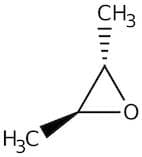
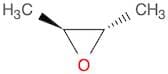
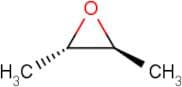
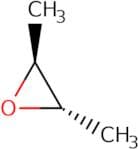
CAS 21490-63-1
:trans-2,3-Dimethyloxiran
- (2R*,3R*)-2,3-Dimethyloxirane
- Butane, 2,3-epoxy-, trans-
- NSC 24244
- Oxirane, 2,3-dimethyl-, (2R,3R)-rel-
- Oxirane, 2,3-dimethyl-, trans-
- rel-(2R,3R)-2,3-Dimethyloxirane
- trans-2,3-Butene oxide
- trans-2,3-Butylene oxide
- trans-2,3-Epoxybutane
- trans-2-Butene oxide
- trans-2-Butylene oxide
- Weitere Synonyme anzeigen
trans-2,3-Epoxybutane, 97%
CAS:A higher order cuprate reacted with trans-2,3-epoxybutane a high yield both counted on the epoxide (96%) and on the haloalkane (85%). Enolate derived from trans-2,3-Epoxybutan has chiral recognition.This Thermo Scientific Chemicals brand product was originally part of the Alfa Aesar product portfoliFormel:C4H8OReinheit:97%Farbe und Form:Colorless to pale yellow, LiquidMolekulargewicht:72.11trans-2,3-Epoxybutane
CAS:trans-2,3-EpoxybutaneFormel:C4H8OReinheit:97%Farbe und Form: clear liquidMolekulargewicht:72.11g/moltrans-2,3-Epoxybutane
CAS:Formel:C4H8OReinheit:97%Farbe und Form:Liquid, Clear light yellow liquidMolekulargewicht:72.107trans-2,3-Epoxybutane
CAS:Pinostrobin is a chalcone that has been shown to inhibit the growth of certain fungi by inhibiting the enzyme activities involved in cell walls synthesis. Pinostrobin is converted to trans-2,3-epoxybutane (EPB) by intramolecular hydrogen transfer. EPB has an antifungal activity that is stronger than pinostrobin and it can be used as a fungicide against certain fungal diseases. This compound may also have anticancer effects. EPB binds to mammalian cells by forming hydrogen bonds with the amino acids, glutamine and asparagine, which are found in abundance on the surface of mammalian cells. EPB's binding to these amino acids prevents the formation of hydrogen bonds between glutamine and asparagine residues on adjacent protein molecules, leading to destabilization of the cell membrane and cell death.
Reinheit:Min. 95%