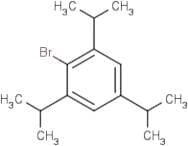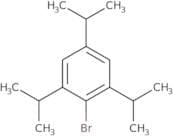
CAS 21524-34-5
:2-Brom-1,3,5-triisopropylbenzol
Beschreibung:
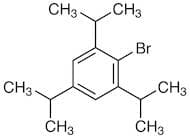
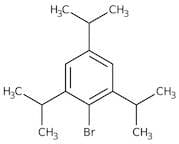
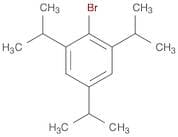
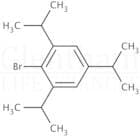
2-Brom-1,3,5-triisopropylbenzol ist eine organische Verbindung, die durch ihre aromatische Struktur gekennzeichnet ist und ein Bromatom sowie drei Isopropylgruppen aufweist, die an einen Benzolring gebunden sind. Die Anwesenheit des Bromsubstituenten führt zu einem Halogen, das die Reaktivität und die physikalischen Eigenschaften der Verbindung beeinflussen kann, wie z.B. Siedepunkte und Schmelzpunkte. Die Isopropylgruppen tragen zur sterischen Hülle und zum hydrophoben Charakter des Moleküls bei, was seine Löslichkeit in verschiedenen Lösungsmitteln beeinflusst. Typischerweise zeigen Verbindungen wie diese eine moderate bis geringe Löslichkeit in Wasser, sind jedoch in organischen Lösungsmitteln besser löslich. Die Verbindung kann in der organischen Synthese und als Zwischenprodukt bei der Herstellung anderer chemischer Substanzen verwendet werden. Ihre Reaktivität kann durch das Bromatom beeinflusst werden, das nucleophile Substitutionsreaktionen durchlaufen kann. Sicherheitsüberlegungen sollten beim Umgang mit dieser Verbindung berücksichtigt werden, da bromierte Verbindungen Gesundheitsrisiken darstellen können. Insgesamt ist 2-Brom-1,3,5-triisopropylbenzol eine bemerkenswerte Verbindung im Bereich der organischen Chemie aufgrund ihrer einzigartigen strukturellen Merkmale und potenziellen Anwendungen.
Formel:C15H23Br
InChl:InChI=1/C15H23Br/c1-9(2)12-7-13(10(3)4)15(16)14(8-12)11(5)6/h7-11H,1-6H3
SMILES:CC(C)c1cc(C(C)C)c(c(c1)C(C)C)Br
Synonyme:- 1-Bromo-2,4,6-triisopropylbenzene
- 2,4,6-Triisopropylbromobenzene
- 2-Bromo-1,3,5-Tri(Propan-2-Yl)Benzene
- 1,3,5-Triisopropyl-2-bromobenzene
- 1-Bromo-2,4,6-(triisopropyl)benzene
Sortieren nach
Reinheit (%)
0
100
|
0
|
50
|
90
|
95
|
100
7 Produkte.
2-Bromo-1,3,5-triisopropylbenzene
CAS:Formel:C15H23BrReinheit:>95.0%(GC)Farbe und Form:Colorless to Light yellow clear liquidMolekulargewicht:283.252-Bromo-1,3,5-triisopropylbenzene, 96%
CAS:2-Bromo-1,3,5-triisopropylbenzene is used in Suzuki reaction. It is found to effect highly selective ring closures of homoallylic alcohols to substituted tetrahydrofurans. This Thermo Scientific Chemicals brand product was originally part of the Alfa Aesar product portfolio. Some documentation and lFormel:C15H23BrReinheit:96%Farbe und Form:Clear colorless to pale yellow, LiquidMolekulargewicht:283.252-Bromo-1,3,5-triisopropylbenzene
CAS:Formel:C15H23BrReinheit:97%Farbe und Form:LiquidMolekulargewicht:283.24712-Bromo-1,3,5-triisopropylbenzene
CAS:2-Bromo-1,3,5-triisopropylbenzene
Formel:C15H23BrReinheit:97%Farbe und Form: colourless liquidMolekulargewicht:283.25g/mol2-Bromo-1,3,5-triisopropylbenzene
CAS:Formel:C15H23BrReinheit:97%Farbe und Form:SolidMolekulargewicht:283.2532-Bromo-1,3,5-triisopropylbenzene
CAS:2-Bromo-1,3,5-triisopropylbenzene is an ethylene acetal that is prepared by the catalyzed reaction of aryl chlorides and anhydrous zinc bromide in the presence of triethylamine. The selectivities of this method are high because it can produce mainly a single isomer. The stereoselectivity is also high because the reaction proceeds with the formation of only one stereoisomer. The mechanism for this reaction involves a nucleophilic substitution of the halogenated aryl chloride with the trialkylborane, which generates two different products. This product has been used in the synthesis of biphenyls and nitro compounds.
Formel:C15H23BrReinheit:Min. 95%Farbe und Form:Colorless Clear LiquidMolekulargewicht:283.25 g/mol