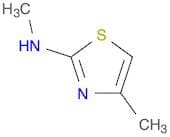
CAS 2161-68-4
:2-Thiazolamin, N,4-dimethyl-
Beschreibung:
2-Thiazolamin, N,4-dimethyl- ist eine organische Verbindung, die durch ihre Thiazolringstruktur gekennzeichnet ist, die sowohl Schwefel- als auch Stickstoffatome enthält. Diese Verbindung weist eine Dimethylsubstitution an der Position 4 des Thiazolrings und eine Aminogruppe an der Position 2 auf, was zu ihrer Basizität und potenziellen Reaktivität beiträgt. Sie ist typischerweise ein weißer bis off-white fester Stoff und in polaren Lösungsmitteln löslich, was für viele Thiazolderivate typisch ist. Die Anwesenheit der Aminogruppe ermöglicht Wasserstoffbrückenbindungen, die ihre Löslichkeit in Wasser und anderen polaren Medien erhöhen. 2-Thiazolamin-Derivate sind in verschiedenen Bereichen von Interesse, einschließlich der medizinischen Chemie, aufgrund ihrer biologischen Aktivität und potenziellen Anwendungen in der Pharmazie. Die Verbindung kann Eigenschaften wie antimikrobielle oder antimykotische Aktivität aufweisen, was sie zu einem Forschungsgegenstand in der Arzneimittelentwicklung macht. Sicherheitsdaten sollten für den Umgang und die Verwendung konsultiert werden, wie bei jeder chemischen Substanz, um sicherzustellen, dass die richtigen Vorsichtsmaßnahmen getroffen werden.
Formel:C5H8N2S
Sortieren nach
Reinheit (%)
0
100
|
0
|
50
|
90
|
95
|
100
3 Produkte.
N,4-Dimethylthiazol-2-amine
CAS:Formel:C5H8N2SReinheit:95%Farbe und Form:SolidMolekulargewicht:128.19544-Methyl-2-(methylamino)thiazole
CAS:4-Methyl-2-(methylamino)thiazoleReinheit:98%Molekulargewicht:128.20g/mol4-Methyl-2-(methylamino)thiazole
CAS:4-Methyl-2-(methylamino)thiazole is an organic compound that is a bromination substrate, a palladium catalyst, and an inhibitor of cyclin-dependent kinases. It has been shown to be an effective inhibitor of the Suzuki coupling reaction. 4-Methyl-2-(methylamino)thiazole reacts with borane in the presence of a palladium catalyst to form 4-methylthiazoleboronic acid. This reaction can be used as a way to synthesize target products. 4-Methyl-2-(methylamino)thiazole also reacts with carbon monoxide and hydrogen cyanide to form 2,4-dimethoxybenzaldehyde in the presence of sodium hydroxide.
Formel:C5H8N2SReinheit:Min. 95%Molekulargewicht:128.2 g/mol