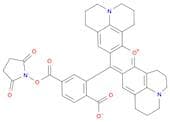
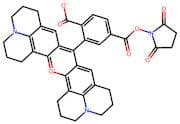
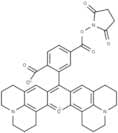
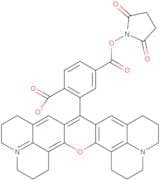
![1H,5H,11H,15H-Xantheno[2,3,4-ij:5,6,7-i'j′]diquinolizin-18-ium, 9-[2-carboxy-5-[[(2,5-dioxo-1-pyrr…](/_next/image/?url=https%3A%2Fstatic.cymitquimica.com%2Fcas-image%2Fthumb-webp%2F254852-6-rox-se.webp&w=3840&q=75)
CAS 216699-36-4
:1H,5H,11H,15H-Xantheno[2,3,4-ij:5,6,7-i'j′]diquinolizin-18-ium, 9-[2-carboxy-5-[[(2,5-dioxo-1-pyrrolidinyl)oxy]carbonyl]phenyl]-2,3,6,7,12,13,16,17-octahydro-, inneres Salz
- 1H,5H,11H,15H-Xantheno[2,3,4-ij:5,6,7-i'j′]diquinolizin-18-ium, 9-[2-carboxy-5-[[(2,5-dioxo-1-pyrrolidinyl)oxy]carbonyl]phenyl]-2,3,6,7,12,13,16,17-octahydro-, inner salt
- 6-Carboxy-X-rhodamine succinimidyl ester
- 6-ROX, SE [6-Carboxy-X-rhodamine, succinimidyl ester
- 6-Carboxy-X-rhodamine sucinimidyl ester
- 6-CXR SE
- ROX NHS ester
- 6-ROX SE, 6-CXR SE
- 6-ROX, SE
- 6-CARBOXY-X-RHODAMINE N-SUCCINIMIDYL ESTER
- 6-ROX, SE [6-Carboxy-X-rhodamine, succinimidyl ester] *CAS#: 216699-36-4*
- 6-ROX, SE [6-Carboxy-X-rhodaMine, suciniMidyl ester]
- 6-Carboxy-X-rhodamine, succinimidyl ester, single isomer
- ROX-NHS ester
- Weitere Synonyme anzeigen
9-(2-Carboxy-5-(((2,5-dioxopyrrolidin-1-yl)oxy)carbonyl)phenyl)-2,3,6,7,12,13,16,17-octahydro-1H,5H,11H,15H-xantheno[2,3,4-ij:5,6,7-i'j']diquinolizin-18-ium inner salt
CAS:9-(2-Carboxy-5-(((2,5-dioxopyrrolidin-1-yl)oxy)carbonyl)phenyl)-2,3,6,7,12,13,16,17-octahydro-1H,5H,11H,15H-xantheno[2,3,4-ij:5,6,7-i'j']diquinolizin-18-ium inner saltReinheit:96%Molekulargewicht:631.69g/mol6-ROX, SE
CAS:6-ROX, SE, an amine-reactive carboxy-X-rhodamine isomer, labels oligonucleotides for DNA sequencing.Formel:C33H30N2O5Reinheit:98%Farbe und Form:SolidMolekulargewicht:631.676-Carboxy-X-rhodamine, succinimidyl ester
CAS:Single isomer of 5(6)-ROX. It is a fluorescent dye used in RT-PCR methods as an internal reference to determine fluorescence variation that is not associated with the amplification process (plastic of the wells, small differences in concentration or volume, instrument measurements). It produces a constant fluorescence emission signal during the PCR process that is used to normalise the emission produced by the reporter. The fluorescence signal is compatible with most reporters. It is used to label the 5â end of oligonucleotides as a reporter in the presence of a quencher at the 3â end (dual labelled probe). During amplification, the dye is cleaved, and the fluorescence increases proportionally with the amount of the specific sequence amplified during the PCR process. The development of the fluorescence signal is therefore specifically related to the amplification of the target sequence.
Formel:C37H33N3O7Reinheit:Min. 95%Molekulargewicht:631.67 g/mol