


CAS 217082-60-5
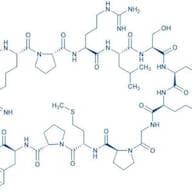
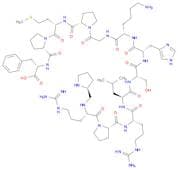
:(Pyr1)-Apelin-13 (menschlich, bovin)
Beschreibung:
(Pyr1)-Apelin-13 ist ein Peptid, das als Ligand für den Apelin-Rezeptor dient, der an verschiedenen physiologischen Prozessen beteiligt ist, einschließlich der kardiovaskulären Regulation, der Flüssigkeitshomöostase und des Energiestoffwechsels. Diese Substanz ist eine modifizierte Form des natürlich vorkommenden Apelin-13-Peptids, bei dem der erste Prolinrest durch einen Pyrrolidinring ersetzt wurde, was ihre Stabilität und Bioaktivität erhöht. Das Peptid zeichnet sich durch seine relativ kleine Größe aus, besteht aus 13 Aminosäuren und weist eine hohe Affinität zum Apelin-Rezeptor auf, was es in der Forschung zu kardiovaskulärer Gesundheit und Stoffwechselstörungen bedeutend macht. Seine Rolle bei der Förderung der Vasodilatation und der Beeinflussung der Appetitregulation hat Interesse an therapeutischen Anwendungen geweckt. Darüber hinaus wird (Pyr1)-Apelin-13 auf seine potenziellen Implikationen bei Erkrankungen wie Herzinsuffizienz und Fettleibigkeit untersucht. Die CAS-Nummer 217082-60-5 identifiziert diese Verbindung eindeutig und erleichtert ihre Erkennung in der wissenschaftlichen Literatur und in Datenbanken. Insgesamt stellt (Pyr1)-Apelin-13 ein wertvolles Werkzeug in der biomedizinischen Forschung dar, insbesondere zum Verständnis des Apelin-Signalwegs.
Formel:C69H108N22O16S
Synonyme:- (Pyr1)apelin-13
- (pGlu1)apelin-13
- Pyr-apelin-13
- L-Phenylalanine,5-oxo-L-prolyl-L-arginyl-L-prolyl-L-arginyl-L-leucyl-L-seryl-L-histidyl-L-lysylglycyl-L-prolyl-L-methionyl-L-prolyl-
- Pyr-Arg-Pro-Arg-Leu-Ser-His-Lys-Gly-Pro-Met-Pro-Phe-OH
Sortieren nach
Reinheit (%)
0
100
|
0
|
50
|
90
|
95
|
100
8 Produkte.
(Pyr¹)-Apelin-13 (human, bovine, mouse, rat)
CAS:The pyroglutamyl form of apelin-13 exhibited a high activity with an EC₅₀ value of 0.30 nM. pERPRLSHKGPMPF is probably the final product of the post-translational modification of apelin and the biologically active endogenous ligand. (Pyr¹)-Apelin-13 has been identified as the predominant apelin isoform in the human heart. Pyr-Apelin-13 stimulates glucose utilization in normal and obese insulin-resistant mice. It could be required for the maintenance of insulin sensitivity.Formel:C69H108N22O16SReinheit: 97.7%Farbe und Form:White LyophilisateMolekulargewicht:1533.82(Pyr¹)-Apelin-13 (human, bovine, mouse, rat)
CAS:Bachem ID: 4104812.
Formel:C69H108N22O16SReinheit:98.2301%Farbe und Form:White PowderMolekulargewicht:1533.82PYR-ARG-PRO-ARG-LEU-SER-HIS-LYS-GLY-PRO-MET-PRO-PHE-OH
CAS:Formel:C69H108N22O16SReinheit:97%Farbe und Form:SolidMolekulargewicht:1533.7986[Pyr1]-Apelin-13
CAS:[Pyr1]-Apelin-13 ([pGlu1]-Apelin-13) is a potent and selective endogenous Apelin receptor (APJ) agonist.Formel:C69H108N22O16SReinheit:99.71%Farbe und Form:SolidMolekulargewicht:1533.8(Pyr 1)-Apelin-13
CAS:Endogenous ligand for apelin APJ receptor
Formel:C69H108N22O16SReinheit:Min. 95%Farbe und Form:White PowderMolekulargewicht:1,533.8 g/mol[Pyr]-Apelin-13
CAS:[Pyr1]-Apelin-13 acts as a ligand for the apelin receptor (APJ) G protein-coupled receptor and is a substrate for angiotensin-converting enzyme 2. Apelin is a member of the adipokine hormone family from adipose tissue. Adipokines are involved in processes such as vascular homeostasis and angiogenesis.Apelin and the apelin receptor are widely distributed throughout the body. Apelin is associated with cardiovascular diseases, obesity, diabetes and cancer. Apelin is expressed in the spinal cord and the human brain. Immunohistochemistry shows that apelin-17 is significantly expressed in the human heart, brain, lungs and endothelial cells. Studies show myocardial infarction apelin mRNA expression is greater during human heart failure than in healthy tissue. Apelin protects against heart failure due to the pyroglutamic form of apelin, [Pyr1]-Apelin-13, which decreases infarct size of myocardial infarctions. Furthermore, rats with hypertension have reduced levels of apelin and APJ. [Pyr1]-Apelin-13 exhibits higher APJ agonist potency than Apelin-13. We also have the alternative available.Formel:C69H108N22O16SFarbe und Form:PowderMolekulargewicht:1,533.8 g/mol[Pyr1]-Apelin-13 (Human, Bovine)
CAS:Apelin-13 is a peptide that belongs to the class of activators. It has been shown to activate the ATP-sensitive potassium ion channels and inhibit the calcium ion channels in cells. Apelin-13 also binds to receptors on cells, which leads to activation of signaling pathways. The affinity for these receptors has been determined using an antibody. In addition, it has been shown that Apelin-13 interacts with other proteins and ligands in a variety of ways through protein interactions and receptor binding.Formel:C69H108N22O16SReinheit:Min. 95%Molekulargewicht:1,533.8 g/mol



![[Pyr1]-Apelin-13](/_next/image/?url=https%3A%2Fstatic.cymitquimica.com%2Fproducts%2F54%2Fthumb%2FBUP01859.jpg&w=3840&q=75)

![[Pyr1]-Apelin-13](/_next/image/?url=https%3A%2Fstatic.cymitquimica.com%2Fproducts%2FTM%2Fthumb%2FTP1260.jpg&w=3840&q=75)


![[Pyr]-Apelin-13](/_next/image/?url=https%3A%2Fstatic.cymitquimica.com%2Fproducts%2F3D%2Fthumb%2FCRB1000443.jpg&w=3840&q=75)
![[Pyr1]-Apelin-13 (Human, Bovine)](/_next/image/?url=https%3A%2Fstatic.cymitquimica.com%2Fproducts%2F3D%2Fthumb%2FPAP-4361-V.jpg&w=3840&q=75)