CAS 21770-81-0
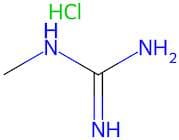
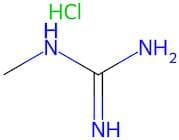
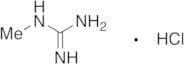
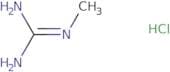
:1-Methylguanidinhydrochlorid
Beschreibung:
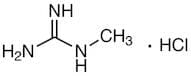
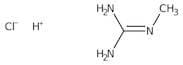
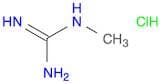
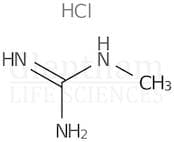
1-Methylguanidinhydrochlorid ist eine chemische Verbindung, die durch ihre Guanidinstruktur gekennzeichnet ist, wobei eine Methylgruppe an das Stickstoffatom gebunden ist. Sie erscheint als weißes bis off-white kristallines Pulver und ist in Wasser löslich, was sie für verschiedene Anwendungen in der biochemischen und pharmazeutischen Forschung geeignet macht. Die Verbindung ist bekannt für ihre Rolle als Reagenz in der organischen Synthese und als potenzielles Zwischenprodukt in der Herstellung von Arzneimitteln. Sie weist basische Eigenschaften aufgrund der Anwesenheit von Guanidin auf, das an Protonierungs- und Deprotonierungsreaktionen teilnehmen kann. Darüber hinaus wurde 1-Methylguanidinhydrochlorid auf seine potenziellen biologischen Aktivitäten untersucht, einschließlich seiner Auswirkungen auf die Stickstoffmonoxid-Synthese und seiner Rolle in zellulären Signalwegen. Sicherheitsüberlegungen sollten beim Umgang mit dieser Verbindung berücksichtigt werden, da sie Gesundheitsrisiken darstellen kann, wenn sie eingenommen oder eingeatmet wird. Angemessene Laborpraktiken und persönliche Schutzausrüstung werden empfohlen, um die Exposition zu verringern.
Formel:C2H7N3·ClH
InChl:InChI=1S/C2H7N3.ClH/c1-5-2(3)4;/h1H3,(H4,3,4,5);1H
InChI Key:InChIKey=VJQCNCOGZPSOQZ-UHFFFAOYSA-N
SMILES:C(NC)(=N)N.Cl
Synonyme:- (E)-amino(imino)-N-methylmethanaminium chloride
- Guanidine, N-methyl-, hydrochloride (1:1)
- Guanidine, methyl-, monohydrochloride
- Methylguanidine Hydrochloride
- Methylguanidinium chloride
- N-Methylguanidine hydrochloride
- N-Methylguanidine monohydrochloride
- 1-methylguanidine hydrochloride
- 1-Methylguanidine hydrochloride
Sortieren nach
Reinheit (%)
0
100
|
0
|
50
|
90
|
95
|
100
11 Produkte.
1-Methylguanidine Hydrochloride
CAS:Formel:C2H7N3·HClReinheit:>98.0%(T)(N)Farbe und Form:White to Almost white powder to crystalMolekulargewicht:109.56Methylguanidine hydrochloride, 98%
CAS:Methylguanidine hydrochloride can be used in the synthesis of biaryl derivatives which were evaluated as BACE1 inhibitors. This Thermo Scientific Chemicals brand product was originally part of the Alfa Aesar product portfolio. Some documentation and label information may refer to the legacy brand. TFormel:C2H7N3•HClReinheit:98%Molekulargewicht:109.561-Methylguanidine hydrochloride
CAS:Formel:C2H8ClN3Reinheit:98%Farbe und Form:SolidMolekulargewicht:109.55801-Methylguanidine hydrochloride
CAS:Formel:C2H7N3·HClReinheit:(Titration) ≥ 98.0%Farbe und Form:White to off-white powder or crystalsMolekulargewicht:109.561-Methylguanidine Hydrochloride
CAS:1-Methylguanidine HydrochlorideReinheit:98%Molekulargewicht:109.56g/mol1-Methylguanidine hydrochloride
CAS:1-Methylguanidine hydrochlorideReinheit:≥98%Molekulargewicht:109.56g/molMethylguanidine HCl
CAS:Formel:C2H7N3·HClFarbe und Form:White To Off-White SolidMolekulargewicht:73.10 36.461-Methylguanidine hydrochloride
CAS:MG derived from protein breakdown, may be toxic in renal failure but has anti-inflammatory properties, inhibiting iNOS and TNF- release.Formel:C2H8ClN3Reinheit:98% - 99.02%Farbe und Form:CrystallineMolekulargewicht:109.56N-Methylguanidine Hydrochloride
CAS:Kontrolliertes ProduktStability Hygroscopic
Applications N-Methylguanidine is an alkylated guanidine which shows inhibitory action against trypsin catalysis. N-Methylguanidine inhibited metabolism of certain hepatic drugs that was mediated by cytochrome P 450 protein in human liver microsome and hepatocyte.
References Inagami, T. et al.: Biochemistry, 7, 4045 (1968); Hanada, K. et al.: Nephron, 103, 179 (2006);Formel:C2H8ClN3Farbe und Form:NeatMolekulargewicht:109.561-Methylguanidine hydrochloride
CAS:Formel:C2H8ClN3Reinheit:95%Farbe und Form:Chunks,Crystalline Powder,PowderMolekulargewicht:109.56Methylguanidine HCl
CAS:Methylguanidine HCl is a denaturing agent that can be used in the analysis of organic substances. It is used to study the biological properties of nitrogen-containing molecules, such as peroneal nerve. Methylguanidine HCl has been shown to have anti-inflammatory activity and can be used as an analgesic. Methylguanidine HCl binds to the ionotropic glutamate receptors, which are chloride channels, and this binding leads to an increase in intracellular chloride concentrations. This effect on chloride ions may be responsible for its ability to reduce pain sensation. Methylguanidine HCl also has a modulating effect on the synthesis of creatine and nitric oxide in serum levels.Formel:C2H8ClN3Reinheit:Min. 95%Molekulargewicht:109.56 g/mol