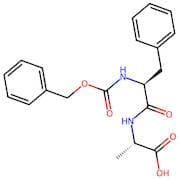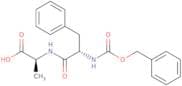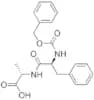
CAS 21881-18-5
:Z-L-phenylalanyl-L-alanin
Beschreibung:
Z-L-phenylalanyl-L-alanin, auch bekannt unter seiner CAS-Nummer 21881-18-5, ist ein Dipeptid, das aus den Aminosäuren Phenylalanin und Alanin besteht. Diese Verbindung weist eine schützende Z (Benzyloxycarbonyl)-Gruppe am Phenylalanin-Rest auf, die ihre Stabilität und Löslichkeit erhöht. Sie wird typischerweise in der biochemischen Forschung und der Peptidsynthese aufgrund ihrer strukturellen Eigenschaften und potenziellen biologischen Aktivität verwendet. Die Anwesenheit der aromatischen Phenylgruppe trägt zu ihren hydrophoben Eigenschaften bei, während der Alaninrest eine neutralere, aliphatische Komponente bereitstellt. Z-L-phenylalanyl-L-alanin kann an verschiedenen biochemischen Wechselwirkungen teilnehmen, was es in Studien zur Proteinstruktur und -funktion von Interesse macht. Darüber hinaus sind seine Synthese und Charakterisierung wichtig für die Entwicklung von Arzneimitteln und therapeutischen Peptiden. Wie bei vielen Peptiden können seine Löslichkeit und Stabilität von Faktoren wie pH und Temperatur beeinflusst werden, die kritische Überlegungen in experimentellen Anwendungen sind.
Formel:C20H22N2O5
Synonyme:- N-cbz-phe-ala
- Z-Phe-Ala-OH
Sortieren nach
Reinheit (%)
0
100
|
0
|
50
|
90
|
95
|
100
5 Produkte.
Z-Phe-Ala-OH
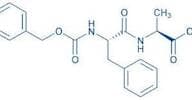
CAS:Sensitive substrate for cathepsin A.Formel:C20H22N2O5Reinheit:> 99%Farbe und Form:White PowderMolekulargewicht:370.41L-Alanine, N-[(phenylmethoxy)carbonyl]-L-phenylalanyl-
CAS:Formel:C20H22N2O5Reinheit:95%Farbe und Form:SolidMolekulargewicht:370.3991Z-Phe-Ala-OH
CAS:Z-Phe-Ala-OH is a synthetic amino acid with the chemical formula of C10H13NO3. This compound is a racemic mixture of L-Z-Phe and D-Z-Phe. Z-Phe-Ala-OH has been shown to inhibit protein synthesis by acting as an enzyme inhibitor, which leads to neuronal death. It also has reactive properties that can lead to cell death, which may be due to its ability to react with methyl ketones. Z-Phe-Ala-OH's acidic nature makes it a toxic compound for cells and can cause apoptotic effects. The reactive properties of this compound make it a potential candidate for use in cancer therapy and other treatments that target glutamate receptors and their signaling pathways, such as excitotoxic or glutamate antagonists.
Formel:C20H22N2O5Reinheit:Min. 95%Farbe und Form:White To Off-White SolidMolekulargewicht:370.4 g/mol

![L-Alanine, N-[(phenylmethoxy)carbonyl]-L-phenylalanyl-](/_next/image/?url=https%3A%2Fstatic.cymitquimica.com%2Fproducts%2FIN%2Fthumb%2FDA00I48Z.jpg&w=3840&q=75)