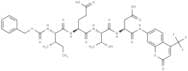
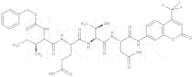
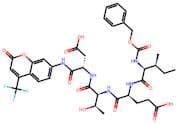
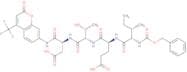
![L-a-Asparagine,N-[(phenylmethoxy)carbonyl]-L-isoleucyl-L-a-glutamyl-L-threonyl-N-[2-oxo-4-(trifluo…](/_next/image/?url=https%3A%2Fstatic.cymitquimica.com%2Fcas-image%2Fthumb-webp%2F313182-l-a-asparagine-n-phenylmethoxy-carbonyl-l-isoleucyl-l-a-glutamyl-l-threonyl-n-2-oxo-4-trifluoromethyl-2h-1-benzopyran-7-yl-9ci.webp&w=3840&q=75)
CAS 219138-02-0
:L-a-Asparagin,N-[(phenylmethoxy)carbonyl]-L-isoleucyl-L-a-glutamyl-L-threonyl-N-[2-oxo-4-(trifluormethyl)-2H-1-benzopyran-7-yl]-(9CI)
- Z-Ietd-Afc
Z-IETD-AFC
CAS:Z-IETD-AFC is a fluorescent substrate for caspase-8 and granzyme B. It can be used to quantify cysteinyl aspartate-8 or granzyme B activity.Formel:C37H42F3N5O13Reinheit:98.67%Farbe und Form:SolidMolekulargewicht:821.75Caspase substrate
CAS:Caspase substrates are a class of pharmacological agents that regulate apoptosis. Caspases are proteases that cleave specific proteins in the cell, leading to apoptosis. Pro-apoptotic proteins activate caspases, while anti-apoptotic proteins inhibit them. Caspase substrates can be either pro-caspase or anti-caspase, depending on the desired effect. They may also be used to regulate caspases without affecting their activity. The caspase substrate is cleaved by caspases and releases a polypeptide fragment that triggers apoptosis in some cells, but not others. For example, the Hl-60 cell line is resistant to the pro-apoptotic effects of the substrate because it contains an anti-apoptotic protein called Bcl-2. In contrast, myocardial cells contain pro-apoptotic proteins and are sensitive to the pro-apoptotic effects of the substrate. In
Reinheit:Min. 95%Molekulargewicht:821.75 g/mol