


CAS 219694-63-0
:Ingavirin
Beschreibung:
Ingavirin, mit der CAS-Nummer 219694-63-0, ist ein antivirales Medikament, das hauptsächlich zur Behandlung von Influenza und anderen Virusinfektionen eingesetzt wird. Es zeichnet sich durch seinen Wirkmechanismus aus, der die Modulation der Immunantwort und die Hemmung der viralen Replikation umfasst. Ingavirin ist bekannt für seine Fähigkeit, die Produktion von Interferonen zu steigern, die Proteine sind, die eine entscheidende Rolle in der Abwehr des Körpers gegen Virusinfektionen spielen. Der Stoff wird typischerweise oral verabreicht und ist bekannt für sein relativ niedriges Toxizitätsprofil. Ingavirin wird oft für seinen schnellen Wirkungseintritt hervorgehoben und wird normalerweise für den Einsatz in den frühen Stadien von Virusinfektionen verschrieben. Seine chemische Struktur umfasst einen zentralen Imidazolring, der zu seiner biologischen Aktivität beiträgt. Obwohl es gegen verschiedene Influenza-Stämme wirksam ist, sollte die Anwendung durch medizinischen Rat geleitet werden, wobei mögliche Kontraindikationen und Wechselwirkungen mit anderen Medikamenten zu berücksichtigen sind. Insgesamt stellt Ingavirin eine bedeutende Option in der antiviralen Therapie dar, insbesondere in Regionen, in denen Influenza verbreitet ist.
- 5-[2-(1H-imidazol-5-yl)ethylamino]-5-oxopentanoic acid
- 5-((2-(1H-imidazol-5-yl)ethyl)amino)-5-oxopentanoic acid
Sortieren nach
Reinheit (%)
0
100
|
0
|
50
|
90
|
95
|
100
6 Produkte.
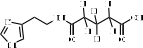
4-{[2-(1H-imidazol-5-yl)ethyl]carbamoyl}butanoic acid
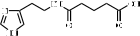
CAS:Formel:C10H15N3O3Reinheit:95%Farbe und Form:SolidMolekulargewicht:225.24445-((2-(1H-Imidazol-5-yl)ethyl)amino)-5-oxopentanoic acid
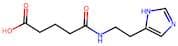
CAS:5-((2-(1H-Imidazol-5-yl)ethyl)amino)-5-oxopentanoic acidReinheit:95%Molekulargewicht:225.25g/molIngavirin
CAS:Ingavirin, a novel inhibitor of the influenza virus reproduction, inhubits the formation of the virus specific hemagglutinin.Formel:C10H15N3O3Reinheit:98%Farbe und Form:SolidMolekulargewicht:225.244-{[2-(1H-Imidazol-5-yl)ethyl]carbamoyl}butanoic acid
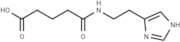
CAS:4-{[2-(1H-Imidazol-5-yl)ethyl]carbamoyl}butanoic acid (4AICB) is a potent replication inhibitor of the influenza virus. It targets the viral RNA polymerase (RdRP), which is essential for virus replication and transcription. 4AICB inhibits the activity of RdRP by binding to its active site, thereby preventing the initiation of transcription. This mechanism of action has been shown to be effective against influenza A viruses and other RNA viruses. In addition, this drug has been shown to inhibit growth factor signaling pathways in human hematopoietic cells, which may be responsible for its anti-inflammatory effects. 4AICB also possesses pharmacokinetic properties that make it an ideal candidate for use as a diagnostic agent or as a treatment for inflammatory diseases. It can be administered orally or intravenously and is rapidly absorbed from the gastrointestinal tract or injected sites into systemic circulation, with rapidFormel:C10H15N3O3Reinheit:Min. 95%Farbe und Form:PowderMolekulargewicht:225.24 g/molRef: 3D-UIA69463
Ausgelaufenes produkt
![4-{[2-(1H-imidazol-5-yl)ethyl]carbamoyl}butanoic acid](/_next/image/?url=https%3A%2Fstatic.cymitquimica.com%2Fproducts%2FIN%2Fthumb%2FDA01BXR0.jpg&w=3840&q=75)




![4-{[2-(1H-Imidazol-5-yl)ethyl]carbamoyl}butanoic acid](/_next/image/?url=https%3A%2Fstatic.cymitquimica.com%2Fproducts%2F3D%2Fthumb%2FUIA69463.jpg&w=3840&q=75)
