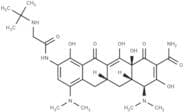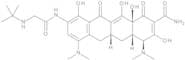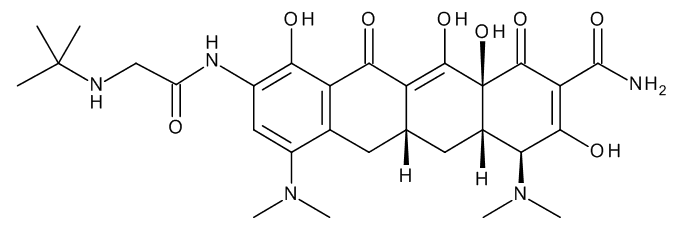
CAS 220620-09-7
:Tigecyclin
Beschreibung:
Tigecyclin ist ein Breitband-Glycylcyclin-Antibiotikum, das strukturell mit Tetracyclinen verwandt ist und hauptsächlich zur Behandlung verschiedener bakterieller Infektionen eingesetzt wird, insbesondere solcher, die durch multiresistente Organismen verursacht werden. Es zeigt einen einzigartigen Wirkmechanismus, indem es die bakterielle Proteinsynthese durch Bindung an die 30S-ribosomale Untereinheit hemmt und somit die Einbindung von Aminosäuren in Peptide verhindert. Tigecyclin ist wirksam gegen eine Vielzahl von grampositiven und gramnegativen Bakterien, einschließlich einiger Stämme von methicillin-resistentem Staphylococcus aureus (MRSA) und vancomycin-resistentem Enterococcus (VRE). Es wird typischerweise intravenös verabreicht und ist angezeigt bei komplizierten Haut- und Hautstrukturinfektionen, komplizierten intraabdominalen Infektionen und community-acquired pneumonia. Tigecyclin hat eine relativ niedrige orale Bioverfügbarkeit, weshalb die parenterale Verabreichung bevorzugt wird. Zu den Nebenwirkungen können Übelkeit, Erbrechen und eine mögliche Erhöhung der Leberenzyme gehören. Aufgrund seiner breiten Aktivität und Wirksamkeit gegen resistente Stämme spielt Tigecyclin eine entscheidende Rolle bei der Behandlung schwerer Infektionen, obwohl seine Anwendung oft auf spezifische Fälle beschränkt ist, um das Risiko der Entwicklung von Resistenzen zu verringern.
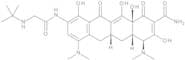
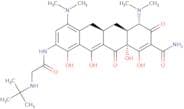
Formel:C29H39N5O8
InChl:InChI=1S/C29H39N5O8/c1-28(2,3)31-11-17(35)32-15-10-16(33(4)5)13-8-12-9-14-21(34(6)7)24(38)20(27(30)41)26(40)29(14,42)25(39)18(12)23(37)19(13)22(15)36/h10,12,14,21,31,36,38-39,42H,8-9,11H2,1-7H3,(H2,30,41)(H,32,35)/t12-,14-,21-,29-/m0/s1
InChI Key:InChIKey=FPZLLRFZJZRHSY-HJYUBDRYSA-N
SMILES:O[C@]12[C@]([C@H](N(C)C)C(O)=C(C(N)=O)C1=O)(C[C@]3(C(=C2O)C(=O)C=4C(C3)=C(N(C)C)C=C(NC(CNC(C)(C)C)=O)C4O)[H])[H]
Synonyme:- 2-Naphthacenecarboxamide, 4,7-bis(dimethylamino)-9-[[[(1,1-dimethylethyl)amino]acetyl]amino]-1,4,4a,5,5a,6,11,12a-octahydro-3,10,12,12a-tetrahydroxy-1,11-dioxo-, (4S,4aS,5aR,12aS)-
- GAR 936
- 2-Naphthacenecarboxamide, 4,7-bis(dimethylamino)-9-[[2-[(1,1-dimethylethyl)amino]acetyl]amino]-1,4,4a,5,5a,6,11,12a-octahydro-3,10,12,12a-tetrahydroxy-1,11-dioxo-, (4S,4aS,5aR,12aS)-
- WAY-GAR 936
- (4S,4aS,5aR,12aS)-4,7-Bis(dimethylamino)-9-[[2-[(1,1-dimethylethyl)amino]acetyl]amino]-1,4,4a,5,5a,6,11,12a-octahydro-3,10,12,12a-tetrahydroxy-1,11-dioxo-2-naphthacenecarboxamide
Sortieren nach
Reinheit (%)
0
100
|
0
|
50
|
90
|
95
|
100
14 Produkte.
Tigecycline
CAS:Formel:C29H39N5O8Reinheit:>98.0%(HPLC)Farbe und Form:Light yellow to Brown powder to crystalMolekulargewicht:585.66Tigecycline
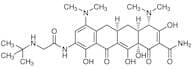
CAS:Tetracyclines and their derivatives; salts thereofFormel:C29H39N5O8Farbe und Form:Orange PowderMolekulargewicht:585.27986(4S,4aS,5aR,12aS)-4,7-Bis(dimethylamino)-9-[[2-[(1,1-dimethylethyl)amino]acetyl]amino]-1,4,4a,5,5a,6,11,12a-octahydro-3,10,12,12a-tetrahydroxy-1,11-dioxo-2-naphthacenecarboxamide
CAS:Formel:C29H39N5O8Reinheit:96%Farbe und Form:SolidMolekulargewicht:585.6487Tigecycline
CAS:Tigecycline (GAR-936), a broad-spectrum glycylcycline, disrupts protein synthesis by binding the 30S ribosomal subunit.Formel:C29H39N5O8Reinheit:98.81% - >99.99%Farbe und Form:PowderMolekulargewicht:585.65Ref: TM-T1569
5mg35,00€10mg54,00€1mL*10mM (DMSO)56,00€25mg74,00€50mg100,00€100mg159,00€200mg235,00€500mg395,00€Tigecycline
CAS:Stability Light Sensitive
Applications A glycylcycline antibiotic, used to treat infection by drug resistant bacteria such as Staphylococcus aureus (Staph aureus) and Acinetobacter baumannii.
References Lim, T., et al.: J. Antibiotics, 62, 675 (2009), Presterl, E., et al.: Antimicrob. Agents Chemother., 53, 3205 (2009), Varma, M., et al.: J. Med. Chem., 52, 4844 (2009),Formel:C29H39N5O8Farbe und Form:OrangeMolekulargewicht:585.65Tigecycline
CAS:Inhibitor of protein synthesis; glycylcycline class
Formel:C29H39N5O8Reinheit:Min. 98 Area-%Farbe und Form:Orange PowderMolekulargewicht:585.65 g/molTigecycline, Antibiotic for Culture Media Use Only
CAS:Tigecycline is an antibiotic specifically tailored for use in culture media, which is derived from glycylcycline, a structural analogue of minocycline. Its mode of action involves binding to the 30S ribosomal subunit, thereby inhibiting protein synthesis in a broad spectrum of Gram-positive and Gram-negative bacteria. This action is distinct and not easily circumvented by common resistance mechanisms, such as efflux or ribosomal protection proteins, making tigecycline an effective agent in controlling bacterial contamination during microbiological studies.Formel:C29H39N5O8Reinheit:Min. 95 Area-%Molekulargewicht:585.65 g/mol



![(4S,4aS,5aR,12aS)-4,7-Bis(dimethylamino)-9-[[2-[(1,1-dimethylethyl)amino]acetyl]amino]-1,4,4a,5,5a…](/_next/image/?url=https%3A%2Fstatic.cymitquimica.com%2Fproducts%2FIN%2Fthumb%2FDA003UT8.jpg&w=3840&q=75)