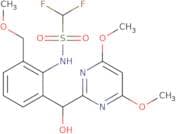
![N-{2-[(4,6-dimethoxypyrimidin-2-yl)(hydroxy)methyl]-6-(methoxymethyl)phenyl}-1,1-difluoromethanesu…](/_next/image/?url=https%3A%2Fstatic.cymitquimica.com%2Fcas-image%2Fthumb-webp%2F392738-n-2-46-dimethoxypyrimidin-2-yl-hydroxy-methyl-6-methoxymethyl-phenyl-11-difluoromethanesulfonamide.webp&w=3840&q=75)
CAS 221205-90-9
:N-{2-[(4,6-dimethoxypyrimidin-2-yl)(hydroxy)methyl]-6-(methoxymethyl)phenyl}-1,1-difluormethansulfonamid
Beschreibung:
N-{2-[(4,6-dimethoxypyrimidin-2-yl)(hydroxy)methyl]-6-(methoxymethyl)phenyl}-1,1-difluormethansulfonamid ist eine komplexe organische Verbindung, die durch ihre einzigartigen strukturellen Merkmale gekennzeichnet ist, einschließlich eines Pyrimidinrings und einer Sulfonamid-Funktionalgruppe. Das Vorhandensein mehrerer Methoxygruppen trägt zu ihrer Löslichkeit und potenziellen Reaktivität bei, während die Difluoromethansulfonamid-Gruppe ihre biologische Aktivität verbessern kann. Diese Verbindung wird wahrscheinlich spezifische Wechselwirkungen mit biologischen Zielen aufweisen, was sie in der medizinischen Chemie von Interesse macht, insbesondere bei der Entwicklung von Arzneimitteln. Ihre molekulare Struktur deutet auf potenzielle Anwendungen in Bereichen wie der Enzyminhibition oder als therapeutisches Mittel hin. Darüber hinaus kann das Vorhandensein von Hydroxymethyl- und Difluoromethylgruppen ihre pharmakokinetischen Eigenschaften beeinflussen, einschließlich Absorption, Verteilung, Metabolismus und Exkretion. Insgesamt veranschaulicht diese Verbindung das komplexe Design, das häufig in der Arzneimittelentwicklung zu finden ist, wo Modifikationen des molekularen Rahmens die biologische Wirksamkeit und Sicherheitsprofile erheblich beeinflussen können.
Formel:C16H19F2N3O6S
InChl:InChI=1/C16H19F2N3O6S/c1-25-8-9-5-4-6-10(13(9)21-28(23,24)16(17)18)14(22)15-19-11(26-2)7-12(20-15)27-3/h4-7,14,16,21-22H,8H2,1-3H3
SMILES:COCc1cccc(c1NS(=O)(=O)C(F)F)C(c1nc(cc(n1)OC)OC)O
Synonyme:- 221205-90-9
Sortieren nach
Reinheit (%)
0
100
|
0
|
50
|
90
|
95
|
100
4 Produkte gefunden.
LC PestiMix 9 10 µg/mL in Acetonitrile
CAS:- 1003318-67-9
- 1031756-98-5
- 104273-71-4
- 105779-78-0
- 1072957-71-1
- 1101132-67-5
- 1207727-04-5
- 121451-02-3
- 1220411-29-9
- 1228284-64-7
- 1229654-66-3
- 123572-88-3
- 1255734-28-1
- 1263133-33-0
- 130561-48-7
- 135186-78-6
- 1352994-67-2
- 1383809-87-7
- 1390661-72-9
- 140163-89-9
- 1417782-03-6
- 1472649-01-6
- 147411-69-6
- 1486617-22-4
- 156963-66-5
- 158237-07-1
- 162320-67-4
- 168088-61-7
- 173662-97-0
- 188489-07-8
- 200509-41-7
- 221205-90-9
- 224049-04-1
- 238410-11-2
- 256412-89-2
- 283159-90-0
- 330459-31-9
- 337458-27-2
- 352010-68-5
- 366815-39-6
- 42835-25-6
- 447399-55-5
- 473278-76-1
- 473798-59-3
- 494793-67-8
- 500207-04-5
- 517875-34-2
- 56073-07-5
- 5836-29-3
- 68049-83-2
- 688046-61-9
- 704886-18-0
- 799247-52-2
- 81-81-2
- 81-82-3
- 81334-34-1
- 81777-95-9
- 82692-44-2
- 847749-37-5
- 850881-70-8
- 862588-11-2
- 874195-61-6
- 874967-67-6
- 875915-78-9
- 881685-58-1
- 882182-49-2
- 902760-40-1
- 907204-31-3
- 911499-62-2
- 915972-17-7
- 926914-55-8
- 943831-98-9
Farbe und Form:MixturePyrimisulfan
CAS:Kontrolliertes ProduktFormel:C16H19F2N3O6SFarbe und Form:NeatMolekulargewicht:419.40Pyrimisulfan
CAS:Pyrimisulfan is a medicinal compound that has shown potent anticancer activity in both human and Chinese hamster cancer cell lines. It is an analog of pyrimidine, a naturally occurring compound found in urine. Pyrimisulfan works by inhibiting the activity of protein kinases, which are enzymes that regulate cell cycle progression and promote cell growth. This inhibition leads to apoptosis, or programmed cell death, in cancer cells. Pyrimisulfan has been shown to be a highly selective inhibitor of certain protein kinases, making it a promising candidate for the development of targeted cancer therapies. Its unique mechanism of action and specificity make it a valuable addition to the arsenal of anticancer inhibitors currently available.
Formel:C16H19F2N3O6SReinheit:Min. 95%Molekulargewicht:419.4 g/mol