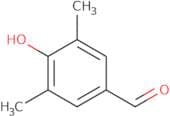
CAS 2233-18-3
:3,5-Dimethyl-4-hydroxybenzaldehyd
Beschreibung:
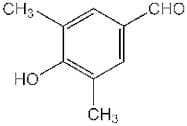
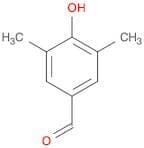
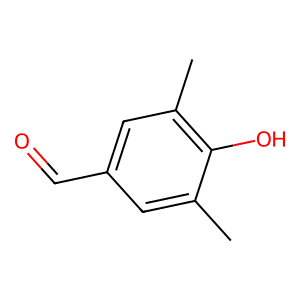
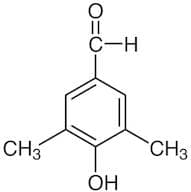
3,5-Dimethyl-4-hydroxybenzaldehyd, mit der CAS-Nummer 2233-18-3, ist eine organische Verbindung, die zur Klasse der aromatischen Aldehyde gehört. Sie weist einen Benzolring auf, der an den Positionen 3 und 5 mit zwei Methylgruppen substituiert ist, eine Hydroxylgruppe an der Position 4 und eine Aldehydfunktion. Diese Verbindung zeichnet sich typischerweise durch ihr blassgelbes bis hellbraunes Aussehen aus und hat einen charakteristischen aromatischen Geruch. Sie ist in organischen Lösungsmitteln wie Ethanol und Ether löslich, aber ihre Löslichkeit in Wasser ist aufgrund ihrer hydrophoben Methylgruppen begrenzt. Die Anwesenheit der Hydroxylgruppe trägt zu ihrer Reaktivität bei, sodass sie an verschiedenen chemischen Reaktionen, einschließlich Oxidation und Kondensation, teilnehmen kann. 3,5-Dimethyl-4-hydroxybenzaldehyd wird häufig in der organischen Synthese verwendet und kann als Zwischenprodukt in der Herstellung von Farbstoffen, Duftstoffen und Arzneimitteln dienen. Ihre Eigenschaften machen sie zu einer wertvollen Verbindung sowohl in der Forschung als auch in industriellen Anwendungen.
Formel:C9H10O2
InChl:InChI=1/C9H10O2/c1-6-3-8(5-10)4-7(2)9(6)11/h3-5,11H,1-2H3
InChI Key:InChIKey=UYGBSRJODQHNLQ-UHFFFAOYSA-N
SMILES:C(=O)C1=CC(C)=C(O)C(C)=C1
Synonyme:- 3,5-Dimethyl-4-hydroxybenzaldehyde
- 4-Formyl-2,6-xylenol
- Benzaldehyde, 4-hydroxy-3,5-dimethyl-
- NSC 128405
- 4-Hydroxy-3,5-dimethylbenzaldehyde
- BUTTPARK 96\57-68
- 4-hydroxy-3,5-dimethyl-benzaldehyd
- 3,5-Dimethyl-4-Hydroxybenzalde
- 3,5-Dimethyl-4-Hydorxybenzaldehyde
- 4-Hydroxy-3,5-dimethylbenzaldehyde, TECH
- Syringnldehyde
Sortieren nach
Reinheit (%)
0
100
|
0
|
50
|
90
|
95
|
100
6 Produkte.
4-Hydroxy-3,5-dimethylbenzaldehyde, 97+%
CAS:This Thermo Scientific Chemicals brand product was originally part of the Alfa Aesar product portfolio. Some documentation and label information may refer to the legacy brand. The original Alfa Aesar product / item code or SKU reference has not changed as a part of the brand transition to Thermo SciFormel:C9H10O2Reinheit:97+%Farbe und Form:White to cream or yellow to orange or pale brown, Crystals or Crystalline powderMolekulargewicht:150.183,5-Dimethyl-4-hydroxybenzaldehyde
CAS:Formel:C9H10O2Reinheit:97%Farbe und Form:SolidMolekulargewicht:150.17453,5-Dimethyl-4-hydroxybenzaldehyde
CAS:3,5-Dimethyl-4-hydroxybenzaldehydeFormel:C9H10O2Reinheit:≥95%Farbe und Form: off-white powderMolekulargewicht:150.17g/mol4-Hydroxy-3,5-dimethylbenzaldehyde
CAS:Formel:C9H10O2Reinheit:>98.0%(T)Farbe und Form:White to Light yellow to Dark green powder to crystalMolekulargewicht:150.184-Hydroxy-3,5-dimethylbenzaldehyde
CAS:4-Hydroxy-3,5-dimethylbenzaldehyde (HDA) is an aromatic hydrocarbon that can be found in plants. It is a product of the oxidation of hydroxyl groups by inorganic acids and has been shown to induce hepatic steatosis in mice. This reaction is mediated by malic acid, which reacts with the benzyl group to form a cavity. The molecular modeling study of this reaction mechanism shows that the carboxylate group deprotonates, which leads to the formation of a carbocation intermediate when it attacks the aromatic ring. The aromatic ring opens up during this step, leading to a carbocation. The carbocation then collapses and hydrogen from the hydroxyl group attaches to carbon 2 on C4, forming HDA and releasing water.Formel:C9H10O2Reinheit:Min. 95%Farbe und Form:Off-White PowderMolekulargewicht:150.17 g/mol4-Hydroxy-3,5-dimethylbenzaldehyde
CAS:Formel:C9H10O2Reinheit:97%Farbe und Form:Crystalline Powder,PowderMolekulargewicht:150.177