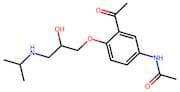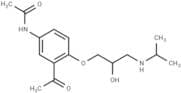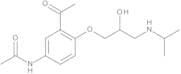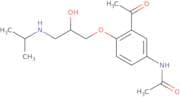
CAS 22568-64-5
:Diacetolol
- (1)-N-(3-Acetyl-4-(2-hydroxy-3-((1-methylethyl)amino)propoxy)phenyl)acetamide
- (RS)-1-(2-Acetyl-4-acetamidophenoxy)-2-hydroxy-3-isopropylaminopropane
- 1-(4-Acetamido-2-acetylphenoxy)-2-hydroxy-3-isopropylaminopropane
- <span class="text-smallcaps">DL</span>-1-(2-Acetyl-4-acetamidophenoxy)-2-hydroxy-3-isopropylaminopropane
- Acetamide, N-(3-acetyl-4-(2-hydroxy-3-((1-methylethyl)amino)propoxy)phenyl)-, (+-)-
- Acetanilide, 3'-acetyl-4'-(2-hydroxy-3-(isopropylamino)propoxy)-, DL- (8CI)
- Acetanilide, 3′-acetyl-4′-[2-hydroxy-3-(isopropylamino)propoxy]-, <span class="text-smallcaps">DL</span>-
- Acetylacebutolol
- Brn 2156350
- DL-1-(2-Acetyl-4-acetamidophenoxy)-2-hydroxy-3-isopropylaminopropane
- Diacetol
- Diacetolol
- Diacetolol [INN:BAN]
- Diacetololum
- Diacetololum [INN-Latin]
- M and B 16942
- N-{3-acetyl-4-[2-hydroxy-3-(propan-2-ylamino)propoxy]phenyl}acetamide
- Unii-4Er0Cz5G7C
- N-[3-Acetyl-4-[2-hydroxy-3-[(1-methylethyl)amino]propoxy]phenyl]acetamide
- Weitere Synonyme anzeigen
Acebutolol Related Compound B (N-{3-Acetyl-4-[2-hydroxy-3-(isopropylamino)propoxy]phenyl}acetamide)
CAS:Compounds containing a pyrimidine ring (whether or notFormel:C16H24N2O4Farbe und Form:PowderMolekulargewicht:308.17361Diacetolol
CAS:Diacetolol is the major metabolite of acebutolol, a selective beta blockers used to treat hypertension, angina pectoris and arrhythmia.Formel:C16H24N2O4Farbe und Form:SolidMolekulargewicht:308.37rac Diacetolol
CAS:Kontrolliertes ProduktImpurity Acebutolol EP Impurity B/ Acebutolol USP RC B
Applications The principal metabolite of Acebutolol (A123800) with less β-adrenoceptor blocking potency but greater cardioselectivity (atrial relative to tracheal tissue. Acebutolol EP Impurity B.
References Basil, B. et al.: Nouv. Pres, Med., 7, 3258 (1978); Choi, S. et al.: Arch. Pharm. Res., 25, 541 (2002); Basil, B. et al.: Eur. J. Pharmacol., 80, 47 (1982);Formel:C16H24N2O4Farbe und Form:NeatMolekulargewicht:308.37rac-Diacetolol
CAS:Rac-Diacetolol is a racemic mixture of two isomers, (+) and (-), of acebutolol. Rac-Diacetolol is used to treat bowel disease, chronic oral inflammation and cardiac arrhythmias. It is also used as an experimental solubility probe in the study of the interactions between drugs and biological membranes. Rac-Diacetolol has been shown to have a low affinity for cytochrome P450 enzymes, which are responsible for metabolizing many drugs in the body. Rac-Diacetolol has been found to reduce plasma concentrations of PCSK9 antibody in patients with inflammatory bowel disease. The drug also has anti-inflammatory properties that may be due to its inhibition of prostaglandin synthesis.
Formel:C16H24N2O4Reinheit:Min. 95%Farbe und Form:PowderMolekulargewicht:308.37 g/molRef: 10-F601069
50mg552,00€100mg785,00€250mg1.072,00€500mg1.532,00€1g1.938,00€2.5g3.727,00€5g5.469,00€