CAS 22996-18-5
:4-Chlor-2-nitrobenzylalkohol
Beschreibung:
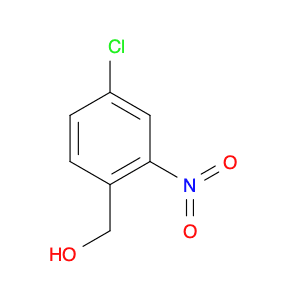
4-Chlor-2-nitrobenzylalkohol, mit der CAS-Nummer 22996-18-5, ist eine organische Verbindung, die durch das Vorhandensein eines chlorierten und nitro-substituierten Benzolrings, der an eine Hydroxymethylgruppe gebunden ist, gekennzeichnet ist. Diese Verbindung erscheint typischerweise als Feststoff bei Raumtemperatur und ist aufgrund der Hydroxylgruppe in polaren Lösungsmitteln löslich, die an Wasserstoffbrückenbindungen teilnehmen kann. Die chlorierten und nitro Gruppen tragen zu ihrer Reaktivität bei, was sie zu einem potenziellen Zwischenprodukt in der organischen Synthese macht, insbesondere bei der Herstellung von Arzneimitteln und Agrochemikalien. Das Vorhandensein der Nitrogruppe verleiht oft elektrophile Eigenschaften, während die Chlorguppe nucleophile Substitutionsreaktionen erleichtern kann. Sicherheitsdaten zeigen, dass sie mit Vorsicht behandelt werden sollte, da sie Gesundheitsrisiken bei Exposition darstellen kann. Insgesamt ist 4-Chlor-2-nitrobenzylalkohol eine wertvolle Verbindung in der synthetischen organischen Chemie, mit Anwendungen, die ihre einzigartigen funktionellen Gruppen nutzen.
Formel:C7H6ClNO3
InChl:InChI=1S/C7H6ClNO3/c8-6-2-1-5(4-10)7(3-6)9(11)12/h1-3,10H,4H2
InChI Key:InChIKey=OAHGNOHGHOTZQU-UHFFFAOYSA-N
SMILES:N(=O)(=O)C1=C(CO)C=CC(Cl)=C1
Synonyme:- (4-Chloro-2-Nitrophenyl)Methanol
- (4-Chloro-3-Nitrophenyl)Methanol
- 4-Chloro-2-nitrobenzenemethanol
- Benzenemethanol, 4-chloro-2-nitro-
- Benzyl alcohol, 4-chloro-2-nitro-
- 4-Chloro-2-nitrobenzyl alcohol
Sortieren nach
Reinheit (%)
0
100
|
0
|
50
|
90
|
95
|
100
5 Produkte.
(4-Chloro-2-nitrophenyl)methanol
CAS:Formel:C7H6ClNO3Reinheit:97%Farbe und Form:SolidMolekulargewicht:187.58044-Chloro-2-nitrobenzyl alcohol
CAS:4-Chloro-2-nitrobenzyl alcoholFormel:C7H6ClNO3Reinheit:97%Farbe und Form: beige solidMolekulargewicht:187.58g/mol4-Chloro-2-nitrobenzyl alcohol
CAS:4-Chloro-2-nitrobenzyl alcohol is an organic compound that is a reactive nucleophile and isomer. It undergoes slow reactions with water and other nucleophiles. The reactivity of 4-chloro-2-nitrobenzyl alcohol is dependent on the solvent, pH, and temperature. This chemical does not react with most substances, including proteins and carbohydrates. 4-Chloro-2-nitrobenzyl alcohol inhibits the growth of bacteria by reacting with bacterial cytoplasmic membrane lipids, which disrupts its integrity. 4-Chloro-2-nitrobenzyl alcohol also inhibits the synthesis of proteins in bacterial cells by binding to ribosomes and interfering with translation.Formel:C7H6ClNO3Reinheit:Min. 95%Molekulargewicht:187.58 g/mol