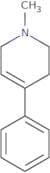
CAS 23007-85-4
:Pyridin, 1,2,3,6-tetrahydro-1-methyl-4-phenyl-, hydrochlorid (1:1)
Beschreibung:
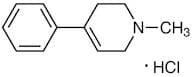
Pyridin, 1,2,3,6-tetrahydro-1-methyl-4-phenyl-, hydrochlorid (1:1), mit der CAS-Nummer 23007-85-4, ist eine chemische Verbindung, die zur Klasse der Tetrahydropyridin-Derivate gehört. Sie weist einen Pyridinring auf, der an bestimmten Positionen gesättigt wurde, was zu einer bicyclischen Struktur führt. Das Vorhandensein einer Methylgruppe und einer Phenylgruppe trägt zu ihren einzigartigen Eigenschaften bei, einschließlich potenzieller biologischer Aktivität. Als Hydrochloridsalz wird sie typischerweise in fester Form angetroffen, was ihre Löslichkeit in Wasser und anderen polaren Lösungsmitteln erhöht. Diese Verbindung kann verschiedene pharmakologische Wirkungen zeigen, was sie in der medizinischen Chemie von Interesse macht. Zu ihren Eigenschaften gehören ein relativ niedriger Schmelzpunkt und eine moderate Stabilität unter Standardbedingungen. Die Hydrochloridform wird häufig verwendet, um die Handhabungs- und Lagereigenschaften der Verbindung zu verbessern. Sicherheitsdaten sollten konsultiert werden, um eine ordnungsgemäße Handhabung zu gewährleisten, wie bei jeder chemischen Substanz, um sichere Laborpraktiken zu gewährleisten.
Formel:C12H15N·ClH
InChl:InChI=1S/C12H15N.ClH/c1-13-9-7-12(8-10-13)11-5-3-2-4-6-11;/h2-7H,8-10H2,1H3;1H
InChI Key:InChIKey=KOWJANGMTAZWDT-UHFFFAOYSA-N
SMILES:CN1CCC(=CC1)C2=CC=CC=C2.Cl
Synonyme:- 1-Methyl-4-Phenyl-1,2,3,6-Tetra-*Hydropyridine Hy
- 1-Methyl-4-Phenyl-1,2,3,6-Tetrahydropyridine Hydrochloride (1:1)
- 1-Methyl-4-phenyl-1,2,3,6-tetrahydropyridine hydrochloride
- Pyridine, 1,2,3,6-tetrahydro-1-methyl-4-phenyl-, hydrochloride
- Pyridine, 1,2,3,6-tetrahydro-1-methyl-4-phenyl-, hydrochloride (1:1)
Sortieren nach
Reinheit (%)
0
100
|
0
|
50
|
90
|
95
|
100
5 Produkte gefunden.
1-Methyl-4-phenyl-1,2,3,6-tetrahydropyridine Hydrochloride
CAS:Formel:C12H15N·HClReinheit:>98.0%(HPLC)Farbe und Form:White to Light yellow powder to crystalMolekulargewicht:209.72Pyridine, 1,2,3,6-tetrahydro-1-methyl-4-phenyl-, hydrochloride (1:1)
CAS:Formel:C12H16ClNReinheit:%Farbe und Form:SolidMolekulargewicht:209.7151MPTP hydrochloride
CAS:MPTP hydrochloride is a precursor of MPP+, a dopamine neurotoxin with blood-brain barrier permeability.Formel:C12H16ClNReinheit:96.35% - 99.98%Farbe und Form:SolidMolekulargewicht:209.72Ref: TM-T4081
5mg34,00€1mL*10mM (DMSO)50,00€10mg52,00€25mg80,00€50mg131,00€100mg177,00€200mg281,00€500mg447,00€1-Methyl-4-phenyl-1,2,3,6-tetrahydropyridine Hydrochloride
CAS:Kontrolliertes ProduktApplications 1-Methyl-4-phenyl-1,2,3,6-tetrahydropyridine hydrochloride is a dopaminergic neurotoxin that reportedly causes a severe and irreversible Parkinsonian condition in humans and monkeys.
Not a dangerous good if item is equal to or less than 1g/ml and there is less than 100g/ml in the package
References Burns, R.S., et al.: Proc. Natl. Acad.Sci. USA, 80, 4546 (1983), Langston, J.W., et al.: Science, 219, 979 (1983), Mogi, M., et al.: Neurosci. Lett., 250, 25 (1998), Przedborski, S. and Jackson-Lewis, V., Mov. Disord., 13, 35 (1998),Formel:C12H15N·ClHFarbe und Form:NeatMolekulargewicht:209.721-Methyl-4-phenyl-1,2,3,6-tetrahydropyridine hydrochloride
CAS:Kontrolliertes Produkt1-Methyl-4-phenyl-1,2,3,6-tetrahydropyridine hydrochloride (MPTP) is a neurotoxin that causes Parkinson's disease in humans and animals. It is an analog of dopamine, which blocks the enzyme that breaks down dopamine. MPTP causes degeneration of dopaminergic neurons in the substantia nigra pars compacta, leading to clinical symptoms such as bowel disease, loss of motor control, and mood disorders. MPTP also affects the neurotransmitter gamma-aminobutyric acid (GABA), by inhibiting its production and release from nerve cells. The result is neuronal death through oxidative stress and inflammation. This drug has been shown to cause locomotor activity impairment in rats and mice due to its effect on the caudate putamen region of the brain. The clinical relevance of this finding is not yet known. MPTP is a neurotoxin that mimics natural compounds found in plants such asFormel:C12H15N·HClReinheit:Min 98%Farbe und Form:White PowderMolekulargewicht:209.71 g/mol