CAS 2306-33-4
:Monoethylphthalat
Beschreibung:
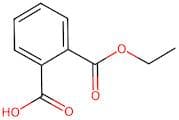
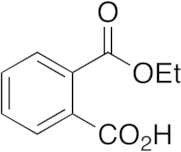
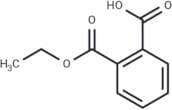
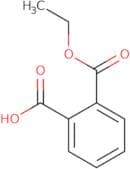
Monoethylphthalat (MEP), mit der CAS-Nummer 2306-33-4, ist eine organische Verbindung, die zur Familie der Phthalate gehört, die Ester der Phthalsäure sind. MEP zeichnet sich durch seine farb- und geruchlose Flüssigkeitsform aus und ist in organischen Lösungsmitteln löslich, hat jedoch eine begrenzte Löslichkeit in Wasser. Es wird hauptsächlich als Weichmacher bei der Herstellung von Polyvinylchlorid (PVC) und anderen Polymeren verwendet, wodurch deren Flexibilität und Haltbarkeit verbessert werden. MEP wird auch in verschiedenen Verbrauchermaterialien eingesetzt, darunter Kosmetika, Körperpflegeprodukte und Klebstoffe. In Bezug auf die chemische Struktur besteht MEP aus einem Phthalat-Rückgrat mit einer Ethylgruppe, die an eine der Carboxylgruppen gebunden ist, was seine physikalischen und chemischen Eigenschaften beeinflusst. Obwohl MEP als wenig akut toxisch gilt, wurden Bedenken hinsichtlich seiner potenziellen endokrinen disruptiven Wirkungen und seiner Umweltpersistenz geäußert. Regulierungsbehörden überwachen seine Verwendung, insbesondere in Produkten, die mit Lebensmitteln in Kontakt kommen oder von Kindern verwendet werden können.
Formel:C10H10O4
InChl:InChI=1S/C10H10O4/c1-2-14-10(13)8-6-4-3-5-7(8)9(11)12/h3-6H,2H2,1H3,(H,11,12)
InChI Key:InChIKey=YWWHKOHZGJFMIE-UHFFFAOYSA-N
SMILES:C(OCC)(=O)C1=C(C(O)=O)C=CC=C1
Synonyme:- 1,2-Benzenedicarboxylic Acid, Monoethyl Ester
- 1,2-Benzenedicarboxylic acid, 1-ethyl ester
- Ethyl 2-carboxybenzoate
- Monoethyl phthalate
- Phthalic acid, ethyl ester
- Phthalic acid, monoethyl ester
Sortieren nach
Reinheit (%)
0
100
|
0
|
50
|
90
|
95
|
100
8 Produkte.
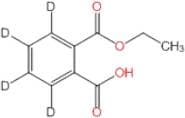
mono-Ethyl Phthalate-3,4,5,6-d4
CAS:Formel:HOOCC6D4COOCH2CH3Reinheit:99 atom % DFarbe und Form:White SolidMolekulargewicht:198.08302Monoethyl Phthalate
CAS:Kontrolliertes ProduktApplications Phthalate metabolite.
References Engel, S., et al.: NeuroToxicol., 30, 522 (2009), Aylward, L., et al.: Reg. Toxicol. Pharmacol., 55, 259 (2009), Blair, J., et al.: Environ., Sci. Technol., 43, 6262 (2009),Formel:C10H10O4Farbe und Form:Light Pink To Off-WhiteMolekulargewicht:194.18Monoethyl Phthalate-d9
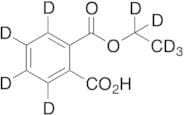
CAS:Kontrolliertes ProduktApplications Monoethyl-d5 Phthalate-d4 is an isotope labeled analog of Monoethyl Phthalate, which is a Phthalate metabolite.
References Engel, S., et al.: NeuroToxicol., 30, 522 (2009), Aylward, L., et al.: Reg. Toxicol. Pharmacol., 55, 259 (2009), Blair, J., et al.: Environ., Sci. Technol., 43, 6262 (2009),Formel:C10HD9O4Farbe und Form:Colourless OilyMolekulargewicht:203.24Monoethyl phthalate
CAS:Monoethyl phthalate: diethyl phthalate metabolite, urinary biomarker for exposure, linked to thyroid issues.Formel:C10H10O4Reinheit:99.79%Farbe und Form:SolidMolekulargewicht:194.18Ref: TM-T39836
2mg35,00€5mg52,00€10mg74,00€25mg137,00€50mg188,00€100mg283,00€500mg697,00€1mL*10mM (DMSO)52,00€Monoethyl phthalate
CAS:Monoethyl phthalate is a hydroxylated phthalic acid ester that is used in wastewater treatment. The compound is an endocrine disruptor and has been shown to cause allergic symptoms, such as dermatitis and asthma, in infants. It also affects maternal blood and can cause phthalate syndrome in humans. Monoethyl phthalate is a carcinogen and has been shown to cause adrenocortical carcinoma in rats. This compound also increases body mass index (BMI) in humans and decreases the glomerular filtration rate (GFR). Monoethyl phthalate can be detected by high performance liquid chromatography (HPLC) or gas chromatography-mass spectrometry (GC-MS) using analytical methods such as sample preparation and granulosa cells for analysis.Formel:C10H10O4Reinheit:Min. 95%Farbe und Form:White PowderMolekulargewicht:194.18 g/mol