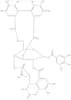
CAS 23094-71-5
:Chebulaginsäure
Beschreibung:
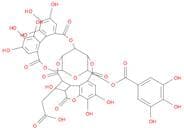
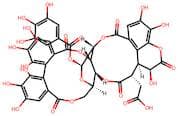
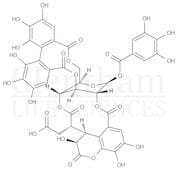
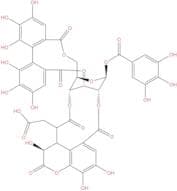
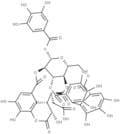
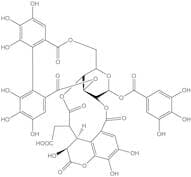
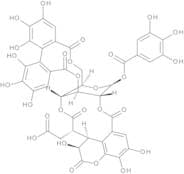
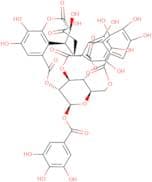
Chebulaginsäure ist eine natürlich vorkommende polyphenolische Verbindung, die hauptsächlich in der Frucht des Terminalia chebula-Baums vorkommt, der häufig in der traditionellen Medizin verwendet wird. Es wird als Tannin klassifiziert und ist bekannt für seine antioxidativen Eigenschaften, die zu seinen potenziellen gesundheitlichen Vorteilen beitragen. Die chemische Struktur von Chebulaginsäure weist mehrere Hydroxylgruppen auf, die seine Fähigkeit verbessern, freie Radikale zu scavengen und entzündungshemmende Wirkungen zu zeigen. Diese Verbindung hat Interesse für ihre potenziellen therapeutischen Anwendungen geweckt, einschließlich ihrer Rolle bei der Förderung der Verdauungsgesundheit und ihrer möglichen krebsbekämpfenden Eigenschaften. Darüber hinaus kann Chebulaginsäure verschiedene biochemische Wege beeinflussen, was es zu einem Forschungsgegenstand in der Pharmakologie und Nutraceuticals macht. Seine Löslichkeit in Wasser und organischen Lösungsmitteln variiert, was seine Bioverfügbarkeit und Wirksamkeit in verschiedenen Formulierungen beeinflussen kann. Insgesamt stellt Chebulaginsäure ein bedeutendes Studienfeld in der Chemie natürlicher Produkte und deren Auswirkungen auf Gesundheit und Wohlbefinden dar.
Formel:C41H30O27
InChl:InChI=1S/C41H30O27/c42-13-1-8(2-14(43)24(13)49)35(56)68-41-34-33-31(64-39(60)12(6-19(47)48)22-23-11(38(59)67-34)5-17(46)27(52)32(23)65-40(61)30(22)55)18(63-41)7-62-36(57)9-3-15(44)25(50)28(53)20(9)21-10(37(58)66-33)4-16(45)26(51)29(21)54/h1-5,12,18,22,30-31,33-34,41-46,49-55H,6-7H2,(H,47,48)
InChI Key:InChIKey=HGJXAVROWQLCTP-UHFFFAOYSA-N
SMILES:C(C(O)=O)C1C2C=3C(C(=O)OC4C5C(OC1=O)C(OC4OC(=O)C6=CC(O)=C(O)C(O)=C6)COC(=O)C=7C(C=8C(C(=O)O5)=CC(O)=C(O)C8O)=C(O)C(O)=C(O)C7)=CC(O)=C(O)C3OC(=O)C2O
Synonyme:- 10,24-(Epoxymethano)-11H-dibenzo[8,9:10,11][1,6]dioxacyclododecino[2,3-d]pyrano[4,3,2-ij][2,6]benzodioxacycloundecin, β-D-glucopyranose deriv.
- Chebulagic acid
- β-D-Glucopyranose, cyclic 3,6-[(1R)-4,4′,5,5′,6,6′-hexahydroxy[1,1′-biphenyl]-2,2′-dicarboxylate] 1-(3,4,5-trihydroxybenzoate), cyclic 2→5:4→1-ester with (2S)-[(3S,4S)-5-carboxy-3,4-dihydro-3,7,8-trihydroxy-2-oxo-2H-1-benzopyran-4-yl]butanedioic acid
- β-D-Glucopyranose, cyclic 3,6-[(1R)-4,4′,5,5′,6,6′-hexahydroxy[1,1′-biphenyl]-2,2′-dicarboxylate] 1-(3,4,5-trihydroxybenzoate), cyclic 2→2:4→1-ester with (2S)-[(3S,4S)-5-carboxy-3,4-dihydro-3,7,8-trihydroxy-2-oxo-2H-1-benzopyran-4-yl]butanedioic acid
- β-D-Glucopyranose, cyclic 3,6-[(1R)-4,4′,5,5′,6,6′-hexahydroxy[1,1′-biphenyl]-2,2′-dicarboxylate] 1-(3,4,5-trihydroxybenzoate), cyclic 2→2:4→1-ester with (2S)-2-[(3S,4S)-5-carboxy-3,4-dihydro-3,7,8-trihydroxy-2-oxo-2H-1-benzopyran-4-yl]butanedioic acid
Sortieren nach
Reinheit (%)
0
100
|
0
|
50
|
90
|
95
|
100
10 Produkte.
Chebulagic Acid
CAS:Other glycosides, natural or reproduced by synthesis, and their salts, ethers, esters and other derivativesFormel:C41H30O27Farbe und Form:Off-White PowderMolekulargewicht:954.09745Chebulagic acid
CAS:Formel:C41H30O27Reinheit:≥ 95.0%Farbe und Form:White, off-white or pale brown powderMolekulargewicht:954.66Chebulagic acid
CAS:Chebulagic acid, isolated from the fruits of Terminalia, it shows potent COX–LOX dual inhibition activity with IC50 values of 15 ± 0.288, 0.92 ± 0.011 and 2.1 ± 0.057 μM for COX-1, COX-2 and 5-LOX respectively, it also shows anti-proliferative activity against HCT-15, COLO-205, MDA-MB-231, DU-145 and K562 cell lines, it induces apoptosis in COLO-205 cell line.Formel:C41H30O27Reinheit:95%~99%Farbe und Form:PowderMolekulargewicht:954.664Chebulagic acid
CAS:Chebulagic acid, isolated from the Terminalia chebula Retz, is a COX-LOX dual inhibitor.Formel:C41H30O27Reinheit:97.82% - 99.8%Farbe und Form:SolidMolekulargewicht:954.66Ref: TM-TQ0180
1mg74,00€5mg157,00€10mg225,00€1mL*10mM (DMSO)244,00€25mg376,00€50mg560,00€100mg798,00€Chebulagic acid
CAS:Natural glycosideFormel:C41H30O27Reinheit:≥ 90.0 % (HPLC)Farbe und Form:PowderMolekulargewicht:954.67Chebulagic acid
CAS:Kontrolliertes ProduktChebulagic acid is a type of polyphenolic compound, which is derived from the dried fruits of the Terminalia chebula plant, an important species in traditional medicine practices such as Ayurveda. This compound exhibits significant bioactivity primarily due to its antioxidant and anti-inflammatory properties. The mode of action of chebulagic acid involves the scavenging of free radicals and modulation of oxidative stress pathways, thereby protecting cells from oxidative damage.Formel:C41H30O27Reinheit:Min. 95%Farbe und Form:PowderMolekulargewicht:954.66 g/mol