

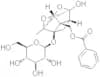
CAS 23180-57-6
:Paeoniflorin
Beschreibung:
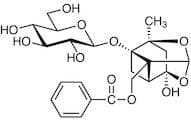
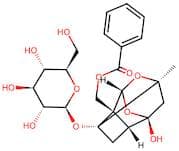
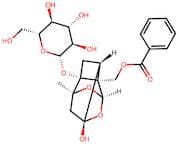
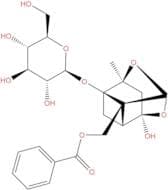
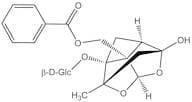
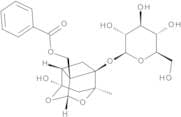
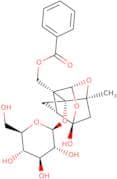
Paeoniflorin ist eine natürliche Verbindung, die hauptsächlich aus den Wurzeln der Pfingstrosenpflanze, insbesondere Paeonia lactiflora, extrahiert wird. Es wird als Monoterpen-Glykosid klassifiziert und ist bekannt für seine verschiedenen pharmakologischen Eigenschaften. Paeoniflorin zeigt entzündungshemmende, schmerzlindernde und neuroprotektive Wirkungen, was es in der traditionellen Medizin und der modernen Pharmakologie von Interesse macht. Die Verbindung wird häufig auf ihr potenzielles therapeutisches Anwendungsspektrum bei Erkrankungen wie Schmerzen, Angstzuständen und neurodegenerativen Krankheiten untersucht. In Bezug auf seine chemische Struktur besteht Paeoniflorin aus einem Glukoseanteil, der mit einer phenolischen Verbindung verbunden ist, was zu seiner biologischen Aktivität beiträgt. Es ist typischerweise in Wasser löslich und zeigt Stabilität unter verschiedenen pH-Bedingungen. Darüber hinaus hat sich gezeigt, dass Paeoniflorin verschiedene Signalwege moduliert, was sein Potenzial als therapeutisches Mittel erhöht. Sein Sicherheitsprofil ist im Allgemeinen günstig, aber weitere Forschungen sind notwendig, um seine Wirkmechanismen und potenziellen Nebenwirkungen vollständig zu verstehen.
Formel:C23H28O11
InChl:InChI=1S/C23H28O11/c1-20-9-22(29)13-7-23(20,32-18-16(27)15(26)14(25)12(8-24)31-18)21(13,19(33-20)34-22)10-30-17(28)11-5-3-2-4-6-11/h2-6,12-16,18-19,24-27,29H,7-10H2,1H3/t12-,13-,14-,15+,16-,18+,19-,20+,21+,22-,23+/m1/s1
InChI Key:InChIKey=YKRGDOXKVOZESV-WRJNSLSBSA-N
SMILES:C(OC(=O)C1=CC=CC=C1)[C@@]23[C@@]4(O[C@@H]5O[C@H](CO)[C@@H](O)[C@H](O)[C@H]5O)[C@@]6(C)O[C@@]2(O[C@@](O)([C@@]3(C4)[H])C6)[H]
Synonyme:- (1aR,2S,3aR,5R,5aR,5bS)-5b-[(Benzoyloxy)methyl]tetrahydro-5-hydroxy-2-methyl-2,5-methano-1H-3,4-dioxacyclobuta[cd]pentalen-1a(2H)-yl β-<span class="text-smallcaps">D</span>-glucopyranoside
- 2,5-Methano-1H-3,4-dioxacyclobuta[cd]pentalene, β-<span class="text-smallcaps">D</span>-glucopyranoside deriv.
- Nsc 178886
- Paeoniflorin
- Peoniflorin
- β-<span class="text-smallcaps">D</span>-Glucopyranoside, (1aR,2S,3aR,5R,5aR,5bS)-5b-[(benzoyloxy)methyl]tetrahydro-5-hydroxy-2-methyl-2,5-methano-1H-3,4-dioxacyclobuta[cd]pentalen-1a(2H)-yl
- β-<span class="text-smallcaps">D</span>-Glucopyranoside, 5b-[(benzoyloxy)methyl]tetrahydro-5-hydroxy-2-methyl-2,5-methano-1H-3,4-dioxacyclobuta[cd]pentalen-1a(2H)-yl, [1aR-(1aα,2β,3aα,5α,5aα,5bα)]-
- β-D-Glucopyranosid, 5b-[(Benzoyloxy)methyl]tetrahydro-5-hydroxy-2-methyl-2,5-methano-1H-3,4-dioxacyclobuta[cd]pentalen-1a(2H)-yl, [1aR-(1aα,2β,3aα,5α,5aα,5ba)]-
- β-D-Glucopyranoside, 5b-[(benzoyloxy)methyl]tetrahydro-5-hydroxy-2-methyl-2,5-methano-1H-3,4-dioxacyclobuta[cd]pentalen-1a(2H)-yl, [1aR-(1aα,2β,3aα,5α,5aα,5bα)]-
- β-D-glucopiranosido, 5b-[(benzoiloxi)metil]tetrahidro-5-hidroxi-2-metil-2,5-metano-1H-3,4-dioxaciclobuta[cd]pentalen-1a(2H)-il, [1aR-(1aα,2β,3aα,5α,5aα,5bα)]-
- β-D-glucopyrannoside, [(benzoyloxy)methyl]-5b tetrahydrohydroxy-5 methyl-2 methano-2,5 1H-dioxacyclo-3,4 buta[cd]pentalenyl 1a(2H), [1aR-(1aα,2β,3aα,5α,5aα,5bα)]-
- Paeoniflorm
- (1aR,2S,3aR,5R,5aR,5bS)-5b-[(Benzoyloxy)methyl]tetrahydro-5-hydroxy-2-methyl-2,5-methano-1H-3,4-dioxacyclobuta[cd]pentalen-1a(2H)-yl β-D-glucopyranoside
- [(3S,3aR,6S,7aR)-3-(beta-D-glucopyranosyloxy)-7a-hydroxy-6-methyloctahydro-2,6-epoxy-1-benzofuran-3-yl]methyl benzoate
- Reishi Mushroom
- [(1aR,2R,3aR,5S,5aR,5bS)-1a-(beta-D-glucopyranosyloxy)-5-hydroxy-2-methyltetrahydro-1H-2,5-methano-3,4-dioxacyclobuta[cd]pentalen-5b(3aH)-yl]methyl benzoate
- [1a-(hexopyranosyloxy)-5-hydroxy-2-methyltetrahydro-1H-2,5-methano-3,4-dioxacyclobuta[cd]pentalen-5b(3aH)-yl]methyl benzoate
- [(1aR,2S,3aR,5R,5aR)-1a-(beta-D-glucopyranosyloxy)-5-hydroxy-2-methyltetrahydro-1H-2,5-methano-3,4-dioxacyclobuta[cd]pentalen-5b(3aH)-yl]methyl benzoate
- 2,5-Methano-1H-3,4-dioxacyclobuta[cd]pentalene, β-D-glucopyranoside deriv.
- Reishi Mushroom Extract
- [(1aR,2S,3aR,5R,5aR,5bS)-1a-(beta-D-glucopyranosyloxy)-5-hydroxy-2-methyltetrahydro-1H-2,5-methano-3,4-dioxacyclobuta[cd]pentalen-5b(3aH)-yl]methyl benzoate
- Weitere Synonyme anzeigen
Sortieren nach
Reinheit (%)
0
100
|
0
|
50
|
90
|
95
|
100
16 Produkte.
Paeoniflorin
CAS:Formel:C23H28O11Reinheit:>95.0%(NMR)Farbe und Form:White to Almost white powder to crystalMolekulargewicht:480.47Paeoniflorin
CAS:Other glycosides, natural or reproduced by synthesis, and their salts, ethers, esters and other derivativesFormel:C23H28O11Farbe und Form:Off-White White PowderMolekulargewicht:480.16316Paeoniflorin
CAS:Paeoniflorin, a novel heat shock protein-inducing compound, is mediated by the activation of heat shock transcription factor 1 (HSF1), which has antiallergic, anti-obesity, anti-inflammatory and immunoregulatory effects. Paeoniflorin can activate PI3K/Akt signaling pathway to protect the PC12 cell injury induced by Aβ25-35, it protects thymocytes against irradiation-induced cell damage by scavenging ROS and attenuating the activation of the mitogen-activated protein kinases.Formel:C23H28O11Reinheit:95%~99%Molekulargewicht:480.466Paeoniflorin
CAS:Paeoniflorin (Peoniflorin) is a herbal constituent extracted from the root of Paeonia albiflora Pall.Formel:C23H28O11Reinheit:96.9% - 97.43%Farbe und Form:White Fine PowderMolekulargewicht:480.46Paeoniflorin
CAS:Natural glycosideFormel:C23H28O11Reinheit:≥ 90.0 % (HPLC)Farbe und Form:PowderMolekulargewicht:480.47Paeoniflorin (>80%)
CAS:Kontrolliertes ProduktApplications Paeoniflorin is an active compound of the Paeonia root. Paeoniflorin inhibits Aβ25-35-induced mitochondrial dysfunction, which includes decreased mitochondrial membrane potential, increased Bax/Bcl-2 ratio, cytochrome c release and activity of caspase-3 and caspase-9. Paeoniflorin could attenuate or restore the viability loss, apoptotic increase, and ROS production induced by Aβ25-35 in SH-SY5Y cells.
References Yuan,Y., et. al.: Int. J. Mol. Sci., 14, 18502 (2013); Wang, K., et. al.: Cell Mol. Neurobiol., 34, 227 (2014)Formel:C23H28O11Reinheit:>80%Farbe und Form:NeatMolekulargewicht:480.46Paeoniflorin
CAS:Paeoniflorin is a bioactive compound, which is a monoterpene glycoside derived from the roots of Paeonia lactiflora, commonly known as peony. This compound functions through multiple mechanisms, including the modulation of calcium channels, the inhibition of the production of pro-inflammatory cytokines, and the regulation of neurotransmitter levels. It effectively exhibits anti-inflammatory and immunomodulatory effects.Formel:C23H28O11Reinheit:Min. 95%Farbe und Form:White PowderMolekulargewicht:480.46 g/molb-D-Glucopyranoside,(1aR,2S,3aR,5R,5aR,5bS)-5b-[(benzoyloxy)methyl]tetrahydro-5-hydroxy-2-methyl-2,5-methano-1H-3,4-dioxacyclobuta[cd]pentalen-1a(2H)-yl
CAS:Formel:C23H28O11Reinheit:95%Farbe und Form:SolidMolekulargewicht:480.4618Paeoniflorin
CAS:PaeoniflorinFormel:C23H28O11Reinheit:88.6%Farbe und Form:Off-WhiteMolekulargewicht:480.16316














![b-D-Glucopyranoside,(1aR,2S,3aR,5R,5aR,5bS)-5b-[(benzoyloxy)methyl]tetrahydro-5-hydroxy-2-methyl-2…](/_next/image/?url=https%3A%2Fstatic.cymitquimica.com%2Fproducts%2FIN%2Fthumb%2FDA00I4J3.jpg&w=3840&q=75)

