CAS 232951-83-6
:2-Chlornicotinat-tert-butylester
Beschreibung:
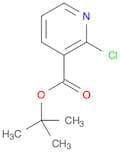
2-Chlornicotinat-tert-butylester ist eine organische Verbindung, die durch ihre Struktur gekennzeichnet ist, die eine tert-Butylgruppe und eine Chlor-Nicotinat-Einheit umfasst. Es ist ein Derivat der Nikotinsäure, bei dem das Wasserstoffatom an der Position 2 durch ein Chloratom ersetzt ist und die Carbonsäuregruppe mit tert-Butanol verestert ist. Diese Verbindung erscheint typischerweise als farblose bis blassgelbe Flüssigkeit oder Feststoff, abhängig von ihrer Reinheit und Temperatur. Sie ist bekannt für ihre potenziellen Anwendungen in der medizinischen Chemie, insbesondere bei der Synthese verschiedener bioaktiver Moleküle. Die Anwesenheit des Chloratoms kann ihre Reaktivität und biologische Aktivität beeinflussen, was sie zu einem interessanten Thema in der Arzneimittelentwicklung macht. Darüber hinaus kann 2-Chlornicotinat-tert-butylester eine moderate Löslichkeit in organischen Lösungsmitteln aufweisen, während ihre Stabilität durch Umweltbedingungen wie Licht und Feuchtigkeit beeinträchtigt werden kann. Wie bei vielen organischen Verbindungen sind eine ordnungsgemäße Handhabung und Sicherheitsvorkehrungen aufgrund der potenziellen Toxizität und Reaktivität unerlässlich.
Sortieren nach
Reinheit (%)
0
100
|
0
|
50
|
90
|
95
|
100
4 Produkte.
3-Pyridinecarboxylic acid, 2-chloro-, 1,1-dimethylethyl ester
CAS:Formel:C10H12ClNO2Reinheit:98%Farbe und Form:LiquidMolekulargewicht:213.6608tert-Butyl 2-chloronicotinate
CAS:tert-Butyl 2-chloronicotinateReinheit:97%Molekulargewicht:213.66g/moltert-Butyl 2-chloronicotinate
CAS:tert-Butyl 2-chloronicotinate is an activated synthetic molecule that activates the nucleophile of an amide or a proton. It has been shown to be a biomimetic and can be used in catalysis. Activation of tert-Butyl 2-chloronicotinate is accomplished by a nucleophilic attack on the carbonyl carbon atom, followed by proton transfer from the leaving group to the electrophilic carbon atom. The tertiary butyl group of this compound is activated as a nucleophile and is capable of transferring its proton to either an amide or a proton. The chloro substituent on tert-Butyl 2-chloronicotinate can also act as a ligand for metal ions, which facilitates catalytic reactions.Formel:C10H12ClNO2Reinheit:Min. 95%Molekulargewicht:213.66 g/mol