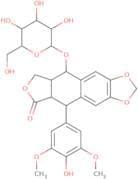
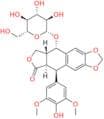
CAS 23363-35-1
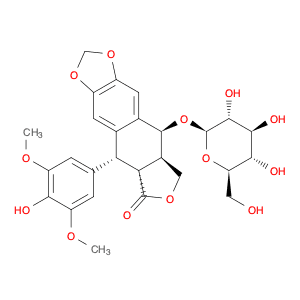
:4-Demethylepipodophyllotoxin 7′-O-β-D-glucopyranosid
Beschreibung:
4-Demethylepipodophyllotoxin 7′-O-β-D-glucopyranosid ist eine chemische Verbindung, die aus Podophyllotoxin abgeleitet ist, einem Naturprodukt, das aus den Wurzeln der Podophyllum-Pflanze gewonnen wird. Diese Verbindung zeichnet sich durch ihre Glykosidstruktur aus, die ein Glucopyranosid-Moiety enthält, das an der 7′-Position des Epipodophyllotoxin-Rückgrats angebracht ist. Sie zeigt bemerkenswerte biologische Aktivität, insbesondere in ihrem Potenzial als Antikrebsmittel, da sie die Zellteilung hemmen kann, indem sie in die Dynamik der Mikrotubuli eingreift. Die Verbindung ist auch von Interesse in der medizinischen Chemie aufgrund ihrer strukturellen Modifikationen, die ihre therapeutische Wirksamkeit verbessern und die Toxizität im Vergleich zu ihrem Ausgangsprodukt reduzieren können. Ihre Löslichkeit und Stabilität in biologischen Systemen werden durch die Glykosylierung beeinflusst, die ihre Pharmakokinetik und Bioverfügbarkeit beeinflussen kann. Als chemische Entität wird sie typischerweise im Kontext der Arzneimittelentwicklung und der Naturstoffchemie untersucht, was zum Verständnis pflanzenbasierter Verbindungen in der Pharmakologie beiträgt.
Formel:C27H30O13
InChl:InChI=1S/C27H30O13/c1-34-16-3-10(4-17(35-2)21(16)29)19-11-5-14-15(38-9-37-14)6-12(11)25(13-8-36-26(33)20(13)19)40-27-24(32)23(31)22(30)18(7-28)39-27/h3-6,13,18-20,22-25,27-32H,7-9H2,1-2H3/t13-,18+,19+,20-,22+,23-,24+,25+,27-/m0/s1
InChI Key:InChIKey=FOVRGQUEGRCWPD-BRLGUANISA-N
SMILES:O=C1[C@@]2([C@@H](C=3C([C@@H](O[C@@H]4O[C@H](CO)[C@@H](O)[C@H](O)[C@H]4O)[C@]2(CO1)[H])=CC5=C(C3)OCO5)C6=CC(OC)=C(O)C(OC)=C6)[H]
Synonyme:- Furo[3′,4′:6,7]naphtho[2,3-d]-1,3-dioxol-6(5aH)-one, 9-(β-D-glucopyranosyloxy)-5,8,8a,9-tetrahydro-5-(4-hydroxy-3,5-dimethoxyphenyl)-, [5R-(5α,5aβ,8aα,9β)]-
- Glucopyranoside, 4′-demethylepipodophyllotoxin, β-D-
- Epipodophyllotoxin, 4′-demethyl-, 9-β-D-glucopyranoside
- (5R,5aR,8aR,9S)-9-(β-D-Glucopyranosyloxy)-5,8,8a,9-tetrahydro-5-(4-hydroxy-3,5-dimethoxyphenyl)furo[3′,4′:6,7]naphtho[2,3-d]-1,3-dioxol-6(5aH)-one
- Furo[3′,4′:6,7]naphtho[2,3-d]-1,3-dioxol-6(5aH)-one, 9-(β-D-glucopyranosyloxy)-5,8,8a,9-tetrahydro-5-(4-hydroxy-3,5-dimethoxyphenyl)-, (5R,5aR,8aR,9S)-
Sortieren nach
Reinheit (%)
0
100
|
0
|
50
|
90
|
95
|
100
7 Produkte.
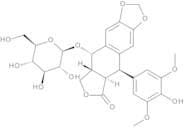
Lignan P ((5R,5aR,8aR,9S)-9-(β-D-glucopyranosyloxy)-5-(4-hydroxy-3,5-dimethoxy phenyl) -5,8,8a,9 -tetrahydro[2]benzofuro-[5,6-f][1,3]benzodioxol-6(5aH)-one)
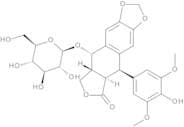
CAS:Lactones, nesoiFormel:C27H30O13Farbe und Form:White PowderMolekulargewicht:562.168644'-demethylepipodophyllotoxin-9 β-glucopyranoside
CAS:Formel:C27H30O13Reinheit:98%Farbe und Form:SolidMolekulargewicht:562.5193Etoposide EP Impurity D
CAS:Formel:C27H30O13Farbe und Form:White To Off-White SolidMolekulargewicht:562.52Lignan P
CAS:Lignan P is a phytoestrogen product composed of plant-derived lignans, primarily sourced from flaxseeds and other lignan-rich seeds. These compounds are classified under a group of polyphenolic substances found in high concentrations within the seeds and are notable for their antioxidant properties. The mode of action of Lignan P involves its conversion into enterolignans by gut microbiota, which can mimic the function of human estrogens by binding to estrogen receptors, thereby influencing estrogenic activity within the body. This ability to interact with estrogen pathways makes Lignan P a potential candidate for modulating hormone-related processes.Formel:C27H30O13Reinheit:Min. 95%Molekulargewicht:562.5 g/mol