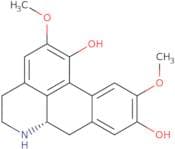
CAS 23599-69-1
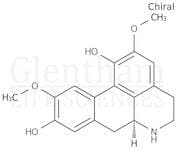
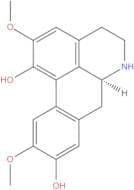
:(+)-Norisoboldin
Beschreibung:
(+)-Norisoboldin ist ein Alkaloid, das aus Pflanzenarten der Familie Amaryllidaceae gewonnen wird, die besonders für ihre Präsenz in verschiedenen Heilpflanzen bekannt sind. Es ist durch seine komplexe bicyclische Struktur gekennzeichnet, die eine phenolische Gruppe und einen stickstoffhaltigen Heterozyklus umfasst. Diese Verbindung zeigt eine Reihe biologischer Aktivitäten, einschließlich potenzieller entzündungshemmender und neuroprotektiver Wirkungen, was sie für die pharmakologische Forschung von Interesse macht. Die Stereochemie von (+)-Norisoboldin ist signifikant, da ihre spezifische optische Drehung ihre chirale Natur anzeigt, die ihre biologischen Interaktionen beeinflussen kann. Darüber hinaus ist sie in organischen Lösungsmitteln löslich, was ihre Extraktion und Reinigung aus pflanzlichen Quellen erleichtert. Die molekulare Formel der Verbindung spiegelt ihre Zusammensetzung aus Kohlenstoff, Wasserstoff, Stickstoff und Sauerstoff wider, was zu ihren vielfältigen chemischen Eigenschaften beiträgt. Die Forschung zu (+)-Norisoboldin untersucht weiterhin seine potenziellen therapeutischen Anwendungen, insbesondere im Kontext neurodegenerativer Erkrankungen und anderer Gesundheitszustände.
Formel:C18H19NO4
InChl:InChI=1/C18H19NO4/c1-22-14-8-11-10(6-13(14)20)5-12-16-9(3-4-19-12)7-15(23-2)18(21)17(11)16/h6-8,12,19-21H,3-5H2,1-2H3/t12-/m0/s1
InChI Key:InChIKey=HORZNQYQXBFWNZ-LBPRGKRZSA-N
SMILES:OC1=C2C=3[C@](CC=4C2=CC(OC)=C(O)C4)(NCCC3C=C1OC)[H]
Synonyme:- (+)-Laurelliptine
- (+)-N-Norisoboldine
- (6aS)-1,10-dimethoxy-5,6,6a,7-tetrahydro-4H-dibenzo[de,g]quinoline-2,9-diol
- (6aS)-2,10-Dimethoxy-5,6,6a,7-tetrahydro-4H-dibenzo[de,g]quinoline-1,9-diol
- (6aS)-5,6,6a,7-Tetrahydro-2,10-dimethoxy-4H-dibenzo[de,g]quinoline-1,9-diol
- (S)-(+)-Laurelliptine
- 4H-Dibenzo[de,g]quinoline-1,9-diol, 5,6,6a,7-tetrahydro-2,10-dimethoxy-, (S)-
- 4H-dibenzo[de,g]quinoline-1,9-diol, 5,6,6a,7-tetrahydro-2,10-dimethoxy-, (6aS)-
- 6aα-Noraporphine-1,9-diol, 2,10-dimethoxy-
- Norisoboldine, 98%, from Lindera aggregata (Sims) Kosterm.
- (+)-Norisoboldine
- Weitere Synonyme anzeigen
Sortieren nach
Reinheit (%)
0
100
|
0
|
50
|
90
|
95
|
100
9 Produkte.
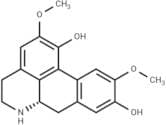
4H-Dibenzo[de,g]quinoline-1,9-diol, 5,6,6a,7-tetrahydro-2,10-dimethoxy-, (6aS)-
CAS:Formel:C18H19NO4Reinheit:99%Farbe und Form:SolidMolekulargewicht:313.3478(S)-2,10-Dimethoxy-5,6,6A,7-Tetrahydro-4H-Dibenzo[De,G]Quinoline-1,9-Diol
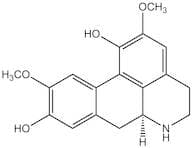
CAS:(S)-2,10-Dimethoxy-5,6,6A,7-Tetrahydro-4H-Dibenzo[De,G]Quinoline-1,9-DiolReinheit:98%Molekulargewicht:313.35g/molNorisoboldine
CAS:Norisoboldine is the main isoquinoline alkaloid occurring in Radix Linderae, the dry roots of Lindera aggregata (Lauraceae family),it has been previously implicated to be able to ameliorate the synovial inflammation and abnormal immune conditions in collagen-induced arthritis of mice; it inhibits the macrophage activation and the resultant production of pro-inflammatory cytokines via down-regulating the activation of MAPKs signaling pathways rather than NF-κB.Formel:C18H19NO4Reinheit:95%~99%Farbe und Form:PowderMolekulargewicht:313.353Norisoboldine
CAS:Norisoboldine, potential rheumatoid arthritis therapy, protects joints and modulates immunity by inhibiting MAPKs, not NF-κB.Formel:C18H19NO4Reinheit:98.12% - 99.7%Farbe und Form:SolidMolekulargewicht:313.35Norisoboldine
CAS:Natural alkaloidFormel:C18H19NO4Reinheit:≥ 90.0 % (HPLC)Farbe und Form:PowderMolekulargewicht:313.354H-Dibenzo[de,g]quinoline-1,9-diol, 5,6,6a,7-tetrahydro-2,10-dimethoxy-, (6aS)-
CAS:Reinheit:99%Molekulargewicht:313.3529968Norisoboldine
CAS:Norisoboldine is a drug that inhibits the activity of P-glycoprotein (P-gp) and has significant cytotoxicity. Norisoboldine has been shown to have therapeutic potential for the treatment of bowel disease, including ulcerative colitis and Crohn's Disease. This drug also inhibits the production of proinflammatory cytokines such as IL-10, which may play a role in its therapeutic effects. Norisoboldine has been shown to inhibit mitochondrial membrane potential and to be an anti-inflammatory agent. It also has a high bioavailability in vivo, which may be due to its ability to bind tightly to human serum proteins.
Formel:C18H19NO4Reinheit:Min. 95%Molekulargewicht:313.35 g/mol
![4H-Dibenzo[de,g]quinoline-1,9-diol, 5,6,6a,7-tetrahydro-2,10-dimethoxy-, (6aS)-](/_next/image/?url=https%3A%2Fstatic.cymitquimica.com%2Fproducts%2FIN%2Fthumb%2FDA002NU2.jpg&w=3840&q=75)

![(S)-2,10-Dimethoxy-5,6,6A,7-Tetrahydro-4H-Dibenzo[De,G]Quinoline-1,9-Diol](/_next/image/?url=https%3A%2Fstatic.cymitquimica.com%2Fproducts%2F54%2Fthumb%2FOR1023235.jpg&w=3840&q=75)






![4H-Dibenzo[de,g]quinoline-1,9-diol, 5,6,6a,7-tetrahydro-2,10-dimethoxy-, (6aS)-](/_next/image/?url=https%3A%2Fstatic.cymitquimica.com%2Fproducts%2F10%2Fthumb%2FF865876.jpg&w=3840&q=75)