CAS 23680-40-2
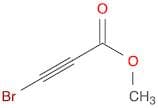
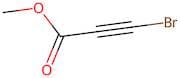
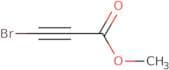
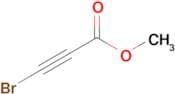
:Methyl-3-bromprop-2-ynoat
Beschreibung:
Methyl-3-bromprop-2-ynoat ist eine organische Verbindung, die durch ihre Alkin-Funktionalgruppe und ein an eine Propynoat-Struktur gebundenes Bromatom gekennzeichnet ist. Sie weist eine Methylestergruppe auf, die zu ihrer Reaktivität und Löslichkeit in organischen Lösungsmitteln beiträgt. Die Anwesenheit der Dreifachbindung im Prop-2-ynoat-Teil des Moleküls verleiht ihr einzigartige chemische Eigenschaften, wodurch sie ein nützliches Zwischenprodukt in der organischen Synthese ist, insbesondere bei der Bildung von Kohlenstoff-Kohlenstoff-Bindungen. Das Bromatom fungiert als gute Abgangsgruppe und erleichtert nucleophile Substitutionsreaktionen. Methyl-3-bromprop-2-ynoat ist typischerweise eine farblose bis blassgelbe Flüssigkeit mit einem ausgeprägten Geruch und ist empfindlich gegenüber Feuchtigkeit und Licht. Es ist wichtig, diese Verbindung mit Vorsicht zu behandeln, da sie potenziell reaktiv ist und das Vorhandensein von Brom gesundheitliche Risiken darstellen kann. In Laborumgebungen wird sie häufig in der Synthese komplexerer organischer Moleküle, einschließlich pharmazeutischer Produkte und Agrochemikalien, verwendet.
Formel:C4H3BrO2
InChl:InChI=1/C4H3BrO2/c1-7-4(6)2-3-5/h1H3
SMILES:COC(=O)C#CBr
Synonyme:- 2-Propynoic acid, 3-bromo-, methyl ester
- Methyl 3-bromo-2-propynoate
- Propiolic acid, bromo-, methyl ester
Sortieren nach
Reinheit (%)
0
100
|
0
|
50
|
90
|
95
|
100
4 Produkte.
2-Propynoic acid, 3-bromo-, methyl ester
CAS:Formel:C4H3BrO2Reinheit:95%Farbe und Form:SolidMolekulargewicht:162.9694Methyl 3-bromopropiolate
CAS:Methyl 3-bromopropiolate is an acetylcholine esterase inhibitor. It is a broad spectrum, reversible inhibitor of acetylcholine esterase and has been shown to have biological properties that are similar to those of curare. Methyl 3-bromopropiolate is used as a control agent in experiments on the effects of acetylcholine and other neurotransmitters. It also has antimicrobial activity against gram-positive bacteria such as Staphylococcus aureus and Enterococcus faecalis. In addition, methyl 3-bromopropiolate reacts with halides to form reactive intermediates that can cross-link DNA strands, which may be important for its efficient asymmetric synthesis. Methyl 3-bromopropiolate is synthesized by reacting an amide with methyl bromoacetate. This reaction generates an asymmetric product in high yield due to the use of a chiralFormel:C4H3BrO2Reinheit:Min. 95%Farbe und Form:Colourless To Pale Yellow LiquidMolekulargewicht:162.97 g/mol