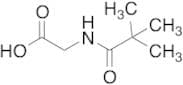
![[(2,2-dimethylpropanoyl)amino]acetate](/_next/image/?url=https%3A%2Fstatic.cymitquimica.com%2Fcas-image%2Fthumb-webp%2F155009-22-dimethylpropanoyl-amino-acetate.webp&w=3840&q=75)
CAS 23891-96-5
:[(2,2-dimethylpropanoyl)amino]acetat
Beschreibung:
Die chemische Substanz, die als [(2,2-dimethylpropanoyl)amino]acetat bekannt ist, mit der CAS-Nummer 23891-96-5, ist eine organische Verbindung, die sowohl Amin- als auch Carboxylat-Funktionalgruppen aufweist. Sie zeichnet sich durch ihre Struktur aus, die eine Dimethylpropanoyl-Gruppe enthält, die an eine Aminogruppe gebunden ist, die mit einer Acetatgruppe verbunden ist. Diese Verbindung wird wahrscheinlich Eigenschaften aufweisen, die typisch für Aminosäuren sind, wie z.B. die Löslichkeit in polaren Lösungsmitteln aufgrund der Anwesenheit der Carboxylatgruppe. Ihre molekulare Struktur deutet auf potenzielle Anwendungen in biochemischen Kontexten hin, möglicherweise als Baustein in der Peptidsynthese oder als Ligand in der Koordinationschemie. Die Anwesenheit der Dimethylgruppe kann ihre sterischen Eigenschaften und Reaktivität beeinflussen, was potenziell ihre Wechselwirkungen in biologischen Systemen beeinflussen kann. Darüber hinaus können die Stabilität und Reaktivität der Verbindung durch Umweltfaktoren wie pH und Temperatur beeinflusst werden. Insgesamt stellt [(2,2-dimethylpropanoyl)amino]acetat eine einzigartige Struktur im Bereich der organischen Chemie dar, mit Implikationen sowohl für synthetische als auch biologische Anwendungen.
Formel:C7H12NO3
InChl:InChI=1/C7H13NO3/c1-7(2,3)6(11)8-4-5(9)10/h4H2,1-3H3,(H,8,11)(H,9,10)/p-1
SMILES:CC(C)(C)C(=NCC(=O)[O-])O
Sortieren nach
Reinheit (%)
0
100
|
0
|
50
|
90
|
95
|
100
6 Produkte gefunden.
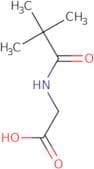
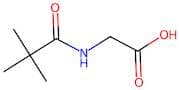
[(2,2-Dimethylpropanoyl)amino]acetic acid
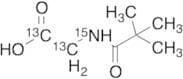
CAS:Formel:C7H13NO3Reinheit:95%Farbe und Form:SolidMolekulargewicht:159.1830Pivaloylglycine-13C2,15N
CAS:Kontrolliertes ProduktFormel:C513C2H1315NO3Farbe und Form:NeatMolekulargewicht:162.16N-Pivaloylglycine
CAS:Kontrolliertes ProduktApplications N-Pivaloylglycine is used in the biological study between dogs and rats. In a high dose toxicity study of pivalic acid (PA), PA caused skeletal muscle disorder in dog, and a significant increase of pivaloyl carnitine (PC) was observed in canine muscle, but not in rat muscle.
References Yamaguchi, T., et al.: Toxicol. Appl. Pharmacol., 214, 61-68 (2006)Formel:C7H13NO3Farbe und Form:NeatMolekulargewicht:159.182-Pivalamidoacetic acid
CAS:2-Pivalamidoacetic acid is an acylglycine. It is a competitive inhibitor of the enzyme carnitine acetyltransferase and lowers levels of carnitine in plasma and muscle tissue. This drug has been used to treat acidemia in humans caused by multiple-reaction monitoring deficiency, which can lead to lactic acidosis, muscle weakness, and severe neurologic problems. 2-Pivalamidoacetic acid has also been used as an oral treatment for long-term treatment of neonatal acylglycinemia type 1 (AG1) due to dehydrogenase deficiency, which can cause growth failure, hypotonia, and respiratory distress.Formel:C7H13NO3Reinheit:Min. 95%Farbe und Form:White PowderMolekulargewicht:159.18 g/mol

![[(2,2-Dimethylpropanoyl)amino]acetic acid](/_next/image/?url=https%3A%2Fstatic.cymitquimica.com%2Fproducts%2FIN%2Fthumb%2FDA006U4Q.jpg&w=3840&q=75)