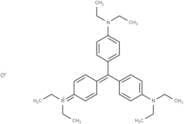
CAS 2390-59-2
:Basis Violett 4
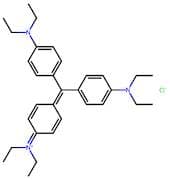
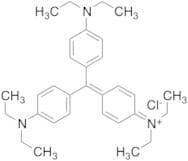
- Ethanaminium, N-[4-[bis[4-(diethylamino)phenyl]methylene]-2,5-cyclohexadien-1-ylidene]-N-ethyl-, chloride
- Ethanaminium, N-[4-[bis[4-(diethylamino)phenyl]methylene]-2,5-cyclohexadien-1-ylidene]-N-ethyl-, chloride (1:1)
- Ethyl Violet AX
- Ethyl Violet GGA
- Ethyl crystal violet
- Ethyl violet
- Lowacryl Violet 4
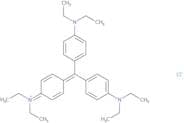
- N-(4-{bis[4-(diethylamino)phenyl]methylidene}cyclohexa-2,5-dien-1-ylidene)-N-ethylethanaminium chloride
- N-(4-{bis[4-(diethylamino)phenyl]methylidene}cyclohexa-2,5-dien-1-ylidene)-N-ethylethanaminium zinc chloride (2:1:4)
- Shikiso Acid Brilliant Blue 6B
- Tris(p-(diethylamino)phenyl)methylium chloride
- C.I. Basic Violet 4
- Weitere Synonyme anzeigen
Ethyl Violet
CAS:Ethyl violet has been used to stain pancreatic tissue and elastin in the detection of gram negative bacteria, and as a reagent for the extractive-spectrophotometric determination of anionic surfactants. It has been used in the extraction and spectrophotometric determination of copper. Along with theFormel:C31H42ClN3Farbe und Form:Dark brown to green, PowderMolekulargewicht:492.15Ethanaminium,N-[4-[bis[4-(diethylamino)phenyl]methylene]-2,5-cyclohexadien-1-ylidene]-N-ethyl-, chloride
CAS:Formel:C31H42ClN3Reinheit:97%Farbe und Form:SolidMolekulargewicht:492.1383Ethyl Violet (C.I. 42600)
CAS:Formel:C31H42ClN3Farbe und Form:Dark brown to olive green crystalline powderMolekulargewicht:492.15Ethyl Violet (Technical Grade)
CAS:Stability Light Sensitive
Applications Ethyl Violet (CAS# 2390-59-2) is a triphenylmethane dye, and has found analytical use with Alzheimer’s patients, of which ethyl violet is able to bind to the Alzheimer’s related β-amyloid peptides and change colour to a fluorescent blue. Dyes and metabolites.
References Salveson, P. J.; et al.: J. Am. Chem. Soc., 140, 11745 (2018).Formel:C31H42N3·ClFarbe und Form:Dark VioletMolekulargewicht:492.1383Ethyl Violet (C.I. No. 42600) for microscopy
CAS:Formel:C31H42N3ClFarbe und Form:Brown to green, Crystalline powderMolekulargewicht:492.20Ethyl violet
CAS:Ethyl violet is a cationic surfactant. It is used as a dye in analytical chemistry to measure the adsorption of glycol ethers on metal oxide surfaces, and it has also been used as a model system for studying the adsorption of detergents on metal oxide surfaces. The adsorption mechanism of ethyl violet on metal oxide surfaces involves an electrostatic attraction between the positively charged ethyl violet molecule and the negatively charged surface. Ethyl violet has been shown to be carcinogenic in mice, although its carcinogenic potential in humans remains unclear. Ethyl violet can be synthesized from glycol ethers and hydrochloric acid by titration calorimetry.
Formel:C31H42N3•ClReinheit:Min. 75 Area-%Farbe und Form:PowderMolekulargewicht:492.14 g/molN-(4-(Bis(4-(diethylamino)phenyl)methylene)cyclohexa-2,5-dien-1-ylidene)-N-ethylethanaminium chloride
CAS:N-(4-(Bis(4-(diethylamino)phenyl)methylene)cyclohexa-2,5-dien-1-ylidene)-N-ethylethanaminium chloride is a useful organic compound for research related to life sciences. The catalog number is T65162 and the CAS number is 2390-59-2.Formel:C31H42ClN3Farbe und Form:SolidMolekulargewicht:492.15
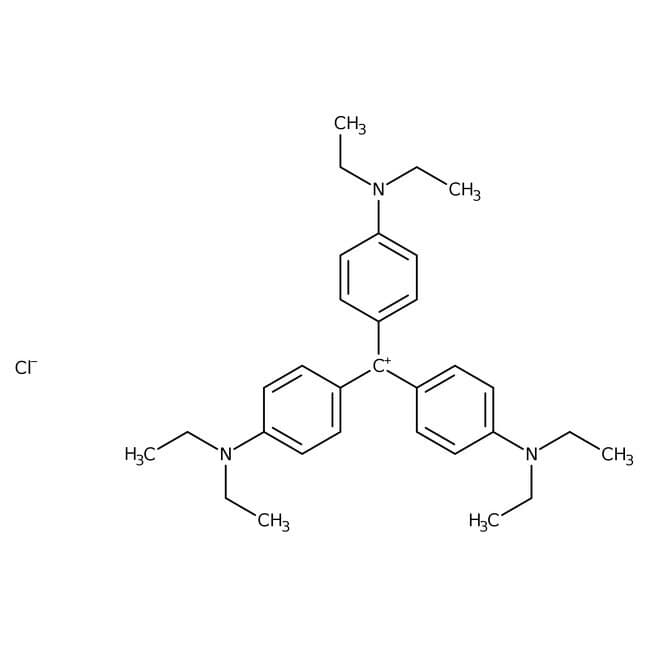

![Ethanaminium,N-[4-[bis[4-(diethylamino)phenyl]methylene]-2,5-cyclohexadien-1-ylidene]-N-ethyl-, ch…](/_next/image/?url=https%3A%2Fstatic.cymitquimica.com%2Fproducts%2FIN%2Fthumb%2FDA00I4M9.jpg&w=3840&q=75)