CAS 23945-44-0
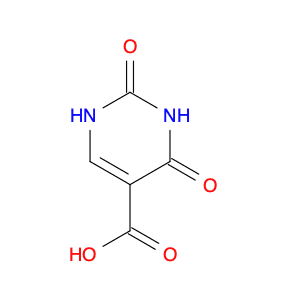
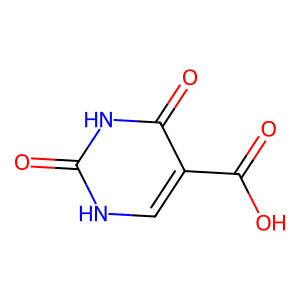
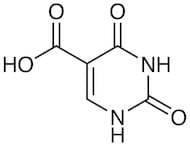
:1,2,3,4-Tetrahydro-2,4-dioxo-5-pyrimidincarbonsäure
Beschreibung:
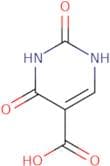
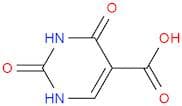
1,2,3,4-Tetrahydro-2,4-dioxo-5-pyrimidincarbonsäure, mit der CAS-Nummer 23945-44-0, ist eine heterocyclische organische Verbindung, die durch ihre Pyrimidinringstruktur gekennzeichnet ist, die einen sechsgliedrigen Ring mit zwei Stickstoffatomen enthält. Diese Verbindung weist eine Tetrahydro-Konfiguration auf, was darauf hinweist, dass sie vier Wasserstoffatome zum Ring hinzugefügt hat, was zu einer gesättigten Form führt. Das Vorhandensein von zwei Carbonylgruppen (Dioxo) trägt zu ihrer Reaktivität und ihrem Potenzial als Vorläufer in verschiedenen chemischen Synthesen bei. Darüber hinaus verbessert die carboxylische funktionelle Gruppe ihre Löslichkeit in polaren Lösungsmitteln und ermöglicht potenzielle Wechselwirkungen in biologischen Systemen. Die Verbindung kann verschiedene biologische Aktivitäten aufweisen, was sie in der medizinischen Chemie von Interesse macht. Ihre strukturellen Merkmale deuten auf potenzielle Anwendungen in der Pharmazie, Agrochemie oder als Baustein in der organischen Synthese hin. Bestimmte Eigenschaften wie Schmelzpunkt, Siedepunkt und Löslichkeit erfordern jedoch empirische Daten für eine präzise Charakterisierung.
Formel:C5H4N2O4
InChl:InChI=1S/C5H4N2O4/c8-3-2(4(9)10)1-6-5(11)7-3/h1H,(H,9,10)(H2,6,7,8,11)
InChI Key:InChIKey=ZXYAAVBXHKCJJB-UHFFFAOYSA-N
SMILES:C(O)(=O)C=1C(=O)NC(=O)NC1
Synonyme:- 1,2,3,4-Tetrahydro-2,4-dioxo-5-pyrimidinecarboxylic acid
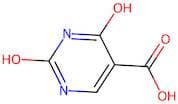
- 2,4-Dihydroxy-5-pyrimidinecarboxylic acid
- 2,4-Dihydroxypyrimidine-5-Carboxylic acid hydrate
- 2,4-Dioxo-1,2,3,4-tetrahydropyrimidine-5-carboxylic acid
- 2,4-Dioxo-1H-pyrimidine-5-carboxylic acid
- 5-Carboxy-2,4-dihydroxypyrimidine
- 5-Carboxyuracil
- 5-Pyrimidinecarboxylic acid, 1,2,3,4-tetrahydro-2,4-dioxo-
- 5-Pyrimidinecarboxylic acid, 2,4-dihydroxy-
- 5-Uracilcarboxylic acid
- Isoorotic acid
- NSC 1589
- Weitere Synonyme anzeigen
Sortieren nach
Reinheit (%)
0
100
|
0
|
50
|
90
|
95
|
100
9 Produkte.
2,4-Dioxo-1,2,3,4-tetrahydropyrimidine-5-carboxylic acid
CAS:Formel:C5H4N2O4Reinheit:97%Farbe und Form:SolidMolekulargewicht:156.09632,4-Dihydroxypyrimidine-5-carboxylic acid
CAS:2,4-Dihydroxypyrimidine-5-carboxylic acidReinheit:≥98%Molekulargewicht:156.1g/mol2,4-Dioxo-1,2,3,4-tetrahydropyrimidine-5-carboxylic Acid
CAS:Formel:C5H4N2O4Reinheit:>97.0%(T)(HPLC)Farbe und Form:White to Almost white powder to crystalMolekulargewicht:156.102,4-Dihydroxypyrimidine-5-carboxylic acid
CAS:2,4-Dihydroxypyrimidine-5-carboxylic acid (Isoorotic acid) has been obtained from 5-formyluracil by the action of enzyme, thymine 7-hydroxylase.Formel:C5H4N2O4Reinheit:99.09%Farbe und Form:Very Slightly Yellow PowderMolekulargewicht:156.12,4-Dihydroxypyrimidine-5-carboxylic acid
CAS:2,4-Dihydroxypyrimidine-5-carboxylic acidReinheit:≥95%Farbe und Form:PowderMolekulargewicht:156.10g/mol2,4-Dihydroxypyrimidine-5-carboxylic acid anhydrous
CAS:2,4-Dihydroxypyrimidine-5-carboxylic acid anhydrous (2,4DPA) is a metabolite of the drug 2,4-diaminopyrimidine. It inhibits protein synthesis in cells through hydrogen bonding interactions with dna duplexes and has been shown to be toxic to bacteria by inhibiting fatty acid biosynthesis. 2,4DPA is used as a standard in biological assays to measure uptake and light exposure. The analytical method for measuring 2,4DPA relies on hydrochloric acid (HCl) as a solvent that converts the material into its dimethyl ester derivative. This derivative can be quantified by gas chromatography/mass spectrometry (GCMS).Formel:C5H4N2O4Reinheit:Min. 94.0 Area-%Farbe und Form:White Off-White PowderMolekulargewicht:156.1 g/mol2,4-Dihydroxypyrimidine-5-carboxylic acid
CAS:Formel:C5H4N2O4Reinheit:97%Farbe und Form:SolidMolekulargewicht:156.0175-Carboxyuracil extrapure, 98%
CAS:Formel:C5H4N2O4Reinheit:min. 98%Farbe und Form:White, PowderMolekulargewicht:156.10