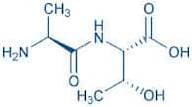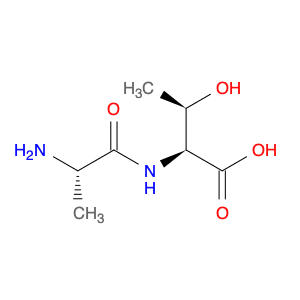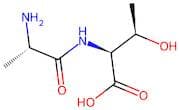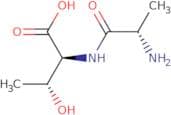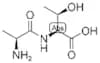
CAS 24032-50-6
:ala-thr
Beschreibung:
Die chemische Substanz, die als "ala-thr" bekannt ist, mit der CAS-Nummer 24032-50-6, bezieht sich auf ein Dipeptid, das aus den Aminosäuren Alanin (Ala) und Threonin (Thr) besteht. Dipeptide entstehen, wenn zwei Aminosäuren durch eine Peptidbindung verbunden sind, was zu einer Verbindung führt, die einige Eigenschaften beider Bestandteile beibehält. ala-thr ist durch seine spezifische Sequenz gekennzeichnet, die sein biochemisches Verhalten und seine Interaktionen beeinflusst. Es ist typischerweise in Wasser löslich aufgrund der polaren Natur der Threonin-Seitenkette, die eine Hydroxylgruppe enthält. Dieses Dipeptid kann eine Rolle in verschiedenen biologischen Prozessen spielen, einschließlich der Proteinsynthese und des Stoffwechsels. Darüber hinaus kann es an Signalwegen beteiligt sein und spezifische biologische Aktivitäten aufweisen, abhängig vom Kontext, in dem es verwendet wird. Wie viele Peptide kann seine Stabilität und Funktionalität durch Faktoren wie pH, Temperatur und das Vorhandensein anderer Ionen oder Moleküle beeinflusst werden.
Formel:C7H14N2O4
InChl:InChI=1/C7H14N2O4/c1-3(8)6(11)9-5(4(2)10)7(12)13/h3-5,10H,8H2,1-2H3,(H,9,11)(H,12,13)
SMILES:CC(C(=NC(C(C)O)C(=O)O)O)N
Synonyme:- H-Ala-Thr-OH
- Alanylthreonine
Sortieren nach
Reinheit (%)
0
100
|
0
|
50
|
90
|
95
|
100
5 Produkte.
H-Ala-Thr-OH
CAS:Bachem ID: 4001340.
Formel:C7H14N2O4Reinheit:> 99%Farbe und Form:White PowderMolekulargewicht:190.2(2S,3R)-2-((S)-2-Aminopropanamido)-3-hydroxybutanoic acid
CAS:(2S,3R)-2-((S)-2-Aminopropanamido)-3-hydroxybutanoic acidReinheit:95%Molekulargewicht:190.2g/molH-Ala-Thr-OH
CAS:H-Ala-Thr-OH is a dipeptide that is used as a stabilizer for the active form of methionine in some nutritional supplements. H-Ala-Thr-OH is synthesized by the hydroxylation of DL-methionine, which is then converted to H-Ala-Thr-OH by an aminopeptidase. The amino acid sequence of H-Ala-Thr-OH resembles that of l-threonine, but lacks an α carbon atom and an amino group on the carboxylic acid end. This dipeptide has been shown to be auxotrophic for both lysine and threonine when expressed in Escherichia coli.Formel:C7H14N2O4Reinheit:Min. 95%Molekulargewicht:190.2 g/mol