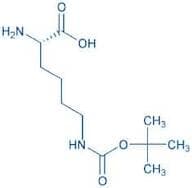
CAS 2418-95-3
:N-epsilon-(tert-Butoxycarbonyl)-L-Lysin
Beschreibung:
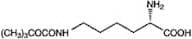
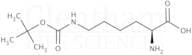
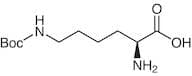
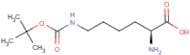
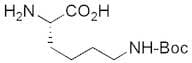
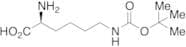
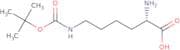
N-epsilon-(tert-Butoxycarbonyl)-L-Lysin, allgemein als Boc-Lysin bekannt, ist ein Derivat der Aminosäure Lysin, das durch das Vorhandensein einer tert-butyloxycarbonyl (Boc) Schutzgruppe an der epsilon-Aminogruppe der Lysin-Seitenkette gekennzeichnet ist. Diese Modifikation verbessert die Stabilität der Aminosäure während chemischer Reaktionen, insbesondere bei der Peptidsynthese, indem sie unerwünschte Reaktionen an der Aminogruppe verhindert. Boc-Lysin ist typischerweise ein weißes bis off-white kristallines Feststoff, löslich in organischen Lösungsmitteln wie Dichlormethan und Dimethylformamid, aber weniger löslich in Wasser. Die Verbindung wird in der organischen Synthese und Biochemie weit verbreitet verwendet, insbesondere bei der Herstellung von Peptiden und Proteinen, aufgrund ihrer Fähigkeit, die selektive Deprotection unter milden sauren Bedingungen zu erleichtern. Ihre molekulare Struktur umfasst eine primäre Amin, eine Carbonsäure und eine hydrophobe tert-Butylgruppe, die ihre Reaktivität und Löslichkeit beeinflusst. Wie bei vielen Aminosäurederivaten ist es wichtig, Boc-Lysin mit Vorsicht zu behandeln und die entsprechenden Sicherheitsprotokolle in einem Laborumfeld zu befolgen.
Formel:C11H22N2O4
InChl:InChI=1/C11H22N2O4/c1-11(2,3)17-10(16)8(13)6-4-5-7(12)9(14)15/h7-8H,4-6,12-13H2,1-3H3,(H,14,15)/t7-,8?/m0/s1
SMILES:CC(C)(C)OC(=O)C(CCC[C@@H](C(=O)O)N)N
Synonyme:- N6-Boc-L-lysine
- Ne-Boc-L-Lysine
- H-Lys(Boc)-OH
Sortieren nach
Reinheit (%)
0
100
|
0
|
50
|
90
|
95
|
100
12 Produkte.
N(ε)-Boc-L-lysine, 97%
CAS:It is used as therapy to treat recurrent herpes simplex infections. This Thermo Scientific Chemicals brand product was originally part of the Alfa Aesar product portfolio. Some documentation and label information may refer to the legacy brand. The original Alfa Aesar product / item code or SKU referFormel:C11H22N2O4Reinheit:97%Farbe und Form:Powder, WhiteMolekulargewicht:246.31N6-(tert-Butoxycarbonyl)-L-lysine
CAS:Formel:C11H22N2O4Reinheit:98%Farbe und Form:SolidMolekulargewicht:246.3034Nε-(tert-Butoxycarbonyl)-L-lysine
CAS:Formel:C11H22N2O4Reinheit:>97.0%(T)Farbe und Form:White to Almost white powder to crystalMolekulargewicht:246.31(2S)-2-Amino-6-(tert-butoxycarbonylamino)hexanoic acid
CAS:(2S)-2-Amino-6-(tert-butoxycarbonylamino)hexanoic acidFormel:C11H22N2O4Reinheit:98%Farbe und Form: white powderMolekulargewicht:246.30g/molLys(Boc)
CAS:Formel:C11H22N2O4Reinheit:97%Farbe und Form:Solid, Crystalline PowderMolekulargewicht:246.307BOC-L-Lysine extrapure, 98%
CAS:Formel:C11H22N2O4Reinheit:min. 98%Farbe und Form:White, Crystalline powderMolekulargewicht:246.30Nε-Boc-L-lysine
CAS:Kontrolliertes ProduktApplications Nε-Boc-D-lysine is an N-Boc-protected form of L-Lysine (L468895). L-Lysine is an essential amino acid for humans, with a suggested intake of 5-8 grams per day. L-Lysine can be found in a variety of food, such as eggs and quinoa, but is also mass produced by microbial fermentation. L-Lysine is also used as therapy to treat recurrent herpes simplex infections.
References Anastassiadis, S.: Biotechnology, 1, 11 (2007); Civitelli, R., et al.: Nutrition, 8, 400 (1991); Griffith, R., et al.: Dermatology, 175, 183 (1987)Formel:C11H22N2O4Farbe und Form:NeatMolekulargewicht:246.31H-Lys(Boc)-OH
CAS:H-Lys(Boc)-OH is an ε-amino-protected lysine that plays a pivotal role in solution phase peptide synthesis. Strategically protected at the ε-amino group, it allows controlled peptide assembly, and it serves as intermediate for synthesizing β-peptides. The bulky Boc (tert-butyloxycarbonyl) group shields its epsilon amine (NH2) group, acting as a protective measure to prevent unwanted side reactions.Formel:C11H22N2O4Farbe und Form:White PowderMolekulargewicht:246.3 g/molH-Lys(Boc)-OH
CAS:Bachem ID: 4000211.
Formel:C11H22N2O4Reinheit:> 99%Farbe und Form:WhiteMolekulargewicht:246.31