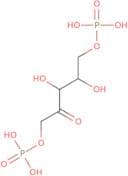
CAS 24218-00-6
:Ribulose-1,5-bisphosphat
Beschreibung:
Ribulose-1,5-bisphosphat (RuBP) ist eine entscheidende organische Verbindung im Prozess der Photosynthese, insbesondere im Calvin-Zyklus, wo sie als Substrat für das Enzym Ribulose-1,5-bisphosphat-Carboxylase/Oxygenase (RuBisCO) fungiert. Dieses fünf-Kohlenstoff-Zuckerphosphat ist durch seine zwei Phosphatgruppen gekennzeichnet, die an den ersten und fünften Kohlenstoffatomen angebracht sind. RuBP spielt eine wichtige Rolle bei der Kohlenstofffixierung, indem es die Umwandlung von atmosphärischem Kohlendioxid in organische Moleküle ermöglicht. Es ist eine farblose, wasserlösliche Verbindung, die typischerweise in den Chloroplasten von Pflanzenzellen vorkommt. Die Struktur von RuBP ermöglicht es ihm, an verschiedenen biochemischen Reaktionen teilzunehmen, was es für den Stoffwechsel und das Wachstum von Pflanzen unerlässlich macht. Darüber hinaus werden seine Stabilität und Reaktivität von Umweltfaktoren wie pH und Temperatur beeinflusst, die die Effizienz der Photosynthese beeinträchtigen können. Insgesamt ist Ribulose-1,5-bisphosphat integraler Bestandteil der Biosphäre und unterstützt das Leben, indem es die Umwandlung von anorganischem Kohlenstoff in organische Formen erleichtert.
Formel:C5H12O11P2
InChl:InChI=1S/C5H12O11P2/c6-3(1-15-17(9,10)11)5(8)4(7)2-16-18(12,13)14/h3,5-6,8H,1-2H2,(H2,9,10,11)(H2,12,13,14)/t3-,5-/m1/s1
InChI Key:InChIKey=YAHZABJORDUQGO-NQXXGFSBSA-N
SMILES:[C@@H]([C@@H](COP(=O)(O)O)O)(C(COP(=O)(O)O)=O)O
Synonyme:- D-Ribulose 1,5-bisphosphate
- D-erythro-Pentulose, 1,5-bis(dihydrogen phosphate)
- D-erythro-2-Pentulose, 1,5-bis(dihydrogen phosphate)
- Ribulose 1,5-bisphosphate
- D-Ribulose 1,5-diphosphate
Sortieren nach
Reinheit (%)
0
100
|
0
|
50
|
90
|
95
|
100
1 Produkte.
D-Ribulose 1,5-bisphosphate sodium hydrate
CAS:D-ribulose 1,5-bisphosphate sodium hydrate (DRBP) is a naturally occurring sugar that is found in plants. It is synthesized by the action of ribulose bisphosphate carboxylase on ribulose 1,5-bisphosphate, with ATP as a cofactor. DRBP has been shown to be an important intermediate in many biochemical pathways and enzymes. DRBP has been shown to inhibit HIV replication in vitro by binding to the enzyme reverse transcriptase and blocking its activity. As an inhibitor of HIV replication, DRBP is activated by a number of factors including p-nitrophenyl phosphate (pNPP), and the presence of hydrogen bond donors such as ATP or NADP+. This chemical also inhibits protease activity and increases the transport rate for D-ribulose 1,5-bisphosphate.Formel:C5H12O11P2•Nax•(H2O)yReinheit:Min. 95%Farbe und Form:PowderMolekulargewicht:310.09 g/mol