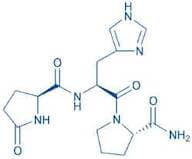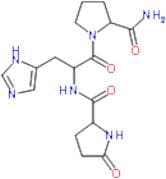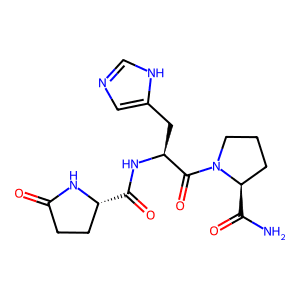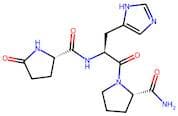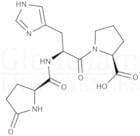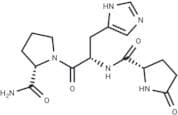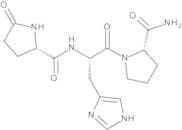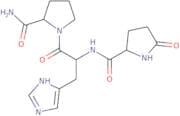
CAS 24305-27-9
:Thyreotropin-Releasing-Hormon
Beschreibung:
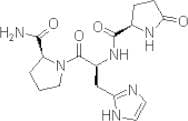
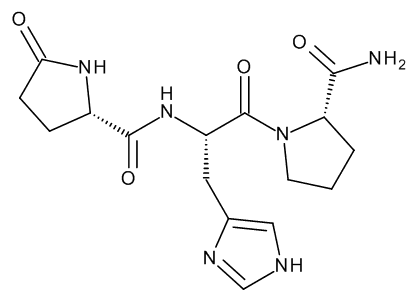
Das thyreotropinfreisetzende Hormon (TRH), auch bekannt als Thyreotropin-Releasing-Hormon, ist ein Tripeptidhormon, das aus drei Aminosäuren besteht: Pyroglutaminsäure, Histidin und Prolin. Es spielt eine entscheidende Rolle bei der Regulierung der Schilddrüsenfunktion, indem es die Freisetzung des schilddrüsenstimulierenden Hormons (TSH) aus der vorderen Hypophyse stimuliert. TRH wird im Hypothalamus synthetisiert und ist am hypothalamisch-hypophysär-schilddrüsen Achse beteiligt, die den Stoffwechsel und die Energiehomöostase beeinflusst. Die CAS-Nummer 24305-27-9 identifiziert dieses Peptid spezifisch, das typischerweise in fester oder lyophilisierter Form für Forschungs- und therapeutische Anwendungen vorliegt. TRH ist wasserlöslich und kann über verschiedene Wege verabreicht werden, einschließlich intravenöser oder subkutaner Injektion. Seine biologische Aktivität wird über spezifische Rezeptoren in der Hypophyse vermittelt, was zu nachgelagerten Effekten auf die Produktion von Schilddrüsenhormonen führt. Darüber hinaus wurde TRH auf seine potenziellen Rollen in verschiedenen physiologischen und pathologischen Zuständen untersucht, einschließlich seiner Auswirkungen auf die Stimmung und die Stressreaktionen.
Formel:C16H22N6O4
InChl:InChI=1S/C16H22N6O4/c17-14(24)12-2-1-5-22(12)16(26)11(6-9-7-18-8-19-9)21-15(25)10-3-4-13(23)20-10/h7-8,10-12H,1-6H2,(H2,17,24)(H,18,19)(H,20,23)(H,21,25)/t10-,11-,12-/m0/s1
InChI Key:InChIKey=XNSAINXGIQZQOO-SRVKXCTJSA-N
SMILES:C([C@H](CC1=CN=CN1)NC(=O)[C@@H]2CCC(=O)N2)(=O)N3[C@H](C(N)=O)CCC3
Synonyme:- (Pyro)-<span class="text-smallcaps">L</smallcap>-glutamic acid-<smallcap>L</smallcap>-histidine-<smallcap>L</span>-proline-NH<sub>2</sub>
- (Pyro)-L-glutamic acid-L-histidine-L-proline-NH2
- 252: PN: WO2010033207 SEQID: 378 claimed protein
- 5-Oxo-<span class="text-smallcaps">L</smallcap>-prolyl-<smallcap>L</smallcap>-histidyl-<smallcap>L</span>-prolinamide
- 83: PN: US20090175821 PAGE: 403 claimed protein
- <span class="text-smallcaps">L</smallcap>-Prolinamide, 5-oxo-<smallcap>L</smallcap>-prolyl-<smallcap>L</span>-histidyl-
- <span class="text-smallcaps">L</smallcap>-Pyroglutamyl-<smallcap>L</smallcap>-histidyl-<smallcap>L</span>-prolinamide
- <span class="text-smallcaps">L</smallcap>-Pyroglutamyl-<smallcap>L</smallcap>-histidyl-<smallcap>L</span>-proline amide
- Abbott 38579
- Antepan
- Fda 1725
- L-Pyroglutamyl-L-histidyl-L-prolinamide
- L-Pyroglutamyl-L-histidyl-L-proline amide
- Lopremone
- Prem
- Protirelin
- Protirelina
- Protireline
- Relefact TRH
- Rifathyroin
- Rifotironin
- Ro 8-6270/9
- Stimu TSH
- Synthetic TRF
- Synthetic TRH
- Synthetic TSH-releasing factor
- Synthetic TSH-releasing hormone
- Synthetic thyrotropin-releasing factor
- Synthetic thyrotropin-releasing hormone
- TRF
- TRH
- TSH-releasing factor
- TSH-releasing hormone
- Thypinone
- Thyrefact
- Thyroid releasing hormone
- Thyroid-stimulating hormone-releasing factor
- Thyroliberin
- Thyrotropic hormone-releasing factor
- Thyrotropic hormone-releasing hormone
- Thyrotropic releasing hormone
- Thyrotropic-releasing factor
- Thyrotropin-releasing factor
- Thyrotropin-releasing hormone
- Tsh-Rf
- L-Prolinamide, 5-oxo-L-prolyl-L-histidyl-
- Weitere Synonyme anzeigen
Sortieren nach
Reinheit (%)
0
100
|
0
|
50
|
90
|
95
|
100
14 Produkte.
Thyrotropin-Releasing Hormone
CAS:Thyrotropin-Releasing HormoneFormel:C16H22N6O4Farbe und Form:White, Lyophilized powderMolekulargewicht:362.38TRH
CAS:TRH exhibits a variety of biological effects, when injected into humans or animals. Its physiological role appears to be the stimulation of thyrotropin (TSH) and prolactin (PRL) release from the anterior pituitary. Though it was first identified in the hypothalamus as a regulator of the pituitary-thyroid axis, TRH was detected as well by Luo et al. in pancreatic β-cells co-localized with insulin. Application of the hormone reverted hyperglycemia in rats. Moreover, TRH plays an important role in the control of human hair-growth and hair follicle pigmentation.Formel:C16H22N6O4Reinheit:98.6%Farbe und Form:Whitish PowderMolekulargewicht:362.39L-Pyroglutamyl-L-Histidyl-L-Prolinamide
CAS:L-Pyroglutamyl-L-Histidyl-L-ProlinamideReinheit:98%Molekulargewicht:362.38g/molProtirelin
CAS:Protirelin (Thyroliberin) is a tripeptide that stimulates the release of thyrotropin and prolactin.Formel:C16H22N6O4Reinheit:99.76%Farbe und Form:White Or Almost White PowderMolekulargewicht:362.38Protirelin
CAS:Formel:C16H22N6O4Reinheit:95%~99%Farbe und Form:White to Off-white PowderMolekulargewicht:362.38Thyrotropin-Releasing Hormone
CAS:Kontrolliertes ProduktApplications Thyrotropin-Releasing Hormone is a hypothalamic hypophysiotropic neuropeptide, which has the ability to stimulate the release of thyroid-stimulating hormone in mammals. It is proven that Thyrotropin-Releasing Hormone can be used to accelerate wound healing.
References Kanasaki, H., et al.: Neuropeptides., 54, 73 (2015); Nie, C., et al.: J. Surg. Res., 189, 364 (2014);Formel:C16H22N6O4Farbe und Form:Off-WhiteMolekulargewicht:362.38L-Pyroglutamyl-L-histidyl-L-prolinamide
CAS:L-Pyroglutamyl-L-histidyl-L-prolinamide (PGC) is a pyrrolidine that is used for the treatment of neurologic disorders. It has been shown to be effective in treating depression and a number of other neurologic disorders, including Parkinson's disease, Alzheimer's disease, and epilepsy. PGC has also been shown to have an antidepressant effect in women with depression who are pregnant or have recently given birth. In addition, it has been found to be clinically effective in the treatment of symptoms associated with Parkinson’s Disease. PGC is not absorbed into the bloodstream and must be injected directly into muscle tissue or fat cells in order to produce its therapeutic effects.Formel:C16H22N6O4Reinheit:Min. 95%Farbe und Form:White PowderMolekulargewicht:362.38 g/molThyrotropin Releasing Hormone (TRH) (Human, Ovine, Porcine, Rat)
CAS:Thyrotropin releasing hormone (TRH) is a peptide that is produced in the hypothalamus. It has various functions, including being an activator of thyroid stimulating hormone (TSH) and releasing growth hormone from the anterior pituitary gland. TRH also has anti-inflammatory effects and is used as a research tool in cell biology. TRH binds to receptors on cells and can activate ion channels, which causes an influx of calcium ions into cells. This leads to the activation of protein kinases, which are important in cell signaling pathways. TRH also interacts with other proteins, such as receptor tyrosine kinases and G-protein coupled receptors.Formel:C16H22N6O4Reinheit:Min. 95%Molekulargewicht:362.38 g/molThyrotropin Releasing Hormone (TRH) (Human, Ovine, Porcine, Rat)
CAS:Thyrotropin Releasing Hormone (TRH) is a hormone that stimulates the release of thyroid hormones. TRH has been used to diagnose and treat conditions such as autoimmune diseases, infectious diseases, and thyroid disease. It is also used in the treatment of patients with hypothyroidism who are not responding to levothyroxine therapy. TRH is administered intravenously or intramuscularly. This drug is primarily used for diagnostic purposes in women who have symptoms of hyperthyroidism but normal serum levels of TSH and thyroxine levels. TRH administration can result in a rise in serum prolactin levels, which may be useful for diagnosis of the condition hyperprolactinemia.Formel:C16H22N6O4•H2OReinheit:Min. 95%Molekulargewicht:380.4 g/mol