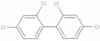
CAS 2437-79-8
:PCB 47
Beschreibung:
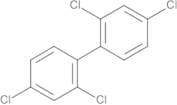
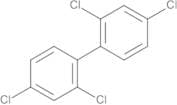
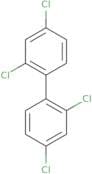
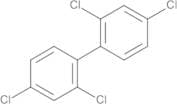
PCB 47, auch bekannt unter seiner Chemical Abstracts Service (CAS) Nummer 2437-79-8, ist eine Verbindung von polychlorierten Biphenylen (PCB). PCBs sind eine Gruppe von synthetischen organischen Chemikalien, die aus Kohlenstoff-, Wasserstoff- und Chloratomen bestehen. PCB 47 zeichnet sich durch seine Biphenylstruktur aus, bei der zwei Benzolringe durch eine Einfachbindung verbunden sind, wobei Chloratome an bestimmten Positionen auf den Ringen substituiert sind. Diese Verbindung ist typischerweise farblos bis hellgelb und bekannt für ihre hydrophobe Natur, was sie in Wasser unlöslich, aber in organischen Lösungsmitteln löslich macht. PCBs, einschließlich PCB 47, sind bekannt für ihre Stabilität und Widerstandsfähigkeit gegen Abbau, was zu ihrem weit verbreiteten historischen Einsatz in elektrischen Geräten, Wärmeübertragungsflüssigkeiten und anderen industriellen Anwendungen geführt hat. Aufgrund ihrer Umweltpersistenz und potenziellen Gesundheitsrisiken, einschließlich krebserzeugender Wirkungen und endokriner Störungen, wurden PCBs jedoch in vielen Ländern verboten oder stark reguliert. PCB 47, wie andere PCBs, stellt Herausforderungen für die Umweltremediation und die öffentliche Gesundheit dar.
Formel:C12H6Cl4
InChl:InChI=1S/C12H6Cl4/c13-7-1-3-9(11(15)5-7)10-4-2-8(14)6-12(10)16/h1-6H
InChI Key:InChIKey=QORAVNMWUNPXAO-UHFFFAOYSA-N
SMILES:ClC1=C(C=CC(Cl)=C1)C2=C(Cl)C=C(Cl)C=C2
Synonyme:- 1,1'-Biphenyl, 2,2',4,4'-tetrachloro-
- 1,1′-Biphenyl, 2,2′,4,4′-tetrachloro-
- 2,2',4,4'-Tetrachlorbiphenyl
- 2,2',4,4'-Tetrachlorobiphenyle
- 2,2',4,4'-Tetrachlorodiphenyl
- 2,2',4,4'-Tetraclorobifenilo
- 2,2′,4,4′-Tetrachloro-1,1′-biphenyl
- 2,2′,4,4′-Tetrachlorobiphenyl
- 2,2′,4,4′-Tetrachlorodiphenyl
- 2,4,2',4'-Tetrachlorobiphenyl
- Biphenyl, 2,2',4,4'-tetrachloro-
- Biphenyl, 2,2′,4,4′-tetrachloro-
- Cb 47
- Pcb 47
- Weitere Synonyme anzeigen
Sortieren nach
Reinheit (%)
0
100
|
0
|
50
|
90
|
95
|
100
9 Produkte.
EPA Method 525.2 PCB Congeners Mixture 500 µg/mL in Acetone
CAS:Kontrolliertes ProduktFarbe und Form:MixtureSVOC Mixture 1002 100-400 µg/mL in Acetone
CAS:Kontrolliertes Produkt- 103-23-1
- 117-81-7
- 118-74-1
- 120-12-7
- 121-14-2
- 129-00-0
- 131-11-3
- 15862-07-4
- 16605-91-7
- 191-24-2
- 193-39-5
- 205-99-2
- 2051-60-7
- 207-08-9
- 208-96-8
- 218-01-9
- 2437-79-8
- 40186-71-8
- 50-32-8
- 52663-71-5
- 53-70-3
- 56-55-3
- 60145-22-4
- 60233-25-2
- 606-20-2
- 77-47-4
- 78-59-1
- 84-66-2
- 84-74-2
- 85-01-8
- 85-68-7
- 86-73-7
- 87-86-5
Formel:C7H6N2O4Farbe und Form:MixtureMolekulargewicht:182.13PCB No. 47 10 µg/mL in Isooctane
CAS:Kontrolliertes ProduktFormel:C12H6Cl4Farbe und Form:Single SolutionMolekulargewicht:291.99Dry Color Manufacturer's Association (DCMA) Mixture 5-100 µg/mL in Hexane
CAS:Kontrolliertes ProduktFormel:C12H6Cl4Farbe und Form:MixtureMolekulargewicht:291.992,2',4,4'-Tetrachlorobiphenyl
CAS:Kontrolliertes Produkt2,2',4,4'-Tetrachlorobiphenyl is a congener of bisphenol A that has been shown to cause skin papillomas in rats. 2,2',4,4'-Tetrachlorobiphenyl has been found to enhance the effects of other substances such as phenyl groups in an interactive manner. This compound is metabolized by cytochrome P450 enzymes and interacts with the cox-2 gene to produce inflammatory mediators. 2,2',4,4'-Tetrachlorobiphenyl can be absorbed through the skin and can be detected in serum levels.br>br> The mechanisms of action for 2,2',4,4'-tetrachlorobiphenyl are not well understood. However it has been shown that this compound may interact with the cox-2 gene to produce inflammatory mediators. 2,2',4,4'-tetrachlorobFormel:C12H6Cl4Reinheit:Min. 95%Molekulargewicht:291.99 g/molPCB No. 47 100 µg/mL in Isooctane
CAS:Kontrolliertes ProduktFormel:C12H6Cl4Farbe und Form:Single SolutionMolekulargewicht:291.99