CAS 244205-40-1
:2-Bromphenylboronsäure
Beschreibung:
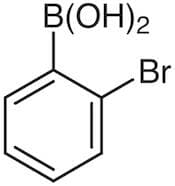
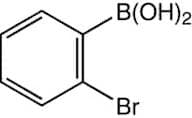
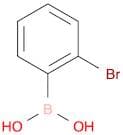
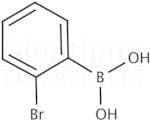
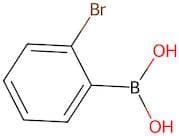
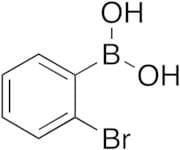
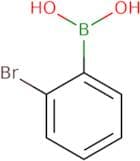
2-Bromphenylboronsäure ist eine Organoborverbindung, die durch das Vorhandensein eines Bromatoms und einer boronsäurehaltigen funktionellen Gruppe, die an einen Phenylring gebunden ist, gekennzeichnet ist. Ihre molekulare Struktur weist eine Phenylgruppe auf, die an der ortho-Position mit einem Bromatom und einer Boronsäuregruppe (-B(OH)2) substituiert ist, die bekannt ist für ihre Fähigkeit, reversible kovalente Bindungen mit Diolen zu bilden, was sie in verschiedenen Anwendungen, einschließlich organischer Synthese und medizinischer Chemie, nützlich macht. Diese Verbindung erscheint typischerweise als weißer bis off-white fester Stoff und ist in polaren Lösungsmitteln wie Wasser und Alkoholen löslich. Sie wird häufig in Suzuki-Miyaura-Kreuzkupplungsreaktionen verwendet, die entscheidend für die Bildung von Kohlenstoff-Kohlenstoff-Bindungen sind. Darüber hinaus kann 2-Bromphenylboronsäure als Baustein in der Synthese von Arzneimitteln und Agrochemikalien dienen. Sicherheitsüberlegungen umfassen den vorsichtigen Umgang, da Boronsäuren reizend sein können, und es sollten geeignete Laborprotokolle befolgt werden, um die Exposition zu minimieren.
Formel:C6H6BBrO2
InChl:InChI=1/C6H6BBrO2/c8-6-4-2-1-3-5(6)7(9)10/h1-4,9-10H
SMILES:c1ccc(c(c1)B(O)O)Br
Synonyme:- 2-Bromobenzeneboronic acid
- O-Bromophenylboronic Acid
- RARECHEM AH PB 0074
- 2-BROMOPHENYLBORONIC ACID
- AKOS BRN-0929
- 2-Bromophenylboronic
- 2-Bromophenylboronic Acid (contains varying amounts of Anhydride)
- 2-Bromobenzeneboronicacid,98%
Sortieren nach
Reinheit (%)
0
100
|
0
|
50
|
90
|
95
|
100
8 Produkte.
2-Bromophenylboronic Acid (contains varying amounts of Anhydride)
CAS:Formel:C6H6BBrO2Reinheit:97.0 to 110.0 %Farbe und Form:White to Almost white powder to crystalMolekulargewicht:200.832-Bromobenzeneboronic acid, 98%
CAS:2-Bromobenzeneboronic acid is used to promote greener amidations of carboxylic acids and amines in catalytic amounts. This technology avoids the requirement of preactivation of the carboxylic acid or use of coupling reagents. This Thermo Scientific Chemicals brand product was originally part of theFormel:C6H6BBrO2Reinheit:98%Farbe und Form:White to off-white, Powder or crystals or crystalline powderMolekulargewicht:200.83(2-Bromophenyl)boronic acid
CAS:Formel:C6H6BBrO2Reinheit:98%Farbe und Form:SolidMolekulargewicht:200.8256Ref: IN-DA003GSR
1kgNachfragen1g25,00€5g25,00€10g28,00€25g52,00€50g72,00€100g109,00€250g192,00€500g509,00€2-Bromobenzeneboronic acid
CAS:2-Bromobenzeneboronic acidFormel:C6H6BBrO2Reinheit:98%Farbe und Form: off-white to faint yellow powderMolekulargewicht:200.83g/mol2-Bromophenylboronic Acid
CAS:Kontrolliertes ProduktApplications 2-Bromophenylboronic Acid is used as an inhibitor of the hormone sensitive lipase.
References Ebdrup, S. et al.: Bioorg. Med. Chem. Lett., 13, 2305 (2005);Formel:C6H6BBrO2Farbe und Form:NeatMolekulargewicht:200.832-Bromobenzeneboronic acid (contains varying amounts of anhydride)
CAS:Formel:C6H6BBrO2Reinheit:95.0%Farbe und Form:Solid, White to very pale yellow crystal powderMolekulargewicht:200.832-Bromophenylboronic acid
CAS:2-Bromophenylboronic acid is a glucose monitoring agent that has a ruthenium complex with an acidic environment. The nitro group and the amines are in close proximity to the boron center, and this proximity leads to a high nucleophilic character of the molecule. This reactivity allows 2-bromophenylboronic acid to be used as a fluorescence probe for acidic environments. 2-Bromophenylboronic acid also inhibits secretase enzymes, which are involved in Alzheimer’s disease and other neurodegenerative disorders. It is an inhibitor of γ-secretase, which is responsible for cleaving the amyloid precursor protein (APP), and it has shown efficacy against biphenyl, an anticancer drug that binds to benzodiazepine receptors. 2-Bromophenylboronic acid is also an enantiopure compound because all four substituents are different from each other.Formel:C6H6BBrO2Reinheit:Min. 95%Farbe und Form:White PowderMolekulargewicht:200.83 g/mol