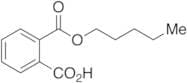
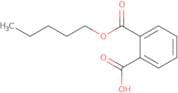
CAS 24539-56-8
:Mono-n-pentylphthalat
Beschreibung:
Mono-n-pentylphthalat (CAS 24539-56-8) ist ein Ester, der aus Phthalsäure und n-Pentanol abgeleitet ist. Er zeichnet sich durch seine Verwendung als Weichmacher aus, der die Flexibilität und Verarbeitbarkeit von Polymeren verbessert, insbesondere bei der Herstellung von flexiblem PVC. Diese Verbindung erscheint typischerweise als farblose bis blassgelbe Flüssigkeit mit geringer Volatilität und moderater Viskosität. Sie ist in organischen Lösungsmitteln löslich, hat jedoch eine begrenzte Löslichkeit in Wasser, was ein häufiges Merkmal von Phthalatestern ist. Mono-n-pentylphthalat ist bekannt für seine relativ geringe Toxizität im Vergleich zu anderen Phthalaten, obwohl es dennoch regulatorischer Prüfung unterliegt, aufgrund potenzieller Umwelt- und Gesundheitsbedenken im Zusammenhang mit der Exposition gegenüber Phthalaten. Seine Anwendungen gehen über Kunststoffe hinaus und umfassen die Verwendung in Beschichtungen, Klebstoffen und Dichtstoffen. Wie bei vielen Phthalaten konzentriert sich die laufende Forschung darauf, die Umweltauswirkungen und potenziellen Auswirkungen auf die menschliche Gesundheit zu verstehen, insbesondere in Bezug auf endokrine Störungen und reproduktive Toxizität.
Formel:C13H16O4
InChl:InChI=1S/C13H16O4/c1-2-3-6-9-17-13(16)11-8-5-4-7-10(11)12(14)15/h4-5,7-8H,2-3,6,9H2,1H3,(H,14,15)
InChI Key:InChIKey=FPGPRAKRYDSZAW-UHFFFAOYSA-N
SMILES:C(OCCCCC)(=O)C1=C(C(O)=O)C=CC=C1
Synonyme:- 1,2-Benzenedicarboxylic Acid, Monopentyl Ester
- 1,2-Benzenedicarboxylic acid, 1-pentyl ester
- Mono-n-pentyl phthalate
- Monoamyl phthalate
- Monopentyl phthalate
- Phthalic acid, monopentyl ester
- Phthalic acid, pentyl ester
- 2-[(Pentyloxy)carbonyl]benzoic acid
Sortieren nach
Reinheit (%)
0
100
|
0
|
50
|
90
|
95
|
100
3 Produkte.
2-Methyl-d3-propionitrile-3,3,3-d3 (isobutyronitrile)
CAS:Formel:CD3CH(CD3)CNReinheit:99 atom % DFarbe und Form:Colorless LiquidMolekulargewicht:75.09551Monopentyl Phthalate
CAS:Applications A metabolite of Di-n-pentyl phthalate (DPP), used mainly as a plasticizer in nitrocellulose.
References Schmid, P., et al.: Xenobiotica, 1985, 15, 251 (1985), Nativelle, C., et al.: Food Chem. Toxicol., 37, 905 (1999), Howdeshell, K., et al.: Toxicol. Sci., 105, 153 (2008),Formel:C13H16O4Farbe und Form:White To Off-WhiteMolekulargewicht:236.26Monopentyl phthalate
CAS:Monopentyl phthalate (MPP) is a plasticizer that is used in the production of polyvinyl chloride (PVC) plastics, such as vinyl flooring and furniture. MPP is also used in the manufacture of paints and adhesives. It is found in many consumer products, such as children's toys, shower curtains, and garden hoses. MPP has been shown to have endocrine disrupting effects on animals at high doses. Endometriosis has been linked to increased levels of MPP metabolites in urine samples from women. The toxicological studies on rats showed that chronic exposure to MPP causes testicular atrophy and decreases sperm production by inhibiting the activity of testosterone-synthesizing cells called Leydig cells. Rats exposed to high doses of MPP had decreased levels of ATP in their testes. The effect was observed even at low doses that were comparable with human exposures from environmental sources. Monopentyl phthalate can beFormel:C13H16O4Reinheit:Min. 95%Molekulargewicht:236.26 g/mol