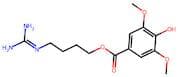
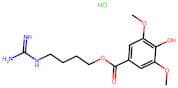
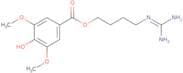
CAS 24697-74-3
:Leonurin
- 24697-74-3
- 4-Carbamimidamidobutyl 4-Hydroxy-3,5-Dimethoxybenzoate Hydrochloride Hydrate
- 4-Carbamimidamidobutyl-4-hydroxy-3,5-dimethoxybenzolcarboxylat
- 4-Guanidino-1-butanol Syringate
- 4-Hydroxy-3,5-dimethoxybenzoic Acid 4-[(Aminoiminomethyl)amino]butyl Ester
- 4-Hydroxy-3,5-dimethoxybenzoic Acid d-Guanidinobutyl Ester
- 4-[(Diaminomethylidene)Amino]Butyl 4-Hydroxy-3,5-Dimethoxybenzoate
- Benzoic Acid, 4-Hydroxy-3,5-Dimethoxy-, 4-[(Aminoiminomethyl)Amino]Butyl Ester
- Benzoic acid, 4-hydroxy-3,5-dimethoxy-, ester with (4-hydroxybutyl)guanidine
- Guanidine, (4-hydroxybutyl)-, 4-hydroxy-3,5-dimethoxybenzoate
- Guanidine, (4-hydroxybutyl)-, 4-hydroxy-3,5-dimethoxybenzoate (ester)
- Leonurin
- Leonurine
- Scm 198
- Syringic Acid d-Guanidinobutyl Ester
- Weitere Synonyme anzeigen
Benzoic acid, 4-hydroxy-3,5-dimethoxy-, 4-[(aminoiminomethyl)amino]butyl ester
CAS:Formel:C14H21N3O5Reinheit:%Farbe und Form:SolidMolekulargewicht:311.33364-Guanidinobutyl 4-Hydroxy-3,5-Dimethoxybenzoate
CAS:4-Guanidinobutyl 4-Hydroxy-3,5-DimethoxybenzoateReinheit:99+%Molekulargewicht:311.33g/molLeonurine
CAS:Leonurine hydrochloride has anti-oxidative, anti-inflammatory, and antitumor activities, it exerts antidiabetic, cardiovascular, and bovine mastitis protection, it has an inhibitory effect on bleeding caused by incomplete abortion. Leonurine hydrochloride increases the expression levels of caspase-3, caspase-9 and Bax/Bcl-2, and it inhibits osteoclastogenesis and prevent osteoporosis associated with estrogen deficiency by inhibiting the NF-κB and PI3K/Akt signaling pathways.Formel:C14H21N3O5Reinheit:95%~99%Molekulargewicht:311.338Leonurine
CAS:Leonurine (SCM-198) is an alkaloid that has been found in H. leonuri and with anti-oxidative and anti-inflammatory.Formel:C14H21N3O5Reinheit:98.55%Farbe und Form:White Crystalline PowderMolekulargewicht:311.33Leonurine
CAS:Kontrolliertes ProduktApplications Leonurine is a pseudoalkaloid that has been isolated from Leonotis leonurus. A natural product with antioxidant, anti-inflammatory and cardioprotective properties for the treatment of wild variety of conditions including stroke, cerebral thrombosis and cardiovascular diseases.
References He, C., et al.: Zhongguo Linchuang Yaolixue Yu Zhiliaoxue, 18, 1419 (2013); Nsuala, B. N., et al.: J. Ethnopharmacol., 174, 520 (2015); Sun, Y., et al.; Eur. J. Drug Metabo. Pharmacokinet., 41, 423 (2016)Formel:C14H21N3O5Farbe und Form:NeatMolekulargewicht:311.33Leonurine
CAS:Leonurine is a polyphenolic compound that belongs to the group of natural compounds. It has been shown to have neuroprotective effects in vitro by inhibiting neuronal death at low doses. Leonurine also blocks the oxidative injury pathway, which may be related to its ability to inhibit apoptosis and reduce atherosclerotic lesion size in mice. In addition, leonurine inhibits the p-hydroxybenzoic acid (PHBA) oxidation pathway, which may contribute to its anti-inflammatory activities. Leonurine binds with high affinity and specificity to toll-like receptor 4 (TLR4), which may be related to its immunosuppressive properties.
Reinheit:Min. 95%
![Benzoic acid, 4-hydroxy-3,5-dimethoxy-, 4-[(aminoiminomethyl)amino]butyl ester](/_next/image/?url=https%3A%2Fstatic.cymitquimica.com%2Fproducts%2FIN%2Fthumb%2FDA002P1O.jpg&w=3840&q=75)