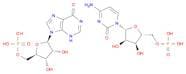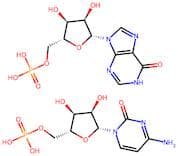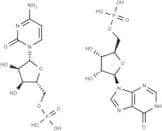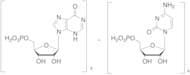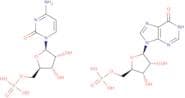
CAS 24939-03-5
:Poly(I:C)
Beschreibung:
Poly(I:C), oder Polyinosinsäure-Polycytidinsäure, ist ein synthetisches doppelsträngiges RNA-Molekül, das als potentes Immunstimulans dient. Es wird hauptsächlich für seine Rolle bei der Nachahmung von Virusinfektionen anerkannt, wodurch die Immunantwort aktiviert wird, insbesondere durch die Stimulation von Toll-like Rezeptoren (TLRs), insbesondere TLR3. Diese Aktivierung führt zur Produktion verschiedener Zytokine und Interferone, die die antiviralen Abwehrkräfte des Körpers stärken. Poly(I:C) wird häufig in der Forschung und in therapeutischen Anwendungen eingesetzt, einschließlich der Impfstoffentwicklung und der Krebsimmuntherapie, aufgrund seiner Fähigkeit, eine robuste Immunantwort zu induzieren. Die Substanz zeichnet sich typischerweise durch ihr hohes Molekulargewicht aus und ist in Wasser löslich, was sie für verschiedene biologische Tests geeignet macht. Darüber hinaus kann Poly(I:C) modifiziert werden, um seine Stabilität und Wirksamkeit zu verbessern, beispielsweise durch die Einbeziehung chemischer Modifikationen, die ihre Widerstandsfähigkeit gegen den Abbau durch Nukleasen erhöhen. Insgesamt ist Poly(I:C) ein wertvolles Werkzeug in der Immunologie und der therapeutischen Forschung, das zu unserem Verständnis der Immunmechanismen und potenzieller Behandlungsstrategien beiträgt.
Formel:(C10H13N4O8P)x·(C9H14N3O8P)x
InChl:InChI=1S/C10H13N4O8P.C9H14N3O8P/c15-6-4(1-21-23(18,19)20)22-10(7(6)16)14-3-13-5-8(14)11-2-12-9(5)17;10-5-1-2-12(9(15)11-5)8-7(14)6(13)4(20-8)3-19-21(16,17)18/h2-4,6-7,10,15-16H,1H2,(H,11,12,17)(H2,18,19,20);1-2,4,6-8,13-14H,3H2,(H2,10,11,15)(H2,16,17,18)/t4-,6-,7-,10-;4-,6-,7-,8-/m11/s1
InChI Key:InChIKey=ACEVNMQDUCOKHT-ZLOOHWKQSA-N
SMILES:O[C@H]1[C@H](N2C3=C(N=C2)C(=O)N=CN3)O[C@H](COP(=O)(O)O)[C@H]1O.O[C@H]1[C@@H](O[C@H](COP(=O)(O)O)[C@H]1O)N2C(=O)N=C(N)C=C2
Synonyme:- 4-amino-1-(5-O-phosphonopentofuranosyl)pyrimidin-2(1H)-one - 9-(5-O-phosphonopentofuranosyl)-3,9-dihydro-6H-purin-6-one (1:1)
- 5'-Cytidylic Acid - 5'-Inosinic Acid (1:1)
- 5′-Cytidylic acid, homopolymer, complex with 5′-inosinic acid homopolymer (1:1)
- 5′-Cytidylic acid, polymers, complex with 5′-inosinic acid polymers (1:1)
- 5′-Inosinic acid homopolymer-5′-cytidylic acid homopolymer complex (1:1)
- 5′-Inosinic acid, homopolymer, complex with 5′-cytidylic acid homopolymer (1:1)
- 5′-Inosinic acid, polymers, complex with 5′-cytidylic acid polymers (1:1)
- NSC 120949
- NSC 123233
- NSC 128576
- Poly I:C
- Poly I:C Polyinosinicacid-polycytidylic acid
- Poly(C).poly(I)
- Poly(C:I)
- Poly(I)-poly(C)
- Poly(I).poly(C) complex
- Poly(cytidylic acid)-poly(inosinic acid)
- Poly(rI)-poly(rC)
- Poly(rI:rC)
- Polycytidylic-polyinosinic acid
- Polycytidysic acid
- Polyinosinate-polycytidylate complex
- Polyinosinate:polycytidylate
- Polyinosine-polycytidylic acid
- Polyinosinic acid-polycytidylic acid
- Polyinosinic acid:polycytidylic acid complex
- Polyinosinic-polycytidylic acid complex
- Weitere Synonyme anzeigen
Sortieren nach
Reinheit (%)
0
100
|
0
|
50
|
90
|
95
|
100
8 Produkte.
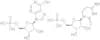
5'-Inosinic acid, homopolymer, complex with 5'-cytidylic acidhomopolymer (1:1)OTHER CA INDEX NAMES:5'-Cytidylic acid, homopolymer, complex with 5'-inosinic acidhomopolymer (1:1)
CAS:Formel:C21H35N7O16P2Reinheit:90%Farbe und Form:SolidMolekulargewicht:703.4874Polyinosinic-polycytidylic acid
CAS:Polyinosinic-polycytidylic acid (Poly(I:C)) is a synthetic double-stranded RNA (dsRNA) analog and an immunostimulant that acts as the most potent IFN inducer.Formel:(C10H13N4O8P)x·(C9H14N3O8P)xReinheit:90%Farbe und Form:SolidMolekulargewicht:671.406Poly(I:C) (~90%)
CAS:Kontrolliertes ProduktApplications Poly(I:C) is a toll-like receptor 3 dsRNA inflammatory stimulant.
References Smith, G.A., et al.: PLoS One, 10, e0121072 (2015); Dauletbaev, N., et al.: J. Immunol., 195, 2829 (2015); Broering, R., et al.: J. Viral Hepatitis, 21, 480 (2014); Colapicchioni, V., et al.: J. Mater. Chem. B: Mater. Biol. Med., 3, 7408 (2015)Formel:H2(C10H11N4O8P)n·H2(C9H12N3O8P)nReinheit:~90%Farbe und Form:NeatMolekulargewicht:671.4Polyinosinic acid-polycytidylic acid, homopolymer (1:1)
CAS:Polyinosinic acid-polycytidylic acid (Poly I:C), an agonist of TLR3 toll-like receptors, is a synthetic double-stranded RNA analog, consisting of polyinosinic acid (poly I) paired with polycytidylic acid (poly C), forming a stable duplex structure.PolyI:C stimulates the secretion of pro-inflammatory cytokines and type I interferon through its interaction with endosomal Toll-like receptor 3 (TLR-3) and the cytoplasmic receptors melanoma differentiation-associated gene 5 (MDA-5) and retinoic acid-inducible gene I (RIG-I). This immunostimulant activity makes Poly I:C a useful vaccine adjuvant and is used in vaccine formulations. Poly I:C and its stabilized analogs (e.g., poly-ICLC) are also being actively researched for their dual role in oncology: directly targeting tumors and acting as immune potentiators. For example Poly I:C can induce apoptosis in tumor cells and stimulate immunogenic cell death and is therefore being explored alongside chemotherapy, radiotherapy, and checkpoint inhibitors, helping to overcome resistance mechanisms and strengthen treatment outcomes.We can supply PolyI:C to all stages of your project - from R&D and preclinical phases right up to GMP commercial manufacture. Contact our team for custom Poly I:C products. For more on poly I:C read out blog 'Poly I:C: A Vaccine Adjuvant With Oncological Potential.'Formel:(C10H13N4O8P)x•(C9H14N3O8P)xFarbe und Form:PowderPolyinosinic acid-polycytidylic acid, homopolymer (1:1)
CAS:Polyinosinic acid-polycytidylic acid (Poly I:C), an agonist of TLR3 toll-like receptors, is a synthetic double-stranded RNA analog, consisting of polyinosinic acid (poly I) paired with polycytidylic acid (poly C), forming a stable duplex structure.PolyI:C stimulates the secretion of pro-inflammatory cytokines and type I interferon through its interaction with endosomal Toll-like receptor 3 (TLR-3) and the cytoplasmic receptors melanoma differentiation-associated gene 5 (MDA-5) and retinoic acid-inducible gene I (RIG-I). This immunostimulant activity makes Poly I:C a useful vaccine adjuvant and is used in vaccine formulations. Poly I:C and its stabilized analogs (e.g., poly-ICLC) are also being actively researched for their dual role in oncology: directly targeting tumors and acting as immune potentiators. For example Poly I:C can induce apoptosis in tumor cells and stimulate immunogenic cell death and is therefore being explored alongside chemotherapy, radiotherapy, and checkpoint inhibitors, helping to overcome resistance mechanisms and strengthen treatment outcomes.We can supply PolyI:C to all stages of your project - from R&D and preclinical phases right up to GMP commercial manufacture. Contact our team for custom Poly I:C products. For more on poly I:C read out blog 'Poly I:C: A Vaccine Adjuvant With Oncological Potential.'Formel:(C10H13N4O8P)x•(C9H14N3O8P)xReinheit:(Hplc-Ms) Min. 95.0 Area-%