CAS 25015-92-3
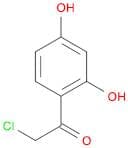
:2-chlor-1-(2,4-dihydroxyphenyl)ethanon
Beschreibung:
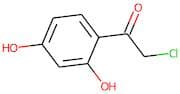
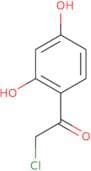
2-chlor-1-(2,4-dihydroxyphenyl)ethanon, mit der CAS-Nummer 25015-92-3, ist eine organische Verbindung, die durch ihre funktionellen Gruppen und strukturellen Merkmale gekennzeichnet ist. Sie enthält ein Chlorsubstituent und eine Ketogruppe, die zu ihrer Reaktivität und potenziellen Anwendungen in der organischen Synthese beitragen. Die Anwesenheit von zwei Hydroxylgruppen im phenolischen Ring erhöht ihre Polarität und Löslichkeit in polaren Lösungsmitteln und bietet gleichzeitig Stellen für potenzielle Wasserstoffbrückenbindungen. Diese Verbindung kann biologische Aktivität zeigen, da sie strukturelle Ähnlichkeiten mit verschiedenen phenolischen Verbindungen aufweist, die für ihre antioxidativen Eigenschaften bekannt sind. Darüber hinaus kann die chlorierte Struktur ihre Stabilität und Reaktivität beeinflussen, was sie zu einem Kandidaten für weitere chemische Modifikationen macht. In Bezug auf die Sicherheit kann sie, wie viele chlorierte Verbindungen, Umwelt- und Gesundheitsrisiken darstellen, was eine sorgfältige Handhabung und Entsorgung erforderlich macht. Insgesamt ist 2-chlor-1-(2,4-dihydroxyphenyl)ethanon sowohl für die synthetische Chemie als auch für potenzielle pharmakologische Anwendungen von Interesse.
Formel:C8H7ClO3
InChl:InChI=1/C8H7ClO3/c9-4-8(12)6-2-1-5(10)3-7(6)11/h1-3,10-11H,4H2
SMILES:c1cc(c(cc1O)O)C(=O)CCl
Synonyme:- 2-Chloro-2',4'-Dihydroxyacetophenone
Sortieren nach
Reinheit (%)
0
100
|
0
|
50
|
90
|
95
|
100
6 Produkte.
Ethanone, 2-chloro-1-(2,4-dihydroxyphenyl)-
CAS:Formel:C8H7ClO3Reinheit:97%Farbe und Form:SolidMolekulargewicht:186.59242-Chloro-1-(2,4-dihydroxy-phenyl)-ethanone
CAS:Formel:C8H7ClO3Reinheit:97%Farbe und Form:SolidMolekulargewicht:186.592-Chloro-1-(2,4-dihydroxy-phenyl)-ethanone
CAS:2-Chloro-1-(2,4-dihydroxy-phenyl)-ethanone (CDPE) is a neutralizing chemical that can be used for the detection of various organic solvents. It reacts with the solvent to form a fluorescent compound. CDPE has high specificity and can detect a wide range of solvents, including chlorinated hydrocarbons, alcohols, ketones, and esters. The reaction between CDPE and the solvent generates a fluorescence signal that can be detected by UV light at 365 nm or 366 nm. This probe is sensitive enough to detect as little as 0.02 mg/L of chloroform in water. CDPE is soluble in alkaline solutions but not in acidic solutions and therefore will only react with an alkaline solution when it is mixed with an organic solvent. The reaction between CDPE and the solvent generates a fluorescence signal that can be detected by UV light at 365 nmFormel:C8H7ClO3Reinheit:Min. 95%Molekulargewicht:186.59 g/mol