CAS 25126-32-3
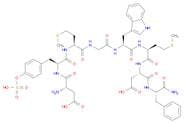
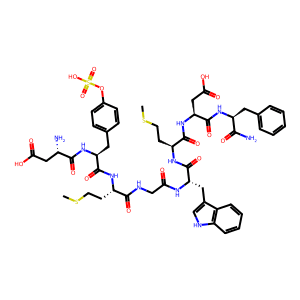
:(27-tyr(so(3)H))cholecystokinin-Fragment (26-33)-amid
Beschreibung:
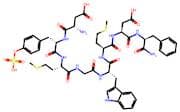
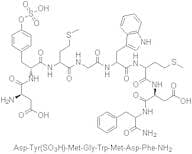
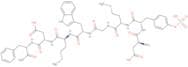
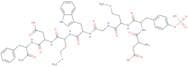
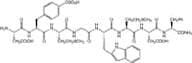
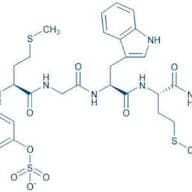
Die chemische Substanz, die als "(27-tyr(so(3)H))cholecystokinin-Fragment (26-33)-amid" bekannt ist, mit der CAS-Nummer 25126-32-3, ist ein Peptidfragment, das von Cholezystokinin (CCK) abgeleitet ist, einem Hormon, das an der Verdauung und Sättigung beteiligt ist. Dieses spezifische Fragment besteht aus den Aminosäuren 26 bis 33 des CCK-Moleküls, mit einer sulfatierte Tyrosin an Position 27, die entscheidend für seine biologische Aktivität ist. Die Anwesenheit der Sulfatgruppe verbessert die Wechselwirkung des Peptids mit seinen Rezeptoren und beeinflusst verschiedene physiologische Prozesse wie die Kontraktion der Gallenblase und die Sekretion von Enzymen aus der Bauchspeicheldrüse. Die Struktur dieses Peptids umfasst eine Sequenz von Aminosäuren, die durch Peptidbindungen verbunden sind, und es zeigt typische Eigenschaften von Peptiden, wie Löslichkeit in Wasser und Stabilität unter physiologischen Bedingungen. Seine biologische Bedeutung wird durch seine Rolle im gastrointestinalen System unterstrichen, was es zu einem interessanten Thema in Studien über Verdauung, Appetitregulation und potenzielle therapeutische Anwendungen bei gastrointestinalen Störungen macht.
Formel:C49H62N10O16S3
InChl:InChI=1/C49H62N10O16S3/c1-76-18-16-34(55-47(69)37(58-44(66)32(50)23-41(61)62)21-28-12-14-30(15-13-28)75-78(72,73)74)45(67)53-26-40(60)54-38(22-29-25-52-33-11-7-6-10-31(29)33)48(70)56-35(17-19-77-2)46(68)59-39(24-42(63)64)49(71)57-36(43(51)65)20-27-8-4-3-5-9-27/h3-15,25,32,34-39,52H,16-24,26,50H2,1-2H3,(H2,51,65)(H,53,67)(H,54,60)(H,55,69)(H,56,70)(H,57,71)(H,58,66)(H,59,68)(H,61,62)(H,63,64)(H,72,73,74)/t32-,34-,35-,36-,37-,38-,39-/m0/s1
SMILES:CSCC[C@@H](C(=NCC(=N[C@@H](Cc1c[nH]c2ccccc12)C(=N[C@@H](CCSC)C(=N[C@@H](CC(=O)O)C(=N[C@@H](Cc1ccccc1)C(=N)O)O)O)O)O)O)N=C([C@H](Cc1ccc(cc1)OS(=O)(=O)O)N=C([C@H](CC(=O)O)N)O)O
Synonyme:- (tyr(so3H)27)-cholecystokinin fragment*26-33 amid
- Sincalide
- Cholecystokinin Octapeptide
- Tyr(SO3H]27)Cholecystokinin fragment 26-33 Amide
- alpha-aspartyl-O-sulfotyrosylmethionylglycyltryptophylmethionyl-alpha-aspartylphenylalaninamide
- L-alpha-aspartyl-O-sulfo-L-tyrosyl-L-methionylglycyl-L-tryptophyl-L-methionyl-L-alpha-aspartyl-L-phenylalaninamide
- Sincalide(CCK-8)
- Asp-Tyr(SO3H)-Met-Gly-Trp-Met-Asp-Phe-NH2
- Caerulein, 1-de(5-oxo-L-proline)-2-de-L-glutamine-5-L-methionine-
- Cholecystokinin C-terminal octapeptide
- Cholecystokinin octapeptide (26-33 sulfated)
- Cholecystokinin-(26-33)-amide
- Cholecystokinin-8 (chicken)
- Cholecystokinin-8 (pig)
- Cholecystokinin-8 (Squalus acanthias)
- Cholecystokinin-8 (swine)
- Cholecystokinin-pancreozymin (swine intestine C-terminal octapeptide)
- Cholecystokinin-pancreozymin C-terminal octapeptide
- Human CCK-8
- L-Phenylalaninamide, L-α-aspartyl-O-sulfo-L-tyrosyl-L-methionylglycyl-L-tryptophyl-L-methionyl-L-α-aspartyl-
- Sincalid
- Sincalida
- Weitere Synonyme anzeigen
Sortieren nach
Reinheit (%)
0
100
|
0
|
50
|
90
|
95
|
100
11 Produkte.
Cholecystokinin, CCK Octapeptide (26-33)
CAS:For cellular and molecular biology applicationsFarbe und Form:White, Lyophilized PowderCholecystokinin Octapeptide (sulfated)
CAS:CCK-8 exhibits various gastrointestinal effects as contraction of the gallbladder and stimulation of pancreatic secretion and gastrointestinal transit. In rats, CCK-8 facilitated the uptake of leptin from peripheral circulation to cerebrospinal fluid and its access to the hypothalamus.Formel:C49H62N10O16S3Reinheit:98.42%Farbe und Form:White PowderMolekulargewicht:1143.293-10-Caerulein, 5-L-methionine-
CAS:Formel:C49H62N10O16S3Reinheit:97%Farbe und Form:SolidMolekulargewicht:1143.2690Sincalide(CCK-8)
CAS:Formel:C49H62N10O16S3Reinheit:95%~99%Farbe und Form:White to Off-white PowderMolekulargewicht:1143.27Sincalide
CAS:Sincalide (CCK-8) is an injectable drug used to diagnose gallbladder and pancreas disorders; it's a cholecystokinin fragment.Formel:C49H62N10O16S3Reinheit:98.32%Farbe und Form:SolidMolekulargewicht:1143.27Asp-Tyr(SO3H)-Met-Gly-Trp-Met-Asp-Phe-NH2
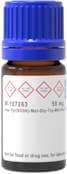
CAS:Asp-Tyr(SO3H)-Met-Gly-Trp-Met-Asp-Phe-NH2 is a versatile building block that can be used in research on complex compounds, fine chemicals, speciality chemicals and reagents. It is a high quality chemical that can be used as an intermediate or a scaffold. Asp-Tyr(SO3H)-Met-Gly-Trp-Met-Asp-Phe NH2 is soluble in water and has a high degree of solubility in organic solvents. The compound is also stable under acidic conditions.Formel:C49H62N10O16S3Reinheit:Min. 98.0 Area-%Molekulargewicht:1,143.27 g/molRef: 3D-W-107263
-Unit-mgmgNachfragen1gNachfragen50mgNachfragen100mgNachfragen250mgNachfragen500mgNachfragenSincalide
CAS:Sincalide is a cholecystokinin (CCK) analog that has been used as a pharmacological agent. It is an agonist for CCK-A receptors and inhibits the activity of protein kinase C. Sincalide also has been shown to suppress tumor growth in experimental models. A polymerase chain reaction analysis of cck-8, a rat CCK receptor gene, showed a high degree of homology with human CCK-A receptor genes. The physiological effects of sincalide are complex and depend on the presence or absence of other hormones such as insulin, glucagon, somatostatin, and leptin.
Formel:C49H62N10O16S3Reinheit:Min. 95%Farbe und Form:PowderMolekulargewicht:1,143.27 g/molCCK-Octapeptide (26-33) (Sulfated Form)
CAS:CCK-Octapeptide (26-33) (Sulfated Form) is a peptide that has been shown to have a variety of biological effects. It has been found to enhance the activity of rifampicin against tuberculosis by increasing the activity of the kinase protein. CCK-Octapeptide (26-33) (Sulfated Form) also has natriuretic peptide-like activity, which means it can regulate blood pressure and fluid balance in the body. In addition, it has been shown to inhibit tumor growth and metastasis in animal models, possibly through its ability to modulate guanosine triphosphate-binding proteins. CCK-Octapeptide (26-33) (Sulfated Form) also exhibits trypsin inhibitory activity and thymidine uptake inhibition. Furthermore, it has been studied as a potential treatment for cancer and as an alternative to vasopressin or nesiritide in certain medical conditions where natriuretic peptides are used therFormel:C49H62N10O16S3Reinheit:Min. 95%Molekulargewicht:1,143.3 g/mol




![(Tyr[SO3H]27)Cholecystokinin fragment 26-33 Amide](/_next/image/?url=https%3A%2Fstatic.cymitquimica.com%2Fproducts%2F7W%2Fthumb%2FGL1683.jpg&w=3840&q=75)