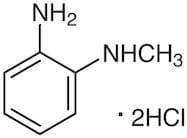
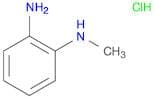
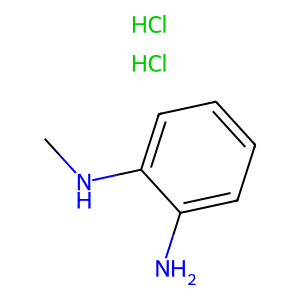
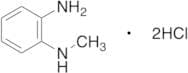
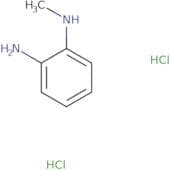
CAS 25148-68-9
:1,2-Benzoldiamin, N1-methyl-, Hydrochlorid (1:2)
Beschreibung:
1,2-Benzoldiamin, N1-methyl-, Hydrochlorid (1:2), auch bekannt als N-Methyl-1,2-Phenylendiamin-Hydrochlorid, ist eine organische Verbindung, die durch ihre aromatische Aminstruktur gekennzeichnet ist. Sie weist einen Benzolring mit zwei Aminogruppen (–NH2) auf, die an den Kohlenstoffatomen 1 und 2 positioniert sind, sowie eine Methylgruppe, die an einem der Aminstickstoffe gebunden ist. Diese Verbindung erscheint typischerweise als weißes bis off-white kristallines Feststoff und ist aufgrund der Anwesenheit der Hydrochlorid-Salzform in Wasser löslich, was ihre Löslichkeit erhöht. Sie wird hauptsächlich in verschiedenen chemischen Synthesen verwendet, einschließlich der Herstellung von Farbstoffen und Pigmenten, und kann auch als Zwischenprodukt in der Herstellung von Arzneimitteln dienen. Wie bei vielen aromatischen Aminen ist es wichtig, diese Verbindung mit Vorsicht zu behandeln, da potenzielle Gesundheitsrisiken bestehen, einschließlich Haut- und Atemwegsreizungen sowie möglicher krebserzeugender Wirkungen. Angemessene Sicherheitsmaßnahmen sollten beim Arbeiten mit dieser Substanz in Labor- oder Industrieumgebungen beachtet werden.
Formel:C7H10N2·2ClH
InChl:InChI=1S/C7H10N2.2ClH/c1-9-7-5-3-2-4-6(7)8;;/h2-5,9H,8H2,1H3;2*1H
InChI Key:InChIKey=DKEONVNYXODZRQ-UHFFFAOYSA-N
SMILES:N(C)C1=C(N)C=CC=C1.Cl
Synonyme:- 1,2-Benzenediamine, N-methyl-, dihydrochloride
- 1,2-Benzenediamine, N<sup>1</sup>-methyl-, hydrochloride (1:2)
- 1-Amino-2-methylaminobenzene dihydrochloride
- 2-(Methylamino)aniline Dihydrochloride
- N-Methyl-1,2-benzenediamine dihydrochloride
- N-Methyl-1,2-diaminobenzene dihydrochloride
- N-Methyl-1,2-phenylenediamine dihydrochloride
- N-methylbenzene-1,2-diamine 2hcl
- N-methylbenzene-1,2-diamine dihydrochloride
- o-Phenylenediamine, N-methyl-, dihydrochloride
- 1,2-Benzenediamine, N1-methyl-, hydrochloride (1:2)
- Weitere Synonyme anzeigen
Sortieren nach
Reinheit (%)
0
100
|
0
|
50
|
90
|
95
|
100
8 Produkte.
N-Methyl-1,2-phenylenediamine Dihydrochloride
CAS:Formel:C7H10N2·2HClReinheit:>98.0%(T)(HPLC)Farbe und Form:White to Light yellow to Light red powder to crystalMolekulargewicht:195.091,2-Benzenediamine, N1-methyl-, hydrochloride (1:2)
CAS:Formel:C7H12Cl2N2Reinheit:99%Farbe und Form:SolidMolekulargewicht:195.08962-(Methylamino)aniline dihydrochloride
CAS:2-(Methylamino)aniline dihydrochlorideFormel:C7H10N2·2ClHReinheit:99%Farbe und Form: light purple solidMolekulargewicht:195.08958g/molN-Methyl-1,2-benzenediamine dihydrochloride
CAS:Formel:C7H12Cl2N2Reinheit:95%Farbe und Form:Solid, Purple powderMolekulargewicht:195.09N-Methyl-o-phenylenediamine, Dihydrochloride
CAS:Kontrolliertes ProduktFormel:C7H10N2·2ClHFarbe und Form:NeatMolekulargewicht:195.09N-Methyl-1,2-phenylenediamine dihydrochloride
CAS:N-Methyl-1,2-phenylenediamine dihydrochloride (NMP) is a synthetic compound that is used as the precursor to various pharmaceuticals, such as the antihypertensive drug clonidine. NMP can be synthesized from benzene and ammonia or phenylmagnesium bromide. It is carcinogenic in animals and humans, and has been shown to cause DNA damage and cell apoptosis. The chemical has a high potential for nitrosation reactions when exposed to nitrites. This reaction produces nitric oxide, which is cytotoxic and can lead to liver cancer in rats. The synthesis of NMP generates impurities such as methanol solvent, sodium sulfide, and hydrogen chloride gas. These impurities are often found in recycled NMP due to incomplete removal during processing.Formel:C7H12Cl2N2Reinheit:Min. 95%Farbe und Form:PowderMolekulargewicht:195.09 g/mol